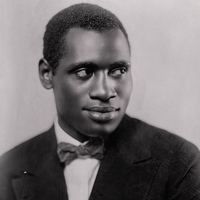
Paul Robeson
Paul Robeson (April 9, 1898 – January 23, 1976) was a multi-lingual American actor, athlete, bass-baritone concert singer, writer, civil rights activist, Spingarn Medal winner, and Lenin Peace Prize laureate. Robeson found fame as an actor and singer with his fine bass-baritone voice. He is one of the few true basses in American music, his beautiful and powerful voice descending as low as a C below the bass clef. In addition to his stage performances, his renditions of old Negro spirituals were acclaimed; Robeson was the first to bring them to the concert stage. Robeson's repertoire of African-American folk songs helped bring these to much wider attention both inside the US and abroad. Robeson also became interested in the folk music of the world; he came to be conversant with 20 languages, fluent or near fluent in 12. His standard repertoire after the 1920's included songs in many languages (e.g., Chinese, Russian, Yiddish, German, etc.). Robeson was among the first performers to sing in concert on behalf of the U.S. World War II war effort. He sang and spoke out against racist conditions experienced by Asian and Black Americans; he condemned segregation in both the North and the South. Like many intellectuals and artists of the time, Robeson supported the Soviet Union. After living as a second-class citizen under Jim Crow laws in the United States, what Robeson saw in the Soviet Union led him to believe that it was free of racial prejudice. In June 1949, Robeson visited the Soviet Union to sing in concert and was given a warm public welcome. In 1950, after he refused to sign an affidavit that he was not a Communist, the U.S. government took away Robeson's passport and, with it, his freedom to travel outside the United States. The travel ban ended in 1958 when Robeson’s passport was returned to him after the U.S. Supreme Court ruled, in Kent vs. Dulles, that the Secretary of State had no right to deny a passport or require any citizen to sign an affidavit because of his political beliefs. However, because of the controversy surrounding him, all of Paul Robeson's recordings and films were withdrawn from circulation. From then until the late 1970s, it became increasingly difficult in the United States to hear Robeson sing on records or on the radio, or to see any of his films, including the highly acclaimed and successful 1936 film version of Show Boat. Welsh miners' organisations were among the most prominent international supporters of the campaign calling for the restoration of his passport and to Let Paul Robeson Sing!. When his passport was returned, Robeson traveled to Wales to appear at the National Eisteddfod in Ebbw Vale. He then performed at the Miners' Eisteddfod, fulfilling a promise he had made while prevented from traveling. In 1960, Robeson's final performance at the Royal Festival Hall in London included choral accompaniment from the Cwmbach Welsh male voice choir. Robeson's association with Wales began in 1928 while he was performing in London in the musical Show Boat. There, he met a group of unemployed miners who had taken part in a "hunger march" from South Wales to protest their situation. During the 1930s, Robeson made several visits to Welsh mining areas, including performances in Cardiff, Neath and Aberdare. A number of Welsh artists have celebrated Robeson's life: The Manic Street Preachers' song "Let Robeson Sing" appears on the album Know Your Enemy.
Biography from Last.fm, available under CC BY-SA.
Country: US
Deathdate: 1976-01-23
Disambiguation: American bass baritone
Gender: Male
Is Living: No
Albums
 Paul Robeson: Songs of Struggle and Love2021Paul Robeson2018Freedom Train and the Welsh Transatlantic Concert2018Every Time I Feel the Spirit2018My Journey: Paul Robeson Live at Carnegie Hall2012The Very Best of Paul Robeson2008The Complete EMI Sessions, 1928-19392008The Best of Paul Robeson2008On My Journey: Paul Roberson's Independent Recordings2007Ol' Man River2006Porgy and Bess (Selections): Original Cast and Other Early Recordings (Recorded 1935–1942)2003The Essential Paul Robeson2000The Legendary Paul Robeson: Ol’ Man River2000Legends of the 20th Century: Paul Robeson1999Ol' Man River1999The Peace Arch Concerts1998Songs of Free Men1997The Legendary Moscow Concert1997Songs for Free Men1997The Voice of the Mississippi1996Spirituals, Folksongs, and Hymns1993The Odyssey of Paul Robeson1992The Power and the Glory1991Paul Robeson Sings "Ol' Man River" & Other Favorites1990A Man and His Beliefs1990The Glorious Voice of Paul Robeson1990Ballad for Americans1989Green Pastures1987'Ol' Man River1987The Golden Voice of Paul Robeson1983Negro Spirituals1982American Baladeer1977Songs Of My People1972The Best of Paul Robeson1970In Live Performance1970Das andere Amerika1966Paul Robeson singt1964Live at Carnegie Hall1960"Encore, Robeson!" Vol. 21960Songs of Free Men * Spirituals1958Robeson1958The Incomparable Voice Of Paul Robeson1957Spirituals1946Songs of Free Men1943Voice of the PeopleThe Collector's Paul RobesonSongs of Struggle (& more)Paul RobesonOl' Man RiverПоль Робсон в Москве (1958 г.)RecitalPaul RobesonSingt Lieder aus aller Welt