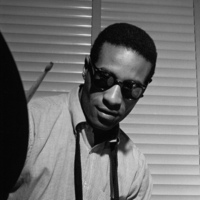
Max Roach
Maxwell Lemuel Roach (January 10, 1924 – August 16, 2007) was an American jazz drummer and composer. A pioneer of bebop, Roach went on to work in many other styles of music, and is generally considered alongside the most important drummers in history. He worked with many famous jazz musicians, including Coleman Hawkins, Dizzy Gillespie, Charlie Parker, Miles Davis, Duke Ellington, Thelonious Monk, Charles Mingus, Billy Eckstine, Stan Getz, Sonny Rollins, Eric Dolphy and Booker Little. He was inducted into the Down Beat Hall of Fame in 1980 and the Modern Drummer Hall of Fame in 1992. Roach also led his own groups, notably a pioneering quintet co-led with trumpeter Clifford Brown and the percussion ensemble M'Boom, and made numerous musical statements relating to the Civil Rights Movement. Roach was born in the Township of Newland, Pasquotank County, North Carolina, which borders the southern edge of the Great Dismal Swamp, to Alphonse and Cressie Roach. Many confuse this with Newland Town in Avery County. Although Roach's birth certificate lists his date of birth as January 10, 1924, Roach has been quoted by Phil Schaap as having stated that his family believed he was born on January 8, 1925. Roach's family moved to the Bedford-Stuyvesant neighborhood of Brooklyn, New York when he was 4 years old. He grew up in a musical home, his mother being a gospel singer. He started to play bugle in parade orchestras at a young age. At the age of 10, he was already playing drums in some gospel bands. In 1942, as an eighteen-year-old fresh out of Boys High School, he was called to fill in for Sonny Greer with the Duke Ellington Orchestra when they were performing at the Paramount Theater. In 1942, Roach started to go out in the jazz clubs of the 52nd Street and at 78th Street & Broadway for Georgie Jay's Taproom (playing with schoolmate Cecil Payne). His first professional recording took place in December 1943, supporting Coleman Hawkins. Roach's most significant innovations came in the 1940s, when he and jazz drummer Kenny Clarke devised a new concept of musical time. By playing the beat-by-beat pulse of standard 4/4 time on the "ride" cymbal instead of on the thudding bass drum, Roach and Clarke developed a flexible, flowing rhythmic pattern that allowed soloists to play freely. The new approach also left space for the drummer to insert dramatic accents on the snare drum, "crash" cymbal and other components of the trap set. By matching his rhythmic attack with a tune's melody, Roach brought a newfound subtlety of expression to his instrument. He often shifted the dynamic emphasis from one part of his drum kit to another within a single phrase, creating a sense of tonal color and rhythmic surprise. The idea was to shatter musical conventions and take full advantage of the drummer's unique position. "In no other society", Roach once observed, "do they have one person play with all four limbs." While that approach is common today, when Clarke and Roach introduced the new style in the 1940s it was a revolutionary musical advance. "When Max Roach's first records with Charlie Parker were released by Savoy in 1945," jazz historian Burt Korall wrote in the Oxford Companion to Jazz, "drummers experienced awe and puzzlement and even fear." One of those awed drummers, Stan Levey, summed up Roach's importance: "I came to realize that, because of him, drumming no longer was just time, it was music." He was one of the first drummers (along with Kenny Clarke) to play in the bebop style, and performed in bands led by Dizzy Gillespie, Charlie Parker, Thelonious Monk, Coleman Hawkins, Bud Powell, and Miles Davis. Roach played on many of Parker's most important records, including the Savoy November 1945 session, a turning point in recorded jazz. In 1952 Roach co-founded Debut Records with bassist Charles Mingus. This label released a record of a concert, billed and widely considered as "the greatest concert ever," called "Jazz at Massey Hall," featuring Charlie Parker, Dizzy Gillespie, Bud Powell, Mingus and Roach. Also released on this label was the groundbreaking bass-and-drum free improvisation, "Percussion Discussion." In 1954, he formed a quintet featuring trumpeter Clifford Brown, tenor saxophonist Harold Land, pianist Richie Powell (brother of Bud Powell), and bassist George Morrow, though Land left the following year and Sonny Rollins replaced him. The group was a prime example of the hard bop style also played by Art Blakey and Horace Silver. Tragically, this group was to be short-lived; Brown and Powell were killed in a car accident on the Pennsylvania Turnpike in June 1956. After Brown and Powell's deaths, Roach continued leading a similarly configured group, with Kenny Dorham (and later the short-lived Booker Little) on trumpet, George Coleman on tenor and pianist Ray Bryant. Roach expanded the standard form of hard-bop using 3/4 waltz rhythms and modality in 1957 with his album Jazz in 3/4 time. During this period, Roach recorded a series of other albums for the EmArcy label featuring the brothers Stanley and Tommy Turrentine. In 1960 he composed the We Insist! - Freedom Now suite with lyrics by Oscar Brown Jr., after being invited to contribute to commemorations of the hundredth anniversary of Abraham Lincoln's Emancipation Proclamation. Using his musical abilities to comment on the African-American experience would be a significant part of his career. Unfortunately, Roach suffered from being blacklisted by the American recording industry for a period in the 1960s. In 1966 with his album Drums Unlimited (which includes several tracks that are entirely drums solos) he proved that drums can be a solo instrument able to play theme, variations, rhythmically cohesive phrases. He described his approach to music as "the creation of organized sound." Among the many important records Roach has made is the classic Money Jungle 1962, with Mingus and Duke Ellington. This is generally regarded as one of the very finest trio albums ever made. During the 70s, Roach formed a unique musical organization -- M'Boom -- a percussion orchestra. Each member of this unit composed for it and performed on many percussion instruments. Personnel included Fred King, Joe Chambers, Warren Smith, Freddie Waits, Roy Brooks, Omar Clay, Ray Mantilla, Francisco Mora, and Eli Fountain. Not content to expand on the musical territory he had already become known for, Roach spent the decades of the 80s and 90s continually finding new ways to express his musical expression and presentation. In the early 80s, he began presenting entire concerts solo, proving that this multi-percussion instrument, in the hands of such a great master, could fulfill the demands of solo performance and be entirely satisfying to an audience. He created memorable compositions in these solo concerts; a solo record was released by Bay State, a Japanese label, just about impossible to obtain. One of these solo concerts is available on video, which also includes a filming of a recording date for "Chattahoochee Red," featuring his working quartet, Odean Pope, Cecil Bridgewater and Calvin Hill. He embarked on a series of duet recordings. Departing from the style of presentation he was best known for, most of the music on these recordings is free improvisation, created with the avant-garde musicians Cecil Taylor, Anthony Braxton, Archie Shepp, Abdullah Ibrahim and Connie Crothers. He created duets with other performers: a recorded duet with the oration by Martin Luther King, "I Have a Dream"; a duet with video artist Kit Fitzgerald, who improvised video imagery while Roach spontaneously created the music; a classic duet with his life-long friend and associate Dizzy Gillespie; a duet concert recording with Mal Waldron. He wrote music for theater, such as plays written by Sam Shephard, presented at La Mama E.T.C. in New York City. He found new contexts for presentation, creating unique musical ensembles. One of these groups was "The Double Quartet." It featured his regular performing quartet, with personnel as above, except Tyrone Brown replacing Hill; this quartet joined with "The Uptown String Quartet," led by his daughter Maxine Roach, featuring Diane Monroe, Lesa Terry and Eileen Folson. Another ensemble was the "So What Brass Quintet," a group comprised of five brass instrumentalists and Roach, no chordal instrumnent, no bass player. Much of the performance consisted of drums and horn duets. The ensemble consisted of two trumpets, trombone, French horn and tuba. Musicians included Cecil Bridgewater, Frank Gordon, Eddie Henderson, Steve Turre, Delfeayo Marsalis, Robert Stewart, Tony Underwood, Marshall Sealy, and Mark Taylor. Roach presented his music with orchestras and gospel choruses. He performed a concerto with the Boston Symphony Orchestra. He wrote for and performed with the Walter White gospel choir and the John Motley Singers. Roach performed with dancers: the Alvin Aily Dance Company, the Dianne McIntyre Dance Company, the Bill T. Jones/Arnie Zane Dance Company. In the early 80s, Roach surprised his fans by performing in a hip hop concert, featuring the artist-rapper Fab Five Freddy and the New York Break Dancers. He expressed the insight that there was a strong kinship between the outpouring of expression of these young black artists and the art he had pursued all his life. During all these years, while he ventured into new territory during a lifetime of innovation, he kept his contact with his musical point of origin. His last recording, "Friendship", was with trumpet master Clark Terry, the two long-standing friends in duet and quartet. Max Roach died in the early morning of August 16, 2007, in Manhattan. Roach started as a traditional grip player but switched exclusively to matched grip as his career progressed. Roach's most significant innovations came in the 1940s, when he and jazz drummer Kenny Clarke devised a new concept of musical time. By playing the beat-by-beat pulse of standard 4/4 time on the "ride" cymbal instead of on the thudding bass drum, Roach and Clarke developed a flexible, flowing rhythmic pattern that allowed soloists to play freely. The new approach also left space for the drummer to insert dramatic accents on the snare drum, "crash" cymbal and other components of the trap set. By matching his rhythmic attack with a tune's melody, Roach brought a newfound subtlety of expression to his instrument. He often shifted the dynamic emphasis from one part of his drum kit to another within a single phrase, creating a sense of tonal color and rhythmic surprise. The idea was to shatter musical conventions and take full advantage of the drummer's unique position. "In no other society", Roach once observed, "do they have one person play with all four limbs." While that approach is common today, when Clarke and Roach introduced the new style in the 1940s it was a revolutionary musical advance. "When Max Roach's first records with Charlie Parker were released by Savoy in 1945", jazz historian Burt Korall wrote in the Oxford Companion to Jazz, "drummers experienced awe and puzzlement and even fear." One of those awed drummers, Stan Levey, summed up Roach's importance: "I came to realize that, because of him, drumming no longer was just time, it was music." In 1966, with his album Drums Unlimited (which includes several tracks that are entirely drum solos) he demonstrated that drums can be a solo instrument able to play theme, variations, rhythmically cohesive phrases. He described his approach to music as "the creation of organized sound." The track "The drum also waltzes" was often quoted by John Bonham in his Moby Dick drum solo and revisited by other drummers like Neil Peart and Steve Smith. Bill Bruford performed a cover on the album Flags (1985). Roach was given a MacArthur Foundation "genius" grant in 1988, cited as a Commander of the Order of Arts and Letters in France (1989), twice awarded the French Grand Prix du Disque, elected to the International Percussive Art Society's Hall of Fame and the Downbeat Magazine Hall of Fame, awarded Harvard Jazz Master, celebrated by Aaron Davis Hall, given eight honorary doctorate degrees, including degrees awarded by Medgar Evers College, CUNY, the University of Bologna, Italy and Columbia University. While spending the later years of his life at the Mill Basin Sunrise assisted living home, in Brooklyn, Max was honored with a proclamation honoring his musical achievements by Brooklyn borough president Marty Markowitz. In 1986 the London borough of Lambeth named a park in Brixton after him. Roach was able to officially open it when he visited the UK that year invited by the Greater London Council, when he performed at a concert in March at the Royal Albert Hall together with Ghanaian master drummer Ghanaba and others. Roach was inducted into the North Carolina Music Hall of Fame in 2009.
Biography from Last.fm, available under CC BY-SA.
Country: US
Deathdate: 2007-08-15
Disambiguation: 20th century US jazz drummer & composer
Gender: Male
Is Living: No
Groups
 Max Roach Plus FourClifford Brown All StarsFormer (1954-08-11–1954-08-11)The Clifford Brown–Max Roach QuintetFormerKenny Dorham QuintetFormerMax Roach QuintetFormerMiles Davis All StarsMiles Davis QuartetJazz Artists GuildFormerMetronome All StarsFormerThe Miles Davis NonetFormerFats Navarro QuintetM'BoomMax Roach SextetCharlie Parker QuartetDon Lanphere QuintetMax Roach TrioFormerMax Roach QuartetFormerBud Powell TrioFormerCharlie Parker’s Ree BoppersFormerCharlie Parker QuintetFormerCharlie Parker SextetFormerMax Roach, His Chorus and OrchestraFormerMax Roach Double QuartetFormer
Albums
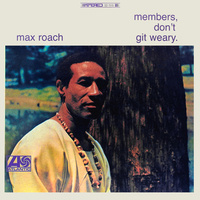 Members, Don’t Git Weary1968
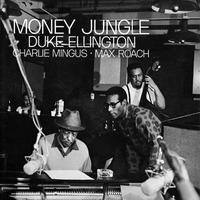 Money Jungle1962
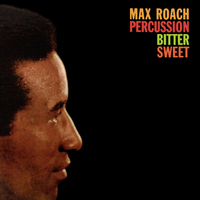 Percussion Bitter Sweet1961
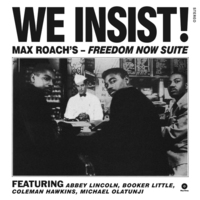 We Insist! Max Roach’s Freedom Now Suite1961
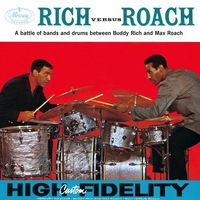 Rich Versus Roach1959
 Hot House: The Complete Jazz at Massey Hall Recordings2023Now’s The Time2022The 1960 Time Sessions2018The Complete Study in Brown2016The Complete Max Roach 1953 - 19582013The Complete Max Roach 1958 - 19622013Eight Classic Albums2012Duo (Verona) 19892011Candid Roach2009Jazz Structures2005Jazz in Paris: Parisian Sketches2002Friendship2002The Complete Mercury Max Roach Plus Four Sessions2000Explorations… to the Mth Degree1999Love for Sale1999Max1997Jazz At The Philarmonic-Frankfurt 19521997Max Roach With the New Orchestra of Boston and the So What Brass Quintet1996The Max Roach 4 Plays Charlie Parker1995Pleyel 48 + Max Roach Quintet 491993Daahoud1992To the Max!1991The Big Beat1991Max Roach and Friends - Volume 11991Max Roach and Friends - Volume 21991The Long March Part 11990Max + Dizzy - Paris 19891990Bright Moments1987Rich versus Roach1986Easy Winners1985Daahoud1985Survivors1984Historic Concerts: McMillin Theatre, Columbia U., New York, December 15, 19791984Swish1982I giganti del jazz, vol. 351981I Giganti Del Jazz Vol. 251981Chattahoochee Red1981M’Boom1980The Long March1980One in Two - Two in One1980Again1979Confirmation1978Birth and Rebirth1978Solos1978Streams of Consciousness1978Sounds As A Roach1977Live in Tokyo, Volume 21977Live in Tokyo, Volume 11977Percussion Discussion1976Force - Sweet Mao - Suid Afrika 761976Newport in New York '72 - The Jam Sessions, Volume 21972Drums Unlimited1966Sonny Clark Trio1960Award Winning Drummer1960Booker Little 4 & Max Roach1959Quiet as It's Kept1959Newport ’581959Max Roach + 4 on the Chicago Scene1958Max Roach + 4 at Newport1958Deeds, Not Words1958Jazz in ¾ Time1957Drummin’ the Blues1957Max Roach + 41956Rollins Plays for Bird1956In Concert1955Jam Session1954Bird - Diz - Bud - Max1953New Sounds1952And the Angels Swing / Symphony Sid's Idea1947I Giganti Del Jazz Vol. 44Max RoachWith the Boston Percussion EnsembleThe LoadstarDrums, Vol. 5Lift Every Voice and SingMilestones Of A Jazz Legend