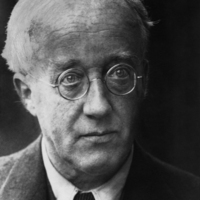
Gustav Holst
Gustav Holst (born September 21, 1874 Cheltenham, Gloucestershire, UK - died May 25, 1934) was an English composer and a music teacher for over 20 years. Holst is most famous for his orchestral suite The Planets. Having studied at the Royal College of Music in London, his early work was influenced by Ravel, Grieg, Richard Strauss, and Ralph Vaughan Williams, but most of his music is highly original, with influences from Hindu spiritualism and English folk tunes. Holst's music is well known for unconventional use of metre and haunting melodies. Gustav Holst wrote almost 200 catalogued compositions, including orchestral suites, operas, ballets, concertos, choral hymns, and songs. (See: selected works, below). Holst became music master at St Paul's Girls' School in 1905 and also director of music at Morley College in 1907, continuing in both posts until retirement (as detailed below). Holst died on May 25, 1934, after stomach surgery, at age 59. He was the brother of Hollywood actor Ernest Cossart, and father of the composer and conductor Imogen Holst, who wrote a biography of her father in 1938. Name He was originally named Gustavus Theodor von Holst but he dropped the von from his name in response to anti-German sentiment in Britain during World War I, making it official by deed poll in 1918. Early life He was born in 1874 in Cheltenham, Gloucestershire, England to a family of Swedish extraction (by way of Latvia and Russia), and was educated at Cheltenham Grammar School for Boys. Holst's grandfather, Gustavus von Holst of Riga, Latvia, a composer of elegant harp music, moved to England, becoming a notable harp teacher. Holst's father Adolph Holst, an organist, pianist, and choirmaster, taught piano lessons and gave recitals; and his mother, Clara von Holst, who died when Gustav was eight, was a singer. As a frail child whose early recollections were musical, Holst had been taught to play piano and violin, and began composing when he was about twelve. Holst's father was the organist at All Saints' Church in Pittville, and his childhood home is now a small museum, devoted partly to Holst, and partly to illustrating local domestic life of the mid-19th century. Holst grew up in the world of Oscar Wilde, H. G. Wells, George Bernard Shaw, Doyle, Gauguin, Monet, Wagner, Tchaikovsky, and Puccini. Both he and his sister learned piano from an early age, but Holst, stricken with a nerve condition that affected the movement of his right hand in adolescence, gave up the piano for the trombone, which was less painful to play. He attended the newly relocated Royal College of Music in London on a scholarship, studying with Charles V. Stanford, and there in 1895, he met fellow student and lifelong friend Ralph Vaughan Williams, whose own music was, for the most part, quite different from Holst’s, but whose praise for his work was abundant and who later shared an interest in Holst teaching the English vocal and choral tradition (folk song, madrigals, and church music). Holst was influenced during these years by socialism, and attended lectures and speeches by George Bernard Shaw, with whom he shared a passion for vegetarianism, and by William Morris, both of whom were among the UK's most outspoken supporters of the socialist movement in the UK. It was also during these years that Holst became interested in Hindu mysticism and spirituality, and this interest was to influence his later works, including Sita (1899–1906, a three-act opera based on an episode in the Ramayana), Savitri, a chamber opera based on a tale from the Mahabharata, and Hymns from the Rig Veda, in preparation for which he taught himself basic Sanskrit to avoid reliance on the ‘substandard’ translations of the day. To earn a living in the era before he had a satisfactory income from his compositions, he played the trombone in the Carl Rosa Opera Company and in a popular orchestra called the 'White Viennese Band', conducted by Stanislas Wurm. The music was cheap and repetitive and not to Holst's liking, and he referred to this kind of work as 'worming' and regarded it as 'criminal'. Fortunately his need to 'worm' came to an end as his compositions became more successful, and his income was given stability by his teaching posts. During these early years, he was influenced greatly by the poetry of Walt Whitman, as were many of his contemporaries, and set his words in The Mystic Trumpeter (1904). He also set to music poetry by Thomas Hardy and Robert Bridges. Musical career In 1905, Holst was appointed Director of Music at St Paul's Girls' School in Hammersmith, London, where he composed the successful and still popular St Paul's Suite for the school orchestra in 1913. In 1907, Holst also became director of music at Morley College. Those two leadership positions were the most important of his teaching posts, and he retained both posts until the end of his life. During the first two decades of the 20th century, musical society as a whole, and Holst's friend Vaughan Williams in particular, became interested in old English folksongs, madrigal singers, and Tudor composers. Holst shared in his friend’s admiration for the simplicity and economy of these melodies, and their use in his compositions is one of his music’s most recognizable features. Holst was an avid rambler. He walked extensively in Italy and France, and had covered nearly every path in England by the time of his death[citation needed]. He also travelled outside the bounds of Europe, heading to French-controlled Algeria in 1906 on doctor's orders as a treatment for asthma and the depression that crippled him after his submission failed to win the Ricordi Prize, a coveted award for composition. His travels in the Arab and Berber land, including an extensive bicycle tour of the Algerian Sahara, inspired the suite Beni Mora, written upon his return. After the lukewarm reception of his choral work The Cloud Messenger in 1912, Holst was again off travelling, financing a trip with fellow composers Balfour Gardiner and brothers Clifford Bax and Arnold Bax to Spain, with funds from an anonymous donation. Despite being shy, Holst was fascinated by people and society, and had always believed that the best way to learn about a city was to get lost in it. In Gerona, Catalonia, he often disappeared, only to be found hours later by his friends having abstract debates with local musicians. It was in Spain that Clifford Bax introduced Holst to astrology, a hobby that was to inspire the later Planets suite. He read astrological fortunes until his death, and called his interest in the stars his "pet vice." Shortly after his return, St Paul’s Girls School opened a new music wing, and Holst composed St Paul’s Suite for the occasion. At around this time (1913), Stravinsky premiered the Rite of Spring, sparking riots in Paris and caustic criticism in London. A year later, Holst first heard Schoenberg’s Five Pieces for Orchestra, an ‘ultra-modern’ set of five movements employing ‘extreme chromaticism’ (the consistent use of all 12 musical notes). Holst would have certainly been affected by the performance and, although he had earlier lampooned the stranger aspects of modern music (he had a strong sense of humour), the new music of Stravinsky and Schoenberg influenced, if not initially spurred, his work on The Planets. Holst's compositions for wind band, though relatively small in number, guaranteed him a position as the medium's cornerstone, as seen in innumerable present-day programmes featuring his two Suites for Military Band. His one work for brass band, A Moorside Suite, remains an important part of the brass band repertoire. The Planets Holst and wife Isobel bought a cottage in Thaxted, Essex and, surrounded by medieval buildings and ample rambling opportunities, he started work on the suite that would become his best known work, the orchestral suite The Planets. It was meant to be a series of ‘mood pictures’ rather than anything concretely connected with astrology or astronomy, though Holst was known to have been using the book What Is A Horoscope by Alan Leo as a guide: Mars – Independent, Ambitious, HeadstrongVenus – Awakens Affection and EmotionMercury – The ‘Winged Messenger of the Gods’, Resourceful, AdaptableJupiter – Brings Abundance, Perseverance Holst was also influenced by a 19th-century astrologer called Raphael, whose book concerning the planets' role in world affairs led Holst to develop the grand vision of the planets that made The Planets suite such an enduring success. The work was finished in two stages, with Mars, Venus and Jupiter written at one time, and Saturn, Uranus, Neptune and Mercury written after a break that Holst had taken to work on other pieces. The work was finished in 1916. The influence of Stravinsky was picked up by a critic who called it ‘the English Le Sacre du Printemps (Rite of Spring)’. The first of the seven pieces is Mars, ‘the most ferocious piece of music in existence’, evoking a battle scene of immense proportion with its signature 5/4 metre (it changes to 5/2 and 3/4 at the end) and blatant dissonance. Holst directed that it be played slightly faster than a regular march, giving it a mechanized and inhuman character. It is often a surprise to learn that Mars was actually finished just before the horrors of World War I. Mars is easily Holst’s most famous piece, and has been quoted in everything from Carl Sagan’s Cosmos to video games. Calm Venus and self-satisfied Jupiter, both also quite well known, demonstrate influence from Vaughan Williams, Stravinsky, Elgar and Schoenberg. Uranus at first appears to be a quirky and frenetic homage to Dukas’s The Sorcerer's Apprentice, but Holst did not know the Frenchman's score at the time. Neptune is mysterious and evokes an other-worldly scene. Most original is Saturn, in which 'a threatening clock ticks inexorably as the bassline, revealing both the dignity and frailties of old age'. Saturn was reputedly Holst's favourite of the seven movements. Holst lived to see the discovery of Pluto in 1930; he chose not to add it to his suite, although a piece entitled "Pluto: The Renewer" was composed by Colin Matthews and has been lately included in select performances of The Planets, and may have been vindicated by the 2006 decision by astronomers to downgrade Pluto's planetary status. Holst himself conducted the London Symphony Orchestra in the very first electrical recording of The Planets, in 1926, for HMV. Although, as his daughter Imogen noted, he couldn't quite achieve the gradual fade-out of women's voices and orchestra he had written (owing to the limitations of early electrical recording), it was a landmark recording of the work. The performance was later issued on LP and CD format. At the onset of World War I, Holst tried to enlist but was rejected because of his bad eyes, bad lungs, and bad digestion. In wartime England, Holst was persuaded to drop the ‘von’ from his name, as it aroused suspicion. His new music, however, was readily received, as ‘patriotic’ and English music was demanded at concert halls, partly due to a ban on all ‘Teutonic’ music. Towards the end of the war he was offered a post within the YMCA’s educational work programme as Musical Director, and he set off for Salonica (present day Greece) and Constantinople in 1918. While he was teaching music to troops eager to escape the drudgery of army life, The Planets Suite was being performed to audiences back home. Shortly after his return after the war’s end, Holst composed Ode to Death, based upon a poem by Walt Whitman. During the years 1920 – 1923, Holst's popularity grew through the success of The Planets and The Hymn of Jesus (1917) (based on the Apocryphal gospels), and the publication of a new opera, The Perfect Fool (a satire of a work by Wagner). Holst became something of 'an anomaly, a famous English composer’, and was busy with conducting, lecturing, and teaching obligations. He hated publicity – he often refused to answer questions posed by the press, and when asked for his autograph, handed out prepared cards that read, “I do not hand out my autograph”. Though he may not have liked the attention, he appreciated having enough money for the first time in his life. Always frail, after a collapse in 1923 he retired from teaching to devote the remaining (eleven) years of his life to composition. Later life In the following years, he took advantage of new technology to publicize his work through sound recordings and the BBC’s ‘wireless’ broadcasts. In 1927, he was commissioned by the New York Symphony Orchestra to write a symphony. He took this opportunity to work on an orchestral piece based on Thomas Hardy’s Wessex, a work that would become Egdon Heath, and which would be first performed a month after Hardy’s death, in his memory. By this time, Holst was ‘going out of fashion’, and the piece was poorly reviewed. However, Holst is said to have considered the short, subdued but powerful tone poem his greatest masterpiece. The piece has been much better received in recent years, with several recordings available. Towards the end of his life, in 1930, Gustav Holst wrote Choral Fantasia (1930), and he was commissioned by the BBC to write a piece for military band: the resulting Hammersmith was a tribute to the place where he had spent most of his life, a musical expression of the London borough (of Hammersmith), which begins with an attempt to recreate the haunting sound of the River Thames sleepily flowing its way. Gustav Holst had a lifetime of poor health worsened by a concussion during a backward fall from the conductor's podium, of which he never fully recovered. In his final 4 years, Holst grew ill with stomach problems. One of his last compositions, The Brook Green Suite, named after the land on which St Paul’s Girls’ School was built, was performed for the first time a few months before he died of complications following stomach surgery on May 25, 1934. His ashes were interred at Chichester Cathedral in West Sussex, with Bishop George Bell giving the memorial oration at the funeral. Audio Biography In 2007, BBC Radio 4 produced a radio play "The Bringer of Peace" by Martyn Wade, which is an intimate biographical portrait of composer Gustav Holst. The play follows his early dismay at his lack of composing success, to the creation of the Planets Suite; it is in seven tiers, following the structure of the Planets Suite. Adrian Scarborough played Gustav Holst. The producer was David Hitchinson.
Biography from Last.fm, available under CC BY-SA.
Country: GB
Deathdate: 1934-05-25
Disambiguation: composer
Gender: Male
Is Living: No
Albums
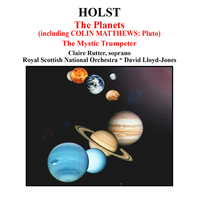 The Planets1974
 The Prodigy Conductor2025Fide et literis2024BBC Music, Volume 33, Number 1: A Tribute to Andrew Davis2024BBC Music, Volume 32, Number 12: Japanese Suite / A Somerset Rhapsody / Indra2024The Planets2024Music for Strings2024The Planets - Gynt2024The Planets2023I Vow to Thee, My Country2022Five Mystical Songs and Other British Choral Anthems2022The Hymn of Jesus, The Perfect Fool, Egdon Heath, Country Song2022Vaughan Williams: String Quartets 1 & 2 / Holst: Phantasy Quartet, op. 362022McEwen: Under Northern Skies / Bowen: Debutante / Burlesque / Miniature Suite / Holst: Wind Quintet in A-flat / Jenkins: Chums! / Jacob: Swansea Town / Spain-Dunk: Rhapsody Quintet2022The Planets (arranged for two pianos by the composer)2021The Planets: Reimagined2020The Cloud Messenger (chamber version)2020The Planets / The Perfect Fool2019Time and Space2019Holst: The Planets / Elgar: Enigma Variations2019Orchestral Works, Volume 4: Symphony “The Cotsworlds” / A Winter Idyll / Scherzo / Invocation / Indra / A Moorside Suite2018STOKOWSKI conducts British music at the NBC (1943/44)2018Holst: The Planets / Strauss: Also sprach Zarathustra2017Sibelius: Symphony no. 1 in E minor, op. 39 / Holst: The Planets, op. 322016British2016English Visionaries2016The Planets; St. Paul’s Suite2015British String Concertos2014Choral Hymns from the Rig Veda / Savitri / Seven Partsongs / The Evening Watch2014Orchestral Works, Volume 3: First Choral Symphony / The Mystic Trumpeter2013BBC Music, Volume 21, Number 10: Holst: The Planets / Beethoven: Piano Concerto No. 12013Holst: The Collector's Edition2012Cotswolds Symphony / Walt Whitman Overture / Indra / Japanese Suite / A Winter Idyll2012Music from the Machine Age2012The Planets, Op. 322011The Planets2011The Planets2011Orchestral Works, Volume 2: The Planets / Beni Mora / Japanese Suite2011BBC Music, Volume 19, Number 3: A Choral Christmas2010The Planets2010Holst: The Planets / Britten: The Young Person's Guide to the Orchestra2009The Planets [Arranged for Brass and Organ]2009The Maverick Conductor2009Orchestral Works, Volume 1: Ballet from "The Perfect Fool" / The Lure / The Golden Goose / The Morning of the Year2009Hymn to Dionysus / Choral Hymns / Two Eastern Pictures2008The Planets2007Parry: Ode on the Nativity / Holst: The Mystic Trumpeter / Vaughan Williams: The Sons of Light2007The Composers Conduct: Holst: The Planets / Vaughan Williams: Symphony no. 42007Walt Whitman - Suite De Ballet - A Hampshire Suite...2007Double Concerto / St Paul's Suite / Brook Green Suite2007Through Gold and Silver Clouds2007English String Miniatures, Volume 62006The Planets2006Composer's Collection: Gustav Holst2006The Planets2005Holst: The Planets / Somerset Rhapsody / Matthews: Pluto2005Holst Conducts Holst: The Planets2005BBC Music, Volume 13, Number 8: Delius: To Be Sung of a Summer Night on the Water / Elgar & Holst: Partsongs2005English Song2004Holst: Out of this World (The Classic Composers - Modern 11)2004Holst: Suite no. 1 in E-flat / Suite no. 2 in F / Handel: Music for the Royal Fireworks / Sousa: Stars and Stripes / Marches, Fanfares and others2004The Planets2004The English Song Series, Volume 6: Vedic Hymns / Four Songs for Voice and Violin / Humbert Wolfe Songs2003The Planets2003Britten: Sinfonia da Requiem / Four Sea Interludes & Passacaglia / Holst: Egdon Heath / The Perfect Fool2003The Planets2003The Planets2002English String Miniatures, Volume 42002The Planets / Serenade, op. 202002The Planets: including Colin Matthews: Pluto / The Mystic Trumpeter2002The Planets / Egdon Heath2002The Planets2001English String Miniatures, Volume 32001Holst: The Planets / Vaughan Williams: Fantasias2001The Planets / Pluto2001The Planets / Transfigured Night2001The Holst Singers and Orchestra: Britten, Bliss, and Holst2001Gustav Holst: The Planets / Richard Strauss: Also sprach Zarathustra2001Gustav Holst: The Planets / Elegy / Edward Elgar: Serenade, op. 20 / Frank Bury: Prelude & Fugue / Edgar Bainton: Miniature Suite2000The Planets / A Somerset Rhapsody / Brook Green Suite2000Symphony in F / A Hampshire Suite / A.M.O1999Holst: Suites / Vaughan Williams: Folk Song Suite / Toccata Marziale1999The Wandering Scholar / Suite de Ballet / A Song of the Night1999British Wind Band Classics1999The Cloud Messenger / A Choral Fantasia / Part-songs1999Britten: Overture "The Building of the House" / Bridge: Enter Spring / The Sea / Holst: Egdon Heath / A Fugal Concerto1999The Art of the Trombone: Works for Trombone and Organ1999The Planets / St. Paul’s Suite1998Music for Two Pianos1998Beni Mora / Somerset Rhapsody / Hammersmith / Egdon Heath / Invocation for Cello and Orchestra1998The Planets1998The Planets1997Holst: The Planets / Varèse: Arcana1997Classical Collection1997Holst: The Planets, op. 32 / Walton: Portsmouth Point Overture / Siesta / Spitfire Prelude & Fugue1997BBC Music, Volume 5, Number 1: The Planets1996Elgar: The Dream of Gerontius / Holst: The Hymn of Jesus / Delius: Sea Drift1996Orchestral Music1996The Planets1996Orchestral Works including Hammersmith and Egdon Heath1996