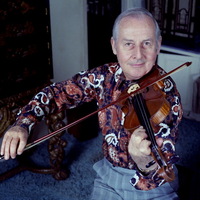
Stéphane Grappelli
Stéphane Grappelli (26 January, 1908 – 1 December, 1997) was a pioneering jazz violinist who founded with Django Reinhardt in 1934 the "Quintette du Hot Club de France", it was one of the first all-string jazz bands. He has been called "the grandfather of jazz violinists" and continued playing concerts around the world well into his 80s. For the first three decades of his career, he was billed using a gallicised spelling of his last name, Grappelly, reverting to "Grappelli" in 1969. The latter, Italian, spelling is now used almost universally when referring to the violinist – even on reissues of his early work. Grappelli was born in France at Paris' Hôpital Lariboisière, and was christened with the name Stéfano. His Italian father, marquess Ernesto Grappelli, was born in Alatri, Lazio, and his French mother, Anna Emilie Hanoque, was from St-Omer. Ernesto was a scholar who taught Italian, sold translations, and wrote articles for local journals. Stéfano's mother died when he was four, leaving his father to care for him. Though he was living in France when World War I broke out, Ernesto was still an Italian citizen, and was drafted to fight in 1914. Ernesto had written an article about dancer Isadora Duncan during his time as a journalist, and turned to her when he needed someone to care for his son. Stéfano enrolled in Duncan's dance school at the age of six, and it was here that he learned to love French Impressionist music. With the war encroaching, Duncan was forced to flee the country and turn over her château to be used as a military hospital. Ernesto, having nowhere else to turn to, entrusted Stéfano to a Catholic orphanage. Grappelli is quoted “I look back at it as an abominable memory…The Place was supposed to be under the eye of the government, but the government looked elsewhere. We slept on the floor, and often were without food. There were many times when I had to fight for a crust of bread,” and claimed that he once tried eating flies as a means of easing his hunger. Stéfano stayed at the orphanage until his father returned from the war in 1918 and brought him to live in an apartment in Barbès. Ernesto was sickened by all things Italian after serving his time in the military, so, on July 28, 1919, he brought Stéfano to city hall, pulled two witnesses off the street, and had his son nationalized as a Frenchman. Stéfano was changed to Stéphane. Stéphane began playing the violin at age 12 after his father pawned his suit to buy him a three-quarter size violin. Ernesto sent his son to proper violin lessons, but Stéphane preferred to learn on his own. Grappelli said that "“My first lessons were in the streets, watching how other violinists played…The first violinist that I saw play was at the Barbès métro station, sheltered under the overhead metro tracks. When I asked how one should play, he exploded in laugher. I left, completely humiliated with my violin under my arm.” After learning independently for a brief period of time, Ernesto enrolled Stéphane at the Conservatoire de Paris on December 31, 1920 where he would learn music theory, ear-training, and solfeggio; Stéphane graduated in 1923 with a second-tier medal. Ernesto announced that he would be remarrying a woman by the name of Anna Fuchs and moving to Strasbourg during Stéphane's final year of schooling. Though he was invited to come with them, Stéphane chose to stay behind as he despised his father's new bride. At the age of 15, Grappelli began busking full-time to support himself financially. Grappelli's playing caught the attention of an elderly violinist who invited him to accompany silent films in the pit orchestra at the Théâtre Gaument. Stéphane played here for six hours every day over the course of a two-year period. During orchestra breaks, Grappelli would visit a local brasserie, Le Boudon, where he would listen to songs from an American proto-jukebox. It was here that Grappelli was first introduced to jazz music. Stéphane was playing in the orchestra at the Ambassador in 1928 when Paul Whiteman headlined with Joe Venuti. Jazz violinists were rare, and, though Venuti played mainly commercial jazz themes and seldom improvised, Grappelli was intrigued by his bowing when he played Louis Armstrong's "Dinah." This led Stéphane to begin developing his own jazz-influenced play style. Grappelli was living with a classically trained violinist named Michel Warlop, and, while Warlop admired Stéphane's jazzy playing, Grappelli envied Warlop's income. After experimenting with piano, he gave up violin, choosing simplicity, new sound, and paid gigs over familiarity. Stéphane began playing piano in a big band led by a musician who went by the name of Grégor. After a night of drinking in 1929, Grégor learned that Grappelli had originally played violin. Grégor borrowed a violin and had Stéphane improvise over "Dinah." Grégor was delighted by Grappelli's jazz playing, and insisted that he begin playing violin once more. In 1930, Grégor ran into financial trouble and was involved in a deadly automobile accident that forced him to flee to South America to avoid arrest. Grégor's band reunified as a true jazz ensemble under the leadership of pianist Alain Romans and saxophonist Ekyan. It was while playing with this band that Stéphane first met Django Reinhardt in 1931. Django told Grappelli that he was looking for a violinist such as himself to play with, and invited him to play at the caravan he was living in. Though the two played for hours that afternoon, their commitments to their respective bands prevented them from pursuing a career together. Three years later, in 1934, the two encountered each other at Claridge's, and it was then that their partnership truly began. Pierre Nourry, the secretary of the Hot Club de France invited Reinhardt and Grappelli to form the Quintette du Hot Club de France with Joseph Reinhardt and Roger Chaput joining Django on guitar, and Louis Vola on bass. In 1937, the American jazz singer Adelaide Hall opened a nightclub in Montmartre along with her husband Bert Hicks and called it 'La Grosse Pomme.' She entertained there nightly and hired the Quintette as one of the house bands at the club. Also in the neighborhood was the artistic salon of R-26, at which Grappelli and Reinhardt performed regularly. For the first three decades of his musical career, Grappelli was billed as Stéphane Grappelly. Grappelli's own explanation for the changed spelling was that he was tired of people mispronouncing his last name as "Grappell-eye". His early fame came playing with the Quintette du Hot Club de France with Django Reinhardt, which disbanded in 1939 at the outbreak of World War II. In 1940, a little-known jazz pianist by the name of George Shearing made his debut as a sideman in Grappelli's band. Shearing went on to enjoy a long career. In 1949, Reinhardt and Grappelli reunited for a brief tour of Italy, during which time they made a series of recordings with an Italian rhythm group. The two recorded roughly 50 tracks together during this time, and about half of them would be later compiled for the album Djangology. Grappelli appeared on hundreds of recordings including sessions with Duke Ellington, jazz pianists Oscar Peterson, Michel Petrucciani and Claude Bolling, jazz violinist Jean-Luc Ponty, jazz violinist Stuff Smith, Indian classical violinist L. Subramaniam, vibraphonist Gary Burton, pop singer Paul Simon, mandolin player David Grisman, classical violinist Yehudi Menuhin, orchestral conductor André Previn, guitar player Bucky Pizzarelli, guitar player Joe Pass, cello player Yo Yo Ma, harmonica and jazz guitar player Toots Thielemans, jazz guitarist Henri Crolla, bassist Jon Burr and fiddler Mark O'Connor. He also collaborated extensively with the British guitarist and graphic designer Diz Disley, recording 13 record albums with him and his trio (which included Denny Wright in its early years), and with now renowned British guitarist Martin Taylor. His Parisian trio of many years included guitarist Marc Fosset and bassist Patrice Carratini. During the 1960s he played for cocktail hour at the Paris Hilton. Grappelli recorded a solo for the title track of Pink Floyd's 1975 album Wish You Were Here. This was made almost inaudible in the mix, and so the violinist was not credited, according to Roger Waters, as it would be "a bit of an insult". A remastered version, with Grappelli's contribution fully audible, can be found on the 2011 Experience & Immersion versions of Wish You Were Here. Grappelli made a cameo appearance in the 1978 film King of the Gypsies, along with noted mandolinist David Grisman. Three years later they performed together in concert, which was recorded live and released to critical acclaim. In the 1980s he gave several concerts with the young British cellist Julian Lloyd Webber. In 1997, Grappelli received the Grammy Lifetime Achievement Award. He is an inductee of the Down Beat Jazz Hall of Fame. He died in Paris after undergoing a hernia operation. He is buried in the city's famous Père Lachaise Cemetery.
Biography from Last.fm, available under CC BY-SA.
Country: FR
Deathdate: 1997-12-01
Disambiguation: jazz violinist
Gender: Male
Is Living: No
Groups
 Quintette du Hot Club de FranceNina Rette et son Hot TrioPhilippe Brun and His Swing BandStéphane Grappelli and His Hot FourStéphane Grappelli and His QuartetTrio de violonsDuo de violonsThe New Hot Club QuintetStéphane Grappelli and His MusiciansGrégor et ses GrégoriensStéphane Grappelli QuartetStéphane Grappelli Quintet
Albums
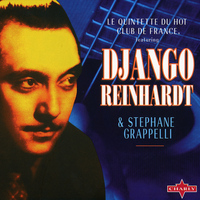 Le Quintette Du Hot Club De France1997
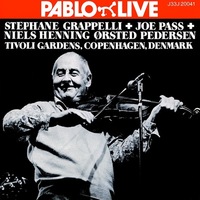 Tivoli Gardens, Copenhagen, Denmark1991
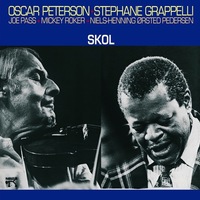 Skol1982
 Mon Ami Django2023From Paris With Love2021Weep No More, My Lady2020With The Quintet of the Hot Club of France2019The Master (Live)2018The Absolutely Essential 3 CD Collection2016Classic Early Recordings2015The Very Best Of2011Quintesential2011The Quintessence: Paris – London 1933–19582010Tribute to Django Reinhardt2009Friends in Music2009Les Rois Du Swing Manouche2009Crazy Blues2009Jazz in Paris: The Nearness of You2008The Ultimate Collection2008Jazz Violin Summit2008The First Session2008Django Reinhardt & Stéphane Grapelli2008Djangology2007Bach to The Beatles2006Swing in Paris2005Rhythm for Two2005The Collection2005I Got Rhythm2005Grappelli Plays Grappelli2003Live at Corby Festival Hall, May, 19752003To Django2003A Froggy Plays in London Town2003Jazz in Paris: Django2002Venuppelli Blues2002Jazz in Paris: Stuff and Steff2002Honeysuckle Rose2002Les Valseuses / Calmos2001Jazz indispensable2001Jazz in Paris: Stéphane Grappelli Plays Cole Porter2001Swing in Paris2001The Best of Stéphane Grappelli Meets George Shearing in London2001Swing 392001Swingin' With Django2001Live in Warsaw2001Moonlight in Vermont2001Vintage Grappelli2001Tea for two2001Jazz in Paris: Improvisations2000Jazz in Paris: Stéphane Grappelli Quartet, Volume 12000Jazz in Paris: Stéphane Grappelli Quartet, Volume 22000Le Hot Club De France, Volume 32000Warsaw Jazz Jamboree2000Le Hot Club De France, Volume 12000Le Hot Club De France, Volume 22000Le Hot Club De France, Volume 42000Stéphane Grappelli2000Crazy Rhythm2000Live at the Cambridge Folk Festival2000In London - Echoes of France2000Swing From Paris2000Stéphane Grappelli1999Hot Club De France1999Puttin’ On the Ritz1999Parisian Swing1999Duet1999Stephane Grappelli1999Fit as a Fiddle 1933-19471998Olympia 19881998Live In San Francisco1998Pent Up House1998A Portrait of Stéphane Grappelli1998Sweet Chorus1998The Quintessential Django Reinhardt & Stéphane Grappelli1998I Got Rhythm1998I Got Rhythm1997Django Reinhardt & Stéphane Grappelli: Parigi1997Flamingo1996Le Meilleur de Stéphane Grappelli1996Douce France1996Le maestro du violon jazz1996Live at the Blue Note1996Aquarius1996Live in Warsaw1996Le retour des P'tits loups du Jazz1995Stephane Grappelli1995Bringing it Together1995Le Jazz Hot, 20 Jazz Masterpieces1995Nuages, Volume 21995I Got Rhythm: Reinhardt & Grappelli Best European Jazz1994The Best Of Hot Club de France1994Grappelli Story1994I Hear Music1994The Chronological Classics: Stéphane Grappelly 1941-19431994Verve Jazz Masters 111994First Class1993Young Django1993Réunion1993The Chronological Classics: Stéphane Grappelli 1935-1940199385 and Still Swinging…1993Anything Goes1993
Singles
What Is This Thing Called Love? / Si tu savais1948Festival 48 / Fantaisie1948Eveline / Diminishing1948Mike / Lady Be Good1948How High the Moon / Lover Man1947R‐Vingt Six / Blue Lou1947Blues / Yours and Mine1947Oui pour vous revoir / Tea For Two1947Ol’ Man River / Si tu savais1947Echos De France / Embraceable You1946Coquette / Django’s Tiger1946Out of Nowhere / Baby1945Swing 42 / Stockholm1941Stephen’s Blues / Sugar1940Interprétation swing et improvisation du premier mouvement du concerto en ré mineur de J.‐S. Bach1938Fiddle Blues / Lady Be Good1938Avalon / Djangology1937Ultrafox / I’ve Had My Moments1937Dinah / Daphne1937Clouds / Believe it, Beloved1935Chasing Shadows / I’ve Had My Moments1935Chasing Shadows / Some of These Days1935St. Louis Blues / China Boy1935Sweet Sue, Just You / Ton Doux Sourire1935Blue Drag / Swanee River1935