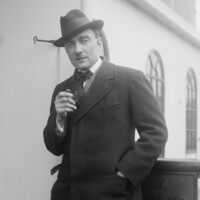
Karol Szymanowski
Karol Maciej Korwin-Szymanowski (1882-1937), was a Polish composer and pianist, Born on the 3rd October 1882 in Tymoszowka, Poland, he lived between the death of Chopin and the rise of the post-World War II generation of Grażyna Bacewicz and Witold Lutosławski. His style developed in three distinct stages: from a strong affinity with Richard Strauss, Alexander Scriabin and fellow countryman Frédéric Chopin, to flavourings of the Orient, the Mediterranean, and the impressionism of Claude Debussy and Maurice Ravel, to a nationalist final period influenced by Polish folk music and the Eastern Church. Even when writing in a Polish idiom, Szymanowski far exceeded the established musical language of central Europe, and is remembered as an exotic outlier of twentieth-century music. He began, however, strongly opposed to folk material as a source for Polish music and considered it provincial. We should remember, however, that Poland, at this point a duchy of the Russian empire, did not become an official nation until after the First World War. Nationalism was expressed mainly through the Catholic Church and through identification with either Chopin or Western Europe – that is, against Russia. After graduating from the Warsaw Music Institute (now, the Conservatory), Szymanowski became involved with a group that called itself Young Poland and included the composer and conductor Grzegorz Fitelberg and composer Ludomir Różycki. His music began to get played in both Poland and Germany. To this period belong the Concert Overture (1906) and his First Symphony (1907). Born into a well-to-do and cultured family, Szymanowski read and travelled widely. In 1911 and 1912, he travelled to Vienna, where they performed his Second Symphony (1910), still very much influenced by the gigantism of Richard Strauss and the fussy Germanic counterpoint deriving from Max Reger. However, in 1914 he also visited Sicily and North Africa (Algiers, Constantine, Biskra and Tunis), which awakened an interest in oriental exoticism, and during the war studied ancient Greek culture, early Christianity and Islam. A novel inspired by these influences, Efebos, was lost in the fires of Warsaw in 1939. Of more musical significance, he also travelled to Paris, where he came into contact with French and Russian music. Debussy and Ravel influence his orchestration and loosen (although do not obliterate) his dependence on Germanic functional harmony. He also became affected by the music of Scriabin. The music in general becomes more Impressionistic and culminates in the First Violin Concerto and the Third Symphony, ”Song of the Night,” both from 1916, and the piano music "Masques" (1916) and "Metopes" (1915). The latter, loosely structured around Homer's Odyssey, features fragments of bird song, polytonalism, and hints of the ancient double flute and lyre. The combination of the Russian Revolution and the First World War precipitated a crisis in Szymanowski’s life, a period in which he began to doubt his artistic capability. His family lost most of their money and all of their land. Between 1918 and 1921, he wrote very little. The ballet-pantomime Mandragora (1920) is probably his most substantial work of the period. He began writing the opera King Roger in 1918. A kind of rewrite of Euripides’ play The Bacchae, it concerns the enlightenment of the twelfth-century Sicilian king by a young peasant, a Dionysian figure representing the values of the East. However, he stopped working on the opera before completing the last act. In 1919 Szymanowski moved to the newly independent Poland, where, following Stravinsky’s appropriation of folk materials into a highly sophisticated and very modern style, he became increasingly influenced by Polish themes. One must note that Szymanowski didn’t tap into this solely for nationalistic reasons, although the founding of the new Polish State probably affected him. He drew particularly on Polish highland folk music, which he discovered in Zakopane. In essence, he traded the hothouse exoticism of ancient Persia and Greece for the Tatra mountains in southern Poland – remote, wild, and ”primitive.” The primitivism of the region appealed to him just as strongly – a new version of the Dionysian exotic closer to home, if you will, than Athens or Baghdad. At any rate, it toughened his music, which could get lost in languid lilies. When he took up working on King Roger again, he ran into the difficulty that the Impressionism of the earlier part was no longer what he wanted to do. Nevertheless, he did complete the work in 1924. The finale, a resplendent hymn to the sun, shows absolutely no trace of the effort it cost him to ”think himself back” into the earlier style and is thus the grandest expression of Szymanowski's Orientalism. He spent much of his time in Paris, receiving commissions for such works as his Stabat Mater (1926). The Polish setting of the this piece combines a plain and direct translation of the text with melodic material from two Polish hymns, parallel movement between voices, modal pitch organisation, and strongly patterned, folkish rhythms. He also became recognised at home. In 1927, he became director of the Warsaw Conservatory, but reactionary forces eventually drove him in 1929. That same year, he was diagnosed with severe tuberculosis. Excessive smoking and drinking didn’t help, and he cut back, leading to improvement in his health. In 1930, he became rector of the Warsaw Music Institute. Two years later, however, the old guard again drove him out. His health declined again. Nevertheless, he managed to compose his radiant Violin Concerto #2 (1933), the intense and austere Litany to the Virgin Mary (1933), the Fourth Symphony (1933), an interesting commingling of his primitivism with neoclassicism, and the ballet Harnasie (1935), perhaps his purest expression of folk spirit. Szymanowski’s final years were marked by destitution and illness. His financial precariousness forced him to undertake punishing tours, which further damaged his health. He died on the 29th March 1937.
Biography from Last.fm, available under CC BY-SA.
Country: PL
Deathdate: 1937-03-28
Disambiguation: Polish composer
Gender: Male
Is Living: No
Albums
 Bach / Haydn / Schubert / Szymanowski2025Masques / Images / Hommages2025Sibelius: Violin Concerto in D minor, op. 47 / Järnefelt: Berceuse in G minor / Szymanowski: Violin Concerto no. 2, op. 612025Bacewicz / Lutosławski / Szymanowski2025BBC Music, Volume 33, Number 2: Szymanowski: Songs of the Fairy‐Tale Princess / Zemlinsky: Die Seejungfrau2024Works for Violin & Piano2024Notturno2024Chopin / Szymanowski2024Szymanowski2024Sonatas & Myths2024Bartók, Janáček, Szymanowski2024Szymanowski Reimagined2024Mythes2023Mythes: Music for Violin & Piano2023Piano Works2022Szymanowski: Stabat Mater, op. 53 / Penderecki: Dies irae / Threnody to the Victims of Hiroshima2022Secret Love Letters2022The Polish Violin, Volume 22021Schubert, Szymanowski, Schönberg2021Concerto pour violon n°1 / Symphonie n° 4 / Mythes / Mazurkas2021Music for Violin and Piano2021Enescu / Prokofiev / Szymanowski2020Piano Works, Vol. 22020Godowsky: Klaviersonate e-moll / Szymanowsky: 9 Präludium, op. 12020Modern Times Edition2020Works by Karol Szymanowski and Ludwig van Beethoven2019Works for Solo Piano2019The Wartime Triptychs2019Fauré / Debussy / Szymanowski / Chopin2019The Polish Violin2019Piano Music2018A Century of Polish Piano Miniatures2018Violin Works2018String Quartets2018Debussy / Szymanowski / Hahn / Ravel2017Schubert / Szymanowski2017Fantasia2017Violin Concertos2017Modern Times2017Szymanowski2017Works for Violin and Piano2017Szymanowski: Overture, op. 12 / Lutosławski: Cello Concerto / Symphony no. 42016Violin Concertos / Mythes2016Moscow2015Works for Violin & Piano2015String Quartets2015Polska2015Complete Music for Violin and Piano2015Myth: Rosanne Philippens Plays Szymanowski2015Best of Szymanowski2015Etude2014Symphony no. 1 / Symphony no. 3 "The Song of the Night" / Love Songs of Hafiz2014Tradition chez les modernes2014Piano Works, Vol. 32014Kletzki: Violin Concerto / Szymanowski: Violin Concerto no. 2 / Lutosławski: Partita2014Masques / Métopes / Études, op. 4 / Études, op. 332014Symphonies nos. 3 & 4 / Stabat Mater2013Stabat Mater / Harnasie2013Symphony no. 2 / Symphony no. 4 "Symphonie concertante" / Concert Overture2013Piano Works, Vol. 22013Symphonies nos 1 & 22013Songs, opp. 46 & 582013Piano Works, Vol. 12012Debussy / Szymanowski2012Hindemith / Schoenberg / Stravinsky / Szymanowski2011Lutoslawski / Szymanowski / A. Tchaikovsky2011Frédéric Vaysse-Knitter plays Szymanowski2011Chopin: Cello Sonata / Szymanowski, Laks: Sonatas2011Coffrets RTL Classiques2011Symphony no. 3 "Song of the Night" / Violin Concerto no. 12010Paris2009Dvořák: Violin Concerto in A minor, op. 53 / Romance in F minor, op. 11 / Szymanowski: Violin Concerto no. 1, op. 352009Piano Sonata, D. 958 / 15 Hungarian Peasant Songs, Sz 71 / Two Pieces from "Masques" / Piano Sonata no. 7 op. 832009The Complete Music for Violin and Piano2009Symphonies nos. 1 and 4 / Concert Overture / Study in B-flat minor2009Harnasie (Ballet-Pantomime) / Mandragora / Prince Potemkin, Incidental Music to Act V2009Lutoslawski: Complete Music for Violin and Piano / Szymanowski: Myths / Janáček: Violin Sonata2009Violin Concertos2009Szymanowski: String Quartets nos 1 & 2 / Różycki: String Quartet2009Stabat Mater / Veni Creator / Litany to the Virgin Mary2008Violin Concertos nos. 1 & 22008Violin Concertos / Stabat Mater / Symphony no. 3 / Symphonie concertante2008Symphony no. 2 / Symphony no. 3 "Song of the Night"2008Wieniawski / Szymanowski: Violin Concertos / Lutoslawski: Chain 22007String Quartets2007Szymanowski: Symphony no. 2 / Symphony no. 3 "Chant de la nuit" / Enesco: Rhapsodie roumaine no. 12007Piano Music, Volume 22007Violin Concertos nos. 1 and 2 / Nocturne and Tarantella2007Violin Sonata / Mythes / Notturno and Tarantella2007Violin Concertos2006The Complete Piano Music2006Songs of a Fairy-Tale Princess / Harnasie / Love Songs of Hafiz2006Portraits2006Franck: Violin Sonata / Szymanowski: Mythes2006Piano Works, Vol. 42005Piano Recital2005Piano Sonata No. 3 / Métopes / Masques2005Piano Works / Works for Violin and Piano2005Nicola Benedetti: Szymanowski / Chausson / Saint-Saëns2005Complete Songs for Voice and Piano2004