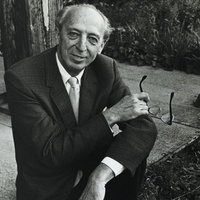
Aaron Copland
Aaron Copland (November 14, 1900 in Brooklyn, New York, United States – December 2,1990) was an American composer who achieved a distinctive musical characterization of American themes in an expressive modern style. Copland, the son of Russian-Jewish immigrants, was born in New York City and attended public schools there. An older sister taught him to play the piano, and by the time he was 15 he had decided to become a composer. As a first step Copland tried to learn harmony through a correspondence course. Haltingly and in an environment not particularly conducive to art, he struggled toward his goal. In the summer of 1921 Copland attended the newly founded school for Americans at Fontainebleau, where he came under the influence of Nadia Boulanger, a brilliant teacher who shaped the outlook of an entire generation of American musicians. He decided to stay on in Paris, where he became Boulanger’s first American student in composition. After three years in Paris, Copland returned to New York City with an important commission: Nadia Boulanger had asked him to write an organ concerto for her American appearances. Copland composed the piece while working as the pianist of a hotel trio at a summer resort in Pennsylvania. That season the Symphony for Organ and Orchestra had its premiere in Carnegie Hall with the New York Symphony under the direction of the composer and conductor Walter Damrosch. In his growth as a composer Copland mirrored the important trends of his time. After his return from Paris, he worked with jazz rhythms in Music for the Theater (1925) and the Piano Concerto (1926). There followed a period during which he was strongly influenced by Igor Stravinsky’s Neoclassicism, turning toward an abstract style he described as “more spare in sonority, more lean in texture.” This outlook prevailed in the Piano Variations (1930), Short Symphony (1933), and Statements for Orchestra (1933–35). After this last work, there occurred a change of direction that was to usher in the most productive phase of Copland’s career. He well summed up the new orientation: “During these years I began to feel an increasing dissatisfaction with the relations of the music-loving public and the living composer. It seemed to me that we composers were in danger of working in a vacuum.” Furthermore, he realized that a new public for modern music was being created by the new media of radio, phonograph, and film scores: “It made no sense to ignore them and to continue writing as if they did not exist. I felt that it was worth the effort to see if I couldn’t say what I had to say in the simplest possible terms.” Copland therefore was led to what became a most significant development after the 1930s: the attempt to simplify the new music in order that it would have meaning for a large public. The decade that followed saw the production of the scores that spread Copland’s fame throughout the world. Most important of these were the three ballets based on American folk material: Billy the Kid (1938), Rodeo (1942), and Appalachian Spring (1944; commissioned by dancer Martha Graham). To this group belong also El salón México (1936), an orchestral piece based on Mexican melodies and rhythms; two works for high-school students—the “play opera” The Second Hurricane (1937) and An Outdoor Overture (1938); and a series of film scores, of which the best known are Of Mice and Men (1939), Our Town (1940), The Red Pony (1948), and The Heiress (1948). Typical too of the Copland style are two major works that were written in time of war—Lincoln Portrait (1942), for speaker and chorus, on a text drawn from Lincoln’s speeches, and Letter from Home (1944), as well as the melodious Third Symphony (1946). In his later years Copland refined his treatment of Americana: “I no longer feel the need of seeking out conscious Americanism. Because we live here and work here, we can be certain that when our music is mature it will also be American in quality.” His later works include an opera, The Tender Land (1954); Twelve Poems of Emily Dickinson (1950), for voice and piano; and the delightful Nonet (1960). During these years Copland also produced a number of works in which he showed himself increasingly receptive to the serial techniques of the so-called 12-tone school of composer Arnold Schoenberg. Notable among such works are the stark and dissonant Piano Fantasy (1957); Connotations (1962), which was commissioned for the opening of Lincoln Center for the Performing Arts in New York City; and Inscape (1967). The 12-tone works were not generally well-received; after 1970 Copland virtually stopped composing, though he continued to lecture and to conduct through the mid-1980s. For the better part of four decades, as composer (of operas, ballets, orchestral music, band music, chamber music, choral music, and film scores), teacher, writer of books and articles on music, organizer of musical events, and a much sought after conductor, Copland expressed “the deepest reactions of the American consciousness to the American scene.” He received more than 30 honorary degrees and many additional awards. His books include What to Listen for in Music (1939), Music and Imagination (1952), Copland on Music (1960), and The New Music, 1900–60 (1968). With the aid of Vivian Perlis, he wrote a two-volume autobiography (Copland: 1900 Through 1942 [1984] and Copland: Since 1943 [1989]).
Biography from Last.fm, available under CC BY-SA.
Country: US
Deathdate: 1990-12-02
Disambiguation: composer
Gender: Male
Is Living: No
Groups

Albums
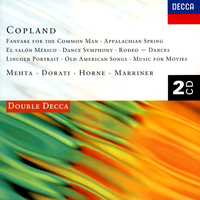 Fanfare For the Common Man / Appalachian Spring / El salón México / Dance Symphony / Rodeo Dances / Lincoln Portrait / Old American Songs / Music for Movies1996
 Hallelujah Junction: Adams, Stravinsky, Gershwin & Copland2025BBC Music, Volume 33, Number 8: Spring Symphony2025Appalachian Spring / Four Dance Episodes from Rodeo / El Salon México2024Copland Conducts Copland: The Complete Columbia Album Collection2024Copland: The Tender Land Suite / Creston: Saxophone Concerto / Kay: Pietà / Piston: The Incredible Flutist Suite2023Symphony no. 32023Upon Further Reflection2022Two Classic Political Film Scores2022From Brighton to Brooklyn2022Copland: Clarinet Concerto / Appalachian Spring / Strauss: Duet Concertino / Capriccio2020American Pioneers2020Songs2020Symphony No. 32020Dvořák: Symphony no. 9 / Copland: Billy the Kid2020Dvořák: Symphony No. 9 “From the New World” / Copland: Quiet City / Ives: Washington’s Birthday2019Billy the Kid / Grohg2019Orchestral Works 4: Symphonies2018Copland: Symphony no. 3 / Clarinet Concerto / Carter: Holiday Overture / Ives: Decoration Day2018I Got Rhythm2018Orchestral Works 3: Symphonies2018Aaron Copland: Essential Works2017The Red Pony / The Heiress2017Symphony no. 3 / Three Latin American Sketches2017Great American Sonatas2017Appalachian Spring (Complete Ballet) / Hear Ye! Hear Ye!2016Orchestral Works 2: Symphonies2016John Corigliano: Symphony no. 1 / Michael Torke: Bright Blue Music / Aaron Copland: Appalachian Spring — Suite2016Orchestral Works 1: Ballets2016American Works for Cello and Piano2015Billy The Kid / Rodeo / El Salón México / An Outdoor Overture2015American Polyphony2015Herrmann / Gershwin / Waxman / Copland2015Hallowed Ground2014Copland: Appalachian Spring; Symphony No 32014New World Quartets2014Above and Beyond: Music for Wind Band2014Composing America2014BBC Music, Volume 22, Number 5: American Journey2014American Piano Concertos2013Copland Conducts Copland2013Works for Clarinet and Orchestra2013Rodeo / Dance Panels / El salón México / Danzón cubano2013Copland: Quiet City, Eight Poems of Emily Dickinson / Barber: Knoxville: Summer of 1915, Capricorn Concerto / Gershwin: Summertime2012Copland: Piano Concerto / Menotti: Piano Concerto2012Copland: Appalachian Spring Suite - Symphonic Ode - Creston: Symphony No. 3, ’Three Mysteries’2012Rodeo - Piano Concerto - Billy the Kid2012Shostakovich: Trios, op 8 & op. 67 / Copland: Trio "Vitebsk"2011Ives/Brant: A Concord Symphony / Copland: Organ Symphony2011Quiet City2011The Pulitzer Project: Pulitzer Prize-Winning Works by Schuman, Sowerby & Copland2011American Classics: Billy the Kid / Rodeo / In the Beginning2010Complete Solo Piano Works, Vol. 12010An American New Year’s Eve2010Of Mice and Men / Our Town2009Southern Harmony2009Aaron Copland: The Red Pony / Benjamin Britten: Sinfonia da Requiem2009Hovhaness: Symphony no. 1 / Milhaud: Symphony no. 1 / Copland: Symphony no. 2 / Serebrier: Symphony no. 12009American Piano Music2009Dance Symphony / Symphony no. 1 / Short Symphony2008Duos for Violin and Viola2008American Classics: Foster: Songs / Griffes: The Rose of the Night / Copland: Eight Poems of Emily Dickinson2008Appalachian Spring / El Salon Mexico / Old American Songs / Fanfare for the Common Man2008Piano Concerto / The Tender Land (Suite) / Old American Songs2008Symphony no. 3 / Clarinet Concerto / Quiet City2007American Jazz Concertos2006Rodeo (Four Dance Episodes) / The Red Pony (Suite) / Prairie Journal / Letter from Home2006BBC Music, Volume 15, Number 2: American Landmarks2006Piano Sonata and Other Works2006The Copland Collection2006America for Two2005Music For The Theatre Vol. 22005Copland: Inscape / Sessions: Symphony No. 8 / Perle: Trancendental Modulations / Rands: ...Where The Murmurs Die...2005Piano Fantasy / Piano Sonata2005Appalachian Spring / Fanfare for the Common Man / Clarinet Concerto2005American Piano Music2005My Name Is Barbara2005Copland: Fanfare / Rodeo; Hindemith: Symphonic Metamorphosis2004Lincoln Portrait & Other Works2004Orchestral Masterpieces2004Voices, Volume 3: The Gift to Be Free2003Something Wild2003Appalachian Spring (Ballet Suite) / Clarinet Concerto2002Third Symphony / Music for the Theatre2002New England Landscapes2002The World of Aaron Copland2002Piano Concertos of the '20s2002Symphony no. 3 / Billy the Kid (Suite)2002Copland: Appalachian Spring / Four Dances from Rodeo / Bernstein: Facsimile / Fancy Free2001Variations2001BBC Music, Volume 9, Number 2: Billy the Kid, Organ Symphony, El salón México, Danzón cubano2000Copland Conducts Copland2000Fanfare for the Common Man: On Aaron Copland, the Man and His Music2000A Copland Celebration, Vol. 12000Copland: The Populist2000Sacred & Secular Choral Music2000Fanfare for the Common Man / Appalachian Spring / Symphony no. 32000Fanfare for the Common Man/ Appalachian Spring/ El Salón México/ 4 Dance Episodes from "Rodeo"1999Bernstein's America1999Orchestral Works1999