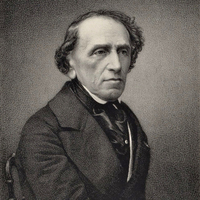
Giacomo Meyerbeer
Giacomo Meyerbeer (September 5, 1791 – May 2, 1864) was a noted German-born opera composer, and the first great exponent of Grand Opera. Meyerbeer was born to a Jewish family in Tasdorf, near Berlin, Germany with the name Jacob Liebmann Beer. His father was the enormously wealthy financier Jacob Judah Herz Beer (1769-1825) and his much-beloved mother, Amalia Liebmann Meyer Wulff (1767-1854) also came from the wealthy elite. Their other children included the astronomer Wilhelm Beer and the poet Michael Beer. Meyerbeer made his debut as a nine-year old playing a Mozart concerto in Berlin. Throughout his youth, although he was determined to become a musician, he found it difficult to decide between playing and composition. Certainly other professionals in the decade 1810-1820, including Moscheles, considered him amongst the greatest virtuosi of his period. In his youth Beer studied with Antonio Salieri and the German master and friend of Goethe, Carl Friedrich Zelter. Realizing, however, that a full understanding of Italian opera was essential for his musical development, he went to study in Italy for some years, during which time he adopted the first name Giacomo. The 'Meyer' in his surname he adopted after the death of his great-grandfather. It was during this time that he became acquainted with, and impressed by, the works of his contemporary Gioacchino Rossini. Meyerbeer's name first became known internationally with his opera Il crociato in Egitto (premiered in Venice in 1824, and produced in London and Paris in 1825; incidentally the last opera ever to feature a castrato), but he became virtually a superstar with Robert le Diable (Robert the Devil, with libretto by Eugène Scribe and Casimir Delavigne), produced in Paris in 1831 and regarded by some as the first grand opera, although this honor rightly belongs to Auber's La muette de Portici. The fusion of dramatic music, melodramatic plot and sumptuous staging proved a sure-fire formula which Meyerbeer repeated in Les Huguenots (1836), Le prophète (1849), and L'Africaine, (produced posthumously, 1865). All of these operas held the international stage throughout the 19th century, as did the more pastoral Dinorah (1859). However, because they were expensive to stage, requiring large casts of leading singers, and subject to consistent attack from the prevalent Wagnerian schools, they gradually fell into desuetude. Meyerbeer left Paris for Berlin in 1842 to take the post of Court musical director, but returned to Paris in 1849. Meyerbeer's immense wealth (increased by the success of his operas) and his continuing adherence to his Jewish religion set him apart somewhat from many of his musical contemporaries. They also gave rise to malicious rumours that his success was due to his bribing musical critics. Richard Wagner (see below) accused him of being only interested in money, not music. Meyerbeer was, however, a deeply serious musician and a sensitive personality. He philosophically resigned himself to being a victim of his own success. Meyerbeer was interred in the Berlin Jewish cemetery in Schönhauser Allee, amongst other members of the Beer family.
Biography from Last.fm, available under CC BY-SA.
Country: DE
Deathdate: 1864-05-02
Disambiguation: composer
Gender: Male
Is Living: No
Albums
 Le Prophète2024L'Africaine - Vasco da Gama2024Overtures and Stage Music2022Robert le Diable2022L'Étoile du Nord2022Romilda E Costanza2020Giacomo Meyerbeer: Gli Amori di Teolinda (Live at Opera, Lausanne)2020Sacred Works2019Le Prophète2018Margherita d’Anjou2018Grand Opera2017Songs 22016Hallelujah - The Choral Works2016French Opera Arias2016Dinorah2016Overtures and Entr'actes from the French Operas2014Vasco de Gama2014Ballet Music from the Operas2014Robert Le Diable2013Songs 12011Semiramide2006Les Huguenots - deutsch (Chor der Wiener Staatsoper & Großes Wiener Rundfunkorchester, feat. conductor: Robert Heger, singers: Bak, Terkal, Berry, Cunitz)2006Operatic Arias for Bass2005Swan Lake (excerpts) / Giselle / Les Patineurs (Suite) (Philadelphia Orchestra feat. conductor: Eugene Ormandy)2003Lieder, Mélodies2001Le Prophète2000Robert le Diable (Chœur et Orchestre National de l'Opera de Paris feat. conductor: Thomas Fulton)1999L’Africaine1999Stuensee / Les Patineurs1998Music for Festive Occasions1998Gli Ugonotti (Les Huguenots)1996Melodies1995Virtuoso Arias1995Le Prophète1994BBC Music, Volume 2, Number 8: Brahms: Liebeslieder Waltzes and Neue Liebeslieder / Spohr: Three Psalms, op. 85 / Meyerbeer: Psalm 911994Il Crociato in Egitto (Royal Philharmonic Orchestra & Geoffrey Mitchell Choir feat. conductor: David Parry)1992Les Huguenots1991Les Huguenots1990Le Prophète1989Bel Canto Arias1986Pomp and Circumstance: Magnificent Marches1984Robert le Diable