
Andrés Segovia
Andrés Segovia Torres, 1st Marquis of Salobreña (21 February 1893 – 2 June 1987), known as Andrés Segovia, was a virtuoso Spanish classical guitarist from Linares, Spain. He is the father of modern classical guitar and has been regarded as one of the greatest guitarists of all time. Practically all professional classical guitarists today are students of Segovia, or students of his students. Segovia's contribution to the modern-romantic repertoire not only included commissions but also his own transcriptions of classical or baroque works. He is remembered for his expressive performances: his wide palette of tone, and his distinctive musical personality, phrasing and style. Segovia was born in Linares, Jaén, Spain. He was sent at a very young age to live with his uncle Eduardo and his wife Maria. Eduardo arranged for Segovia's first music lessons with a violin teacher after recognizing that Segovia had an aptitude for music. This proved to be an unhappy introduction to music for the young Segovia because of the teacher's strict methods, and Eduardo stopped the lessons. His uncle decided to move to Granada to allow Segovia to obtain a better education; after arriving in Granada Segovia recommenced his musical studies. Segovia was aware of flamenco during his formative years as a musician but stated that he "did not have a taste" for the form and chose instead the works of Sor, Tárrega and other classical composers. Tárrega agreed to give the self-taught Segovia some lessons but died before they could meet and Segovia states that his early musical education involved the "double function of professor and pupil in the same body". Segovia's first public performance was in Granada at the age of 16 in 1909. A few years later he played his first professional concert in Madrid which included works by Francisco Tárrega and his own guitar transcriptions of J.S. Bach. Despite the discouragement of his family, who wanted him to become a lawyer, and criticism by some of Tárrega's pupils for his idiosyncratic technique, he continued to diligently pursue his studies of the guitar. He played again in Madrid in 1912, at the Paris Conservatory in 1915, in Barcelona in 1916, and made a successful tour of South America in 1919. Segovia's arrival on the international stage coincided with a time when the guitar's fortunes as a concert instrument were being revived, largely through the efforts of Miguel Llobet. It was in this changing milieu that Segovia, whose strength of personality and artistry coupled with new technological advances such as recording, radio, and air travel, succeeded in making the guitar more popular again. In 1921 in Paris, Segovia met Alexandre Tansman, who later wrote a number of guitar works for Segovia, among them Cavatina, which won a prize at the Siena International Composition contest in 1952. At Granada in 1922 he became associated with the Concurso de Cante Jondo promoted by the Spanish composer Manuel de Falla. The aim of the "classicizing" Concurso was to preserve flamenco in its purity from being distorted by modern popular music. Segovia had already developed as a fine tocador of flamenco guitar, yet his direction was now classical. Invited to open the Concurso held at the Alhambra, he played Homenaje a Debussy by Falla. In 1923 Segovia was in Mexico for the first time. There Manuel Ponce was so impressed with the concert that he wrote a review in El Universal. Later Ponce went on to write many works for Segovia, including numerous sonatas. In 1924, Segovia visited the German luthier Hermann Hauser Sr. after hearing some of his instruments played in a concert in Munich. In 1928 Hauser provided Segovia with one of his personal guitars for use during his United States tour and in his concerts through to 1933. When Hauser delivered the new instrument Segovia had ordered, Segovia passed his 1928 Hauser to his U.S. representative and close friend Sophocles Papas, who gave it to his classical guitar student, the famous jazz and classical guitarist Charlie Byrd, who used it on several records. Segovia's first American tour was arranged in 1928 when Fritz Kreisler, the Viennese violinist who privately played the guitar, persuaded F. C. Coppicus from the Metropolitan Musical Bureau to present the guitarist in New York. After Segovia's debut tour in the U.S. in 1928, the Brazilian composer Heitor Villa-Lobos composed his now well-known Twelve Études (Douze études) and later dedicated them to Segovia. Their relationship proved to be lasting as Villa-Lobos continued to write for Segovia. He also transcribed numerous classical pieces himself and revived the pieces transcribed by predecessors like Tárrega. In 1932, Segovia met and befriended composer Mario Castelnuovo-Tedesco in Venice. Since Castelnuovo-Tedesco did not play the guitar, Segovia provided him with guitar compositions (Ponce's Folias variations and Sor's Mozart Variations) which he could study. Castelnuovo-Tedesco composed a large number of works for the guitar, many of them dedicated to Segovia. The Concerto Op. 99 of 1939 was the first guitar concerto of the 20th century and Castelnuovo-Tedesco's last work in Italy, before he emigrated to the United States. It was premiered by Segovia in Uruguay in 1939. In 1935, he gave his first public performance of Bach's Chaconne, a difficult piece for any instrument. He moved to Montevideo, performing many concerts in South America in the thirties and early forties. After World War II, Segovia began to record more frequently and perform regular tours of Europe and the U.S., a schedule he would maintain for the next thirty years. In 1954, Joaquín Rodrigo dedicated Fantasía para un gentilhombre (Fantasy for a Gentleman) to Segovia. Segovia won the 1958 Grammy Award for Best Classical Performance, Instrumentalist for his recording Segovia Golden Jubilee. John W. Duarte dedicated his English Suite Op.31 to Segovia and his wife (Emilia Magdalena del Corral Sancho) on the occasion of their marriage in 1962. Segovia told the composer "You will be astonished at the success it will have". In recognition of his contributions to music and the arts, Segovia was ennobled on 24 June 1981 by King Juan Carlos I, who gave Segovia the hereditary title of Marqués de Salobreña (English: Marquis of Salobreña) in the nobility of Spain. Andrés Segovia continued performing into his old age, living in semi-retirement during his 70s and 80s on the Costa del Sol. Two films were made of his life and work—one when he was 75 and the other, 84. They are available on DVD called Andrés Segovia — in Portrait. His final RCA LP record (ARL1-1602), Reveries, was recorded in Madrid in June 1977. In 1984, Segovia was the subject of a thirteen part series broadcast on National Public Radio, entitled Segovia! The series was recorded on location in Spain, France, and the United States. Hosted by Oscar Brand, the series was produced by Jim Anderson, Robert Malesky, and Larry Snitzler. Segovia died in Madrid of a heart attack at the age of 94. He is buried at Casa Museo de Linares, in Andalusia. Segovia's technique differed from that of Tárrega and his followers, such as Emilio Pujol. Both Segovia and Miguel Llobet (who taught Segovia several of his transcriptions of Granados' piano works) plucked the strings with a combination of his fingernails and fingertips, producing a sharper sound than many of his contemporaries. With this technique, it was possible to create a wider range of timbres, than when using the fingertips or nails alone. Historically, classical guitarists have debated which of these techniques is the best approach. The vast majority of classical guitarists now play with a combination of the fingernails and fingertips. After World War II, Segovia became among the first to endorse the use of nylon strings instead of gut strings. This new advance allowed for greater stability in intonation, and was the final missing ingredient in the standardization of the instrument. Segovia's repertoire consisted of three principal pillars. Firstly, contemporary works, including concertos and sonatas, usually specifically written for Segovia himself by composers he forged working relationships with, notably Spaniards such as Federico Moreno Torroba, Federico Mompou, and Joaquín Rodrigo, the Mexican composer Manuel Ponce, the Italian composer Mario Castelnuovo-Tedesco, and the great Brazilian composer Heitor Villa-Lobos. Secondly, transcriptions, usually made by Segovia himself, of classical works originally written for other instruments (e.g., lute, harpsichord, piano, violin, cello) by Johann Sebastian Bach, Isaac Albéniz, Enrique Granados, and many other prominent composers. Thirdly, traditional classical guitar works by composers such as Fernando Sor and Francisco Tárrega. Segovia's influence enlarged the repertoire, mainly as a commissioner or dedicatee of new works, as a transcriber, and to a far lesser extent as a composer with such works as his Estudio sin luz. Segovia's main musical aesthetic preferences were music of the early 20th century (and turn of the century) especially in the Spanish romantic-modern and nationalist style. This is perhaps best typified by Segovia's own work Estudio sin Luz. Many works of this and similar style were written especially for him and formed part of his core repertoire: particularly the guitar works of Federico Moreno Torroba (1891–1982), such as the Sonatina, which was first performed by Segovia in Paris in 1925. Segovia was selective and only performed works with which he identified personally. He was known to reject atonal works, or works which he considered too radical, even if they were dedicated to him; e.g. he rejected Frank Martin's Quatre pièces brèves, Darius Milhaud's Segoviana, etc. Even though rejected by Segovia, the works are today all published and available. Segovia viewed teaching as vital to his mission of propagating the guitar and gave master classes throughout his career. His most famous master classes took place at Música en Compostela in the northern Spanish city of Santiago de Compostela. Segovia also taught at the Accademia Musicale Chigiana in Siena for numerous years, where he was aided by Alirio Díaz. Later it was Oscar Ghiglia who continued the Siena class. His teaching style is a source of controversy among some of his former students, who considered it to be dogmatically authoritarian. One of Segovia's most celebrated former students of the classical guitar, John Williams, has said that Segovia bullied students into playing only his style, stifling the development of their own styles. Williams has also said that Segovia was dismissive of music that did not have what Segovia considered the right classical origins, such as South American music with popular roots. Segovia can be considered a catalytic figure in granting respectability to the guitar as a serious concert instrument capable of evocativeness and depth of interpretation. It was Federico Moreno Torroba who said: "The musical interpreter who fascinates me the most is Andrés Segovia". He can be credited to have dignified the classical guitar as a legitimate concert instrument before the discerning music public, which had hitherto viewed the guitar merely as a limited, if sonorous, parlor instrument. In Linares the Segovia Museum "Fundación Andrés Segovia" was established in May 1995, and Linares (Segovia's birthplace) also has a bronze statue in his honour, created by Julio López Hernández and unveiled on 25 May 1984. Segovia influenced a generation of classical guitarists who built on his technique and musical sensibility, including such luminaries as Christopher Parkening, Julian Bream, John Williams (guitarist) and Oscar Ghiglia, all of whom have acknowledged their debt to him. Further, Segovia left behind a large body of edited works and transcriptions for classical guitar, including several transcriptions of J S Bach, in particular, an extraordinarily demanding classical guitar transcription of the Chaconne from the 2nd Partita for Violin (BWV 1004). His editions of works originally written for guitar include newly fingered and occasionally revised versions of works from the standard repertoire (most famously, his edition of a selection of twenty estudios by Fernando Sor, the "cornerstone" of every serious student's technique since its publication in 1945, although somewhat ironically Segovia in the preface to that work disparaged Sor as "not among the vigorous talents") as well as compositions written for him, including by Heitor Villa-Lobos, Federico Mompou, and Castelnuovo-Tedesco. Many of the latter were edited by Segovia, working in collaboration with the composer, before they were first published. Because of Segovia's predilection for altering the musical content of his editions to reflect his interpretive preferences, many of today's guitarists prefer to examine the original manuscripts, or newer publications based on the original manuscripts in order to compare them with Segovia's published versions, so as to accept or reject Segovia's editorial decisions. There are guitar festivals and competitions that were named after Segovia. Segovia was one of those to whom homage was paid in the 1978 song by Ian Dury and The Blockheads There Ain't Half Been Some Clever Bastards. Segovia was awarded many prizes and honours including Ph.D, honoris causa from ten universities. On 24 June 1981, he was ennobled by King Juan Carlos I, who gave Segovia the hereditary title of Marqués de Salobreña (English: Marquis of Salobreña) in the nobility of Spain in recognition of his contributions to music and the arts. He received the Danish Sonning Award in 1974, the Ernst von Siemens Music Prize in 1985, and a Grammy Lifetime Achievement Award in 1986. Segovia's first wife was Adelaida Portillo (marriage in 1918). Segovia's second wife (marriage in 1935) was the pianist Paquita Madriguera, who also made some piano roll recordings. From 1944, he maintained a relationship with Brazilian singer and guitarist Olga Praguer Coelho, which was to last for over a decade. In 1962 Segovia married Emilia Magdalena Corral Sancho. They had one son, Carlos Andrés Segovia, the current Marques of Salobreña.
Biography from Last.fm, available under CC BY-SA.
Country: ES
Deathdate: 1987-06-03
Disambiguation: guitarist
Gender: Male
Is Living: No
Albums
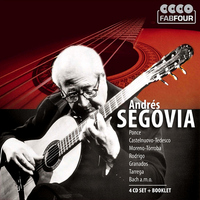 Andrés Segovia2011
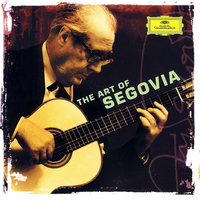 The Art of Segovia2002
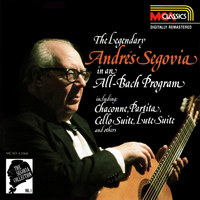 The Segovia Collection, Volume 1: The Legendary Andrés Segovia in an All-Bach Program1987
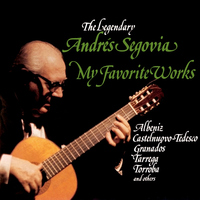 The Segovia Collection, Volume 3: My Favorite Works1987
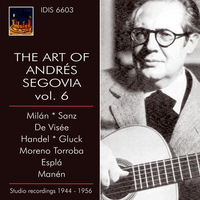 The Art of Andrés Segovia1956
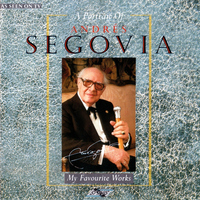 A Portrait
 Tárrega & Albéniz: Guitar Works2021Sor: Works for Guitar2019Guitar Music2016Andrés Segovia - Ritratti (I Grandi Interpreti della Classica)2013The Baroque Repertoire2012Best of Guitar2010The American Decca Recordings 12009Icon: Andrés Segovia2008Andrés Segovia : The Master Guitarist20081950s American Recordings, Volume 42008The Ascona Recital & Other20081950s American Recordings, Volume 32007Non Stop Music2007Guitar Recital2006Definitive Gold: Andrés Segovia2006Segovia & His Contemporaries Vol. 5: Segovia and Vicente Gomez2006Dedication2006The Master of the Classical Guitar2005The Best of Andrés Segovia: The Millennium Collection2004The Great Master2004Andrés Segovia and His Contemporaries, Vol. 92004The Art of Andrés Segovia - Rare Recordings 1952-19542004Quadromania: Andrés Segovia: Recuerdos de la Alhambra2004Segovia & Contemporaries, Vol. 8: Oyanguren, Pt. 22004Portrait2003Guitar Classics2003Bach: Fugue & Gavotte / Villa-Lobos: Preludes / Castelnuovo-Tedesco: Tonadilla & Tarantella / Granados: Danza triste2003Guitar Virtuosos - Masters of Guitar2003The Master2002Complete Bach Recordings 1927 - 19472002Spanish Guitar: Passion and Fire2002The Segovia Collection2002Bach: Guitar Works / Castelnuovo-Tedesco: Guitar Concerto2002Dejavu Retro2001The Early Recordings, Volume 1 & 22001L'arte di Andrés Segovia2001Andrés Segovia 1 Bach, Visée, Sor, Mendelssohn, Malats, Froberger, Tárrega, Albéniz, Granados2000Música española: Música para guitarra II1999The Legendary Segovia1999Estampas Espanolas1998Obras Españolas1998The Gold Collection1997Son de Andalucía1997Segovia & Contemporaries, Vol. 1: Oyanguren1997Maestro, maestro1996Guitar Recital1996Canciones populares1996Golden Guitar Recital1995Poet of the Guitar1995A Centenary Celebration1994Spanish Guitar Classics1994Guitar Recital1993A Bach Solo Guitar Recital1993Recital Bach CD101121993Guitar Recital1992The Segovia Collection, Volume 9: The Romantic Guitar1991The Segovia Collection, Volume 7: Guitar Etudes1990The Segovia Collection, Volume 81990The Segovia Collection, Volume 6: Manuel Ponce Sonatas1989The Segovia Collection, Volume 5: The Legendary Andrés Segovia: Five Centuries of the Spanish Guitar1989The Segovia Collection, Volume 4: The Baroque Guitar1988Obras breves españolas1987Serenata1987The Segovia Collection, Vol. 2: Ponce, Rodrigo, Torroba1987Eduardo Fernández1987Reveries1978Recital Intimo1975The Unique Art of Andrés Segovia1973Platero And I / Sonata Romántica1973España1968Interprète Les Italiens1967Scarlatti - Dowland - Torroba - Giuliani - Narvaez - De Falla - Esplà1962Masters Of The Guitar (Compositions Of Sor And Tarrega)1956Bach: Chaconne1955Andrés Segovia Plays1954An Andrés Segovia Program1952The Genius of Andres Segovia A Bach RecitalLatin American Guitar WorksThe HMV Recordings (1927-1939) Volume 2The Genius of Andrés Segovia: Five Centuries of the Classical GuitarThe Master GuitaristAndrés Segovia and FriendsPonce: Concierto del sur / Rodrigo: Fantasía para un gentilhombreAndres Segovia plays J. S. BachSegovia RaritiesThe Very Best Of Andres Segovia Guitar Genius