
NBC Symphony Orchestra
The NBC Symphony Orchestra was a radio orchestra established by David Sarnoff of the National Broadcasting Company (NBC) especially for conductor Arturo Toscanini. The NBC Symphony performed weekly radio concert broadcasts with Toscanini and other conductors and served as house orchestra for the network, beginning November 13, 1937 and continuing until 1954. Tom Lewis, in the Organization of American Historians Magazine of History, described NBC's plan for cultural programming and the origin of the NBC Symphony: David Sarnoff, the president of RCA who had first proposed the "radio music box" in 1916 so that listeners might enjoy "concerts, lectures, music, recitals," felt that the medium was failing to do this. By 1937, RCA had recovered enough from the effects of the Depression for it to make a dramatic commitment to cultural programming. With the most liberal terms Sarnoff hired Arturo Toscanini to create an entire orchestra and conduct it. On Christmas night, 1937, the NBC orchestra gave its first performance—Vivaldi's Concerto Grosso in D Minor—in an entirely refurbished studio in the RCA Building. "The National Broadcasting Company is an American business organization. It has employees and stockholders. It serves their interests best when it serves the public best." That Christmas night, and whenever the NBC orchestra played over the next 17 years, he was right. Sarnoff devoted considerable resources to create an orchestra of the first rank for NBC. Artur Rodziński, a noted orchestra builder and musical task master in his own right, was engaged to mold and train the new orchestra especially for Toscanini. Prominent musicians from major orchestras around the country were recruited and the conductor Pierre Monteux was hired as well to work with the orchestra in its formative months. A new large broadcast studio was built for the orchestra at NBC's Radio City Studios in Rockefeller Center, New York, "Studio 8-H". In addition to creating prestige for the network, there has been speculation that one of the reasons NBC created the orchestra was to deflect a Congressional inquiry into broadcasting standards. The orchestra's first broadcast concert aired on November 13, 1937 under the direction of Monteux. Toscanini conducted ten concerts that first season, making his NBC debut on December 25, 1937. In addition to weekly broadcasts on the NBC Red and Blue networks, the NBC Symphony Orchestra made many recordings for RCA Victor of symphonies, choral music and operas. Televised concerts began in March 1948 and continued until March 1952. In the fall of 1950, NBC converted Studio 8-H into a television studio (currently in use for NBC's late-night comedy program Saturday Night Live) and moved the broadcast concerts to Carnegie Hall, where many of the orchestra's recording sessions and special concerts had already taken place. Toscanini led the NBC Symphony for 17 years. Under his direction the orchestra toured South America in 1940 and the United States in 1950. The orchestra's guest directors included most of the leading conductors of the day: Monteux, Ernest Ansermet, Erich Kleiber, Erich Leinsdorf, Charles Munch, Fritz Reiner, George Szell, Bruno Walter, and the young Lorin Maazel, among others. The Italian conductor Guido Cantelli, Toscanini's protégé, was a frequent NBC conductor in the orchestra's last seasons. Leopold Stokowski served as principal conductor from 1941-1944 on a three-year contract following a dispute between Toscanini and NBC. During this time Toscanini continued to lead the orchestra in a series of public benefit concerts for war relief. He returned as Stokowski's co-conductor for the 1942-43 and 1943-44 seasons, resuming full control thereafter. Upon Toscanini's retirement in the spring of 1954, NBC disbanded the orchestra, much to Toscanini's distress. The final broadcast concert (recorded in both mono and stereo) took place at Carnegie Hall on April 4, 1954, and the final recording sessions were completed in early June 1954. Musicians: Some notable musicians who were members of the orchestra include violinists Samuel Antek, Henry Clifton, Felix Galimir, Josef Gingold, Daniel Guilet (concertmaster 1952-54), Harry Lookofsky, Mischa Mischakoff (concertmaster 1937-1952), Albert Pratz, David Sarser, Oscar Shumsky, Herman Spielberg and Andor Toth; violists Carlton Cooley, Milton Katims, William Primrose, and Tibor Serly; cellists Frank Miller, Leonard Rose, Harvey Shapiro and Alan Shulman; double bassists Homer Mensch and Oscar G. Zimmerman; flutists Carmine Coppola, Arthur Lora and Paul Renzi; clarinetists Augustin Duques, Al Gallodoro, David Weber and Alexander Williams; saxophonist Frankie Trumbauer; oboists Robert Bloom and Paolo Renzi; bassoonists Elias Carmen, Benjamin Kohon, William Polisi, Leonard Sharrow and Arthur Weisberg; French horn players Arthur Berv, Harry Berv, Jack Berv and Albert Stagliano; and tuba player William Bell, among others. Sponsorship: In the first several seasons the NBC Symphony broadcasts were "sustaining" programs, meaning that they were paid for and presented by NBC itself. In later years the broadcasts were commercially sponsored, primarily by General Motors. Under GM's sponsorship the NBC Symphony broadcasts went out under the title of General Motors Symphony of the Air, not to be confused with the later orchestra of the same name. Other sponsors included the House of Squibb, the Reynolds Metals Company, and the Socony Vacuum Oil Company. Recordings: RCA Victor began making studio recordings of the NBC Symphony for commercial release in 1938; Mozart's Symphony No. 40 and Franz Joseph Haydn's Symphony No. 88 were the first works to be recorded. The orchestra recorded initially in Studio 8-H, but producer Charles O'Connell soon decided to hold most of the studio recording sessions in Carnegie Hall. However, many live broadcast performances originating in Studio 8H were also released on records, and subsequently on CD. The famously dry acoustics of Studio 8-H, designed for broadcasting, were found to be less than ideal for recording. Acoustical modifications in 1939 were thought to have greatly improved the sound of Studio 8H; some recording sessions were held there as late as June 1950. From the fall of 1950 until the orchestra was disbanded, all concerts and recording sessions took place in Carnegie Hall. RCA Victor released the orchestra's recordings on its flagship Red Seal label on the then standard 78-rpm records. In 1950, a 1945 recording of Ferde Grofé's Grand Canyon Suite became the NBC Symphony's first LP release (LM-1004). A mainstay of RCA's catalog through the 1950s, many of the NBC Symphony's recordings were later reissued on the lower priced RCA Victrola label, where they remained until the demise of the LP. In the 1980s, RCA began preparing digitally remastered recordings of the orchestra, including a complete issue of all Toscanini's RCA recordings from 1990-92 on CD and audio cassette. Later advances in digital technology has led RCA (now owned by Sony Music) to claim further enhancement of the sound of the magnetic tapes for additional reissues, changing original equalization balances and adding acoustical enhancement; but critics are divided in their judgment. RCA has only reissued recordings that were personally approved by Toscanini, including some broadcast performances such as the seven complete operas he conducted at NBC between 1944 and 1950; however, other labels have released discs taken from off-the-air recordings of NBC broadcast concerts. Toscanini's final two broadcast programs, in the spring of 1954, were experimentally recorded in stereo, but he did not approve the release of these items; many years passed before they were finally issued on labels other than RCA Victor. Recorded in rather primitive and "minimalist" two-channel sound, the stereo antiphonal effect is striking (if crude); but unfortunately the complete performance from March 21, 1954 of the Tchaikovsky Symhony No. 6 ("Pathetique") is not entirely stereo as the master 2-track tape of the entire 'Allegro molto vivace' third movement has apparently not survived; an artificial stereo synthesis is substituted. The complete series of ten NBC Symphony telecasts has been issued on VHS and Laser Disc by RCA in 1990 and on DVD by Testament in 2006. While the videos are taken from primitive kinescope films, the sound tracks were carefully synchronized from the highest fidelity transcriptions and tapes that exist. One of the NBC Symphony Orchestra's most ambitious projects was the recording of the 13-hour musical score for NBC Television's 1952 series Victory at Sea. Robert Russell Bennett conducted the orchestra in his arrangements of Richard Rodgers' musical themes for the 26 documentary programs (recorded in Rockefeller Center's Center Theatre). The series is currently available on DVD. Some of the music was released by RCA Victor on LP. In the early 1960s, Bennett re-recorded music from Victory at Sea in a famed series of three stereo records for RCA Victor, conducting a studio orchestra, the RCA Victor Symphony Orchestra (members of the Symphony of the Air). These have all been reissued by RCA on CD. In 1954, shortly after the orchestra's final concerts, Stokowski made stereo recordings for RCA of excerpts from Prokofiev's ballet Romeo and Juliet and Menotti's ballet Sebastian. The recordings were originally issued (monophonically) as "Leopold Stokowski and his orchestra," but reissued as "members of the NBC Symphony Orchestra." On April 6, 1954, Guido Cantelli made a recording in Carnegie Hall of César Franck's "Symphony in D minor." The performance was initially issued in mono by RCA, but a stereo version (which had been taped in the same session) was published in the 1970s; it was eventually reissued on CD. Symphony of the Air: After the NBC Symphony Orchestra disbanded, some members went on to play with other orchestras, notably Frank Miller (principal cello) and Leonard Sharrow (principal bassoon) with the Chicago Symphony Orchestra. However, many former NBC Symphony members, in an attempt to stay together and preserve the orchestra, regrouped as a new ensemble called the "Symphony of the Air". They made their first recording on September 21, 1954, and gave their first public concert at the United Nations 9th Anniversary Celebration on October 24.[4] On November 14 they appeared on the acclaimed Omnibus TV program in which Leonard Bernstein, making his first television appearance, discussed Beethoven's Fifth Symphony, and Bernstein led the Symphony of the Air during its first season. With an Asian tour under the auspices of the State Department and an attendance of 60,000 at concerts in the Catskills that summer, the first season was a huge success. For nearly a decade, the Symphony of the Air performed many concerts led by Stokowski, the orchestra's music director from 1955. The orchestra recorded widely (on Columbia, RCA, United Artists and Vanguard) under leading conductors, including Stokowski, Bernstein, Monteux, Reiner, Bruno Walter, Kondrashin, Beecham, and Josef Krips. Only once more did they use their old name, in the 1963 telecast of Gian Carlo Menotti's written-for television opera, Amahl and the Night Visitors, with an all-new cast.[5] The orchestra disbanded in 1963.
Biography from Last.fm, available under CC BY-SA.
Country: US
Deathdate: 1954
Is Living: No
Albums
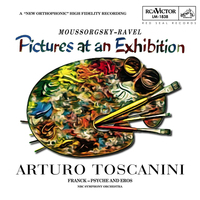 Pictures at an Exhibition - Psyche and Eros1954
 The Four Seasons2022Schumann & Brahms: Orchestral Works (Live)2021Symphony No. 9, Op. 125 "Choral"2020TOSCANINI conducts Richard Strauss (1938-46)2019The 1939 Beethoven Cycle, Volume 52019The 1939 Beethoven Cycle, Volume 22019The 1939 Beethoven Cycle, Volume 12019The 1939 Beethoven Cycle, Volume 62019The 1939 Beethoven Cycle, Volume 32019The 1939 Beethoven Cycle, Volume 42019Piano Concertos 1, 3 & 4: The Complete Live NBC Broadcast Recordings, 1944/19462019Elgar from America, Volume I2019Symphonies 1 & 22019Beethoven: Symphony no. 6 / Liszt: Hungarian Rhapsodies nos. 1, 2 & 3 / “Sounds of Nature”2019Milestones of a Legend: Guido Cantelli2018TOSCANINI conducts Contemporary Russian Music (1939-47)2018Symphony no. 7 “Leningrad”2018BERNSTEIN in the 1940s Volume 1: Blitzstein, Gillis, Ravel (1946)2018STOKOWSKI conducts British music at the NBC (1943/44)2018STOKOWSKI conducts Tchaikovsky (1944)2018Stokowski Conducts Beethoven Symphony no. 9 “Choral”2018Piano Concerto No. 4 in G, Op. 582017Brahms Symphonies 1‐42017TOSCANINI conducts American Music, Volume 22017Requiem in C minor2013Toscanini Conducts Wagner2013Bruno Walter - New York Philharmonic, NBC Symphony Orchestra2012Stravinsky: Symphony in C / Hindemith: Symphony in E-flat / Hartmann: Symphony no. 2 “Adagio” / Hansson: Symphony no. 4 “Requiem” / Harris: Symphony no. 7 / Hovhaness: Symphony no. 32011Requiem2010Hovhaness: Symphony no. 1 / Milhaud: Symphony no. 1 / Copland: Symphony no. 2 / Serebrier: Symphony no. 12009Beethoven: Symphony No.9 in D Minor, Op.125 “Choral”2007Piano Concerto No. 22007Tchaikovsky: Swan Lake (highlights) / Johann Strauss II: On the Beautiful Blue Danube, Tales from the Vienna Woods / Beethoven: Turkish March / Mozart: Turkish March2006Concerto per pianoforte e orchestra, op. 66 / Notturno / Novelletta / Tarantella2005Arturo Toscanini - All Debussy2004The Art Of Guido Cantelli: New York Concerts And Broadcasts, 1949-19522003The Rubinstein Collection, Volume 17: Piano Concertos Nos. 1 & 22001La mer / Nocturnes / Iberia / Prélude à l'après-midi d'un faune2001Great Conductors: Toscanini2000Beethoven, Brahms: Violin Concertos2000The 4 Symphonies1999Arturo Toscanini - Best Selection Vol. 10: Rossini’s Overtures1999Arturo Toscanini & NBC Symphony Orchestra, Vol. 7: Richard Wagner1999Arturo Toscanini Series Vol.V1999Mendelssohn: Violin Concerto / Wagner: Parsifal1998Symphony no. 7 / Septet1998Fidelio Overture / Symphonies Nos. 1 & 31998Symphony no. 9 "Choral" / Choral Fantasy for Piano and Orchestra1998Symphonies no. 5 / No. 6 "Pastoral" / Coriolan Overture1998Symphony No. 8 / Overtures1998Symphonies Nos. 2 and 4 / Overture: Leonore No. 31998Symphony No. 2 / Swan of Tuonela / Finlandia1998Piano Concerto no. 2 / Symphony no. 11998Otello1998Symphony no. 6 "Pathétique" / Piano Concerto no. 11998Beethoven: Piano Concerto No. 3, Overture Coriolanus / Wagner: Siegfried's Rhine Journey from Götterdämmerung1998Requiem1998Symphony no. 2 / Pohjola's Daughter / The Swan of Tuonela / Finlandia1997The Classical Repertoire: From Mozart to Gershwin1994Wagner - Tannhäuser • Götterdämmerung • Lohengrin1992Overtures1992Symphonies nos. 99 & 101 / Sinfonia Concertante1992Arturo Toscanini Collection, Volume 33: Harold en Italie / Romeo et Juliette (extraits)1992Symphony No. 1 / Serenade No. 21992An American in Paris / Grand Canyon Suite / Adagio1992Piano Concertos Nos. 1 & 41992Falstaff1991Manfred Symphony / Romeo & Juliet1991Symphonies nos. 5, 6, 7 & 81990Pini di Roma / Fontane di Roma / Feste Romane1990An der schönen, blauen Donau1990Symphonies Nos. 1 & 3 "Eroica"1990Symphonies Nos. 4 & 6 "Pastorale"1990Symphonies Nos. 5, 81990Symphony no. 4 / Liebeslieder-Walzer, op. 52 / Gesang der Parzen1990Dvorak: Symphony No. 9 / Kodaly: Hary Janos, Suite / Smetana: The Moldau1990Symphony No. 3 / Double Concerto1990Symphony No. 2 / Haydn Variations / Tragic Overture1990Concerto no. 1 per pianoforte, op. 23 / Sinfonia no. 6 "Patetica"1989G. Verdi: Requiem / L. v. Beethoven: Missa solemnis1988Die Walküre: Act I, Scene 3 / Ride of the Valkyries / Siegfried Idyll / Tristan und Isolde: Prelude and Liebestod1987Symphonies Nos. 2, 71986Symphonies no. 4 "Italy" & No. 5 "Reformation"1985The 100 Greatest Recordings Of All Time 49/50 : Favorite Waltzes and Overtures1980The 100 Greatest Recordings Of All Time 45/46 : Legendary Virtuoso Performances1978Rhapsody Liszt Enesco Stokowski1976Concerto for Violin and Cello In A Minor / Variations On a Theme By Haydn / Gesang Der Parzen1972Symphonie N° 9 en ré mineur Op.125 avec chœurs / Symphonie N° 1 en ut majeur Op.211954Symphony no. 21953Symphony no. 11952Concerto no. 2, in B-flat, op. 831951The Toscanini Collection: HighlightsSymphonies Nos. 39, 40 & 41Symphony No. 5Iberia / Prelude à l’après‐midi d’un faune / La MerBrahms: Piano Concerto no. 2 / Schubert / LisztMozart: Symphony No. 40 and No. 41 "Jupiter" / Vaughan Williams: Tallis FantasiaBeethoven - Concerto In D Major, Op. 61Toscanini Conducts Wagner
Singles
Noveletta / Romanza andaluza1948Dvorak Fifth Symphony (New World) Second Movement1947Symphony From Mathis der Maler / Che gelida manina1947Symphony From Mathis der Maler1947Symphony From Mathis der Maler1947Excerpts From Petrouchka / Rainbow’s End1947Souvenir of Florence1947Sunday in Brooklyn / Waltzes by Brahms1947Sunday in Brooklyn1947Firebird Suite1946Firebird Suite1946Fantasia for Double String Orchestra / Overture to a Fairy Tale1946First Movement of Symphony no. 2 in E minor1946First Movement of Symphony no. 2 in E minor / Espanharlem1946Classical Symphony in D major1945La gazza ladra: Overture1945Leonore Overture in C major1945Liebestod / Brünnhilde’s Immolation1945Swan of Tuonela1944Dance of the Soldiers / Minuet1944The Blue Danube1944The Moldau1944Zampa Overture1944Dance of the Hours1943Quartette From Rigoletto / O Don Fatale ‐ Don Carlos1943Garibaldi’s War Hymn / Stars and Stripes Forever1943Carmen / Le Carillon1943