Erik Satie
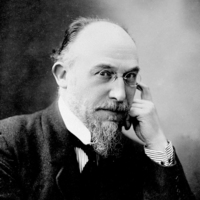
Eric Alfred Leslie Satie (17 May 1866 – 1 July 1925), known as Erik Satie, was a French composer and pianist. Born in Honfleur to a French father and a British mother, he studied at the Paris Conservatoire but did not complete his diploma. In the 1880s, he worked as a pianist in café-cabarets in Montmartre, Paris, and began composing works primarily for solo piano, including "Gymnopédies" and "Gnossiennes". He also wrote music for a Rosicrucian group with which he was briefly affiliated. After a period of limited compositional output, Satie enrolled at the Schola Cantorum in Paris as a mature student, where he found greater academic success than he had at the Conservatoire. Around 1910, he became an influential figure among younger composers drawn to his distinctive approach to music. He was associated with the group Les Six and collaborated with Jean Cocteau on the ballet "Parade" (1917), produced by Serge Diaghilev, with sets and costumes by Pablo Picasso and choreography by Léonide Massine. Satie's work contributed to a shift in French music away from post-Wagnerian and impressionist styles toward a more concise and restrained aesthetic. Composers such as Maurice Ravel, Claude Debussy, and Francis Poulenc acknowledged his influence, and later musicians including John Cage and John Adams have also cited him as an inspiration. His compositions often feature unresolved harmonies and unorthodox structures, such as the omission of bar-lines in pieces like the "Gnossiennes". His melodies are typically straightforward and sometimes reflect his interest in early sacred music. Some later works were given unconventional titles, including "Veritables Preludes flasques (pour un chien)" (1912), "Croquis et agaceries d'un gros bonhomme en bois" (1913), and "Sonatine bureaucratique" (1917). Although most of his compositions are short and written for solo piano, he also produced larger works such as the vocal piece "Socrate" (1919) and the ballets "Mercure" and "Relâche" (1924). Satie remained unmarried and lived in modest accommodation for most of his adult life, initially in Montmartre and later in Arcueil, a suburb of Paris. He was known for adopting various distinctive personal styles over time, including religious attire and matching velvet suits, and is often associated with a final persona characterised by conservative bourgeois dress. Satie was a heavy drinker throughout his life and died of liver cirrhosis at the age of 59.
Biography from Last.fm, available under CC BY-SA.
Country: FR
Deathdate: 1925-07-01
Disambiguation: French composer
Gender: Male
Is Living: No
Albums
 Piano Works / Songs2018
 Noriko Ogawa plays Erik Satie on an 1890 Erard piano, Vol. 12016
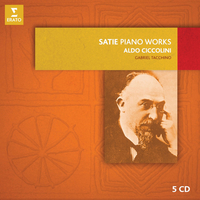 Piano Works2003
 Piano Works (selection)1989
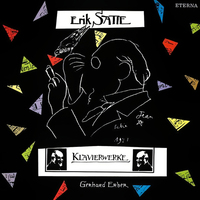 Klavierwerke1987
 Erik Satie - Le bel excentrique2025Satie: Discoveries2025The Unknown Music2025Classical for Sleep2025Satie2025Barber: Adagio - Orchestral Favourites2025The Prodigy Conductor2025Masters of the Harp: Volume II2024Impressions parisiennes2024Peaceful Classical: Piano2024Satie: The Piano Works2024Waves: Music by Satie2024Four Hands2024Wagner's Nightmare2024Pièces humoristiques, Nocturnes & Other Piano Works2024BBC Music, Volume 32, Number 2: Ballet Treasures2023The Music of Erik Satie2023Poems & Cabaret Music2023Art Works 1892–19242023Gymnopédies & Rare Works2023Le Piège de Méduse2022Petits chorales2022Fragments2022Vexations2022Noriko Ogawa Plays Erik Satie on an 1890 Erard Piano, Vol. 52022I’m Sitting in a Room With Satie2021Uspud / Messe des pauvres2021Esoteric Works: Ogives / Sonneries de la rose+croix / Préludes / Danses gothiques2021Landscapes: Satie2021Parade / Relâche / En habit de cheval / Gymnopédies 1 et 3 / 3e Gnossienne / La Belle Excentrique / 5 Grimaces pour “Le songe d’une nuit d’été” / Le Piccadilly2021Early Works: Sarabandes, Gnossiennes, Gymnopédies & Pièces froides2021French Music for Two Pianos: Poulenc; Debussy; Satie2021Noriko Ogawa Plays Erik Satie on an 1890 Erard Piano, Vol. 42021The Waltzes2021Piano Music2021Hélène Boschi : Portrait2021Time Zones2020Famous Piano Pieces2020Erik Satie: Selected Works II2020The Early Recordings2020Complete Piano Works, Vol. 4 (New Salabert Edition)2019Songs and Vexations20197 Gnossiennes2019Piano Trios2018Debussy: Préludes Book I / Satie: Gnossiennes, Gymnopédies2018Complete Piano Works, Vol. 3: New Salabert Edition2018Complete Piano Works • 22018Vexations2017Work & Study Classical Music2017Noriko Ogawa Plays Erik Satie on an 1890 Erard Piano, Vol. 22017Complete Piano Works • 12017Gnossiennes, Gymnopédies, Parade & Other Pieces2017BD Music Presents Erik Satie2016Early & Esoteric Works2016Works for Piano2016The Sound of Erik Satie2016Satie2016Complete Vexations 1–8402016Satie2016Socrate2016French Music for Piano - Four Hands2016Entremont conducts Satie2016Entremont - À la française2016Ravel: Histoires naturelles / Satie: Songs - Melodies2016The French Touch2016Music from France for Oboe and Orchestra20161900 - 1952: Music for 2 Pianos2016Soirée Française2016Complete Piano Music2016Erik Satie & Friends2016BBC Music, Volume 24, Number 6: French Piano Works2016Paris Joyeux & Triste / Piano Duets2016The Best of Erik Satie: Gymnopédie2015Nocturnes2015Rothko Chapel2015Mélodies et chansons2015Tout Satie! Erik Satie Complete Edition2015Du chat noir à la Rose + Croix2015Parade / Gymnopédie nos. 1 & 3 / Relâche2014Satie Slowly2014Parade / Gymnopédies / La Mort de Socrate / La Belle Excentrique / Trois morceaux en forme de poire2014Aki Takahashi plays Erik Satie 12014Satie: The Essential Collection2014Piano Works / Parade2013belle de nuit2012Essential Satie2012Erik Satie et autres messieurs : Airs de jeux2011ImproviSatie2011Satie for Two2011Complete Piano Works2010Le Fils des étoiles2010Tanguy: Sénèque, dernier jour - Satie: Socrate2010Erik Satie2009Musiikkia mestarin kynästä: Satie2009Gymnopédies / Gnossiennes / Parade2009