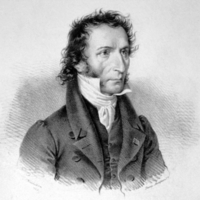
Niccolò Paganini
Niccolò Paganini was born in Genoa, Italy, on 27 October 1782, to Antonio and Teresa (née Bocciardo) Paganini. According to his biographer Peter Lichtenthal, Paganini first learned to play the mandolin from his father at the age of five, and quickly moved to the violin by the age of seven, and began composing before he turned eight. He gave his first public concert at the age of 12. In his early teens he studied under various teachers, including Giovanni Servetto and Alessandro Rolla, but he could not cope well with his success; at the age of 16 he was gambling and drinking. His career was saved by an unknown lady, who took him to her estate where he recovered and studied the violin for three years. He also played the guitar during this time. He reappeared when he was 23, becoming director of music to Napoleon's sister Elisa Baciocchi, Princess of Lucca, when he wasn't touring. He soon became a legend for his unparalleled mastery of the violin, with debuts in Milan in 1813, Vienna 1828, and both London and Paris in 1831. Paganini was one of the first musicians, if not the first, to tour as a solo artist, without supporting musicians. He became one of the first "superstars" of public concertizing. He made a fortune as a touring musician, and was uncanny in his ability to charm an audience. A pervading myth about Paganini is that he sold his soul to the Devil in exchange for his fearsome technique, a rumor which he delighted in and may have even started himself. During a performance his eyes would roll into the back of his head while playing, revealing the whites. His swaying stance, long unruly hair and thin, gaunt stature would add to this rumor. He played so intensely that women would faint and men would break out weeping. Paganini's only violin he ever owned is known as the Cannone Guarnerius violin, its name given by Paganini to reflect the "cannon" sound it produced. Its strings are nearly on the same plane, as opposed to most violins, the strings of which are distinctly arched to prevent accidentally bowing extra strings. The stringing of the Cannone may have allowed Paganini to play on three or even four strings at once. In Paris in 1833, he commissioned a viola concerto from Hector Berlioz, who produced Harold in Italy for him, but Paganini never played it. His health deteriorated due to cancer of the larynx. The disease caused him to lose the ability to speak, but he played his violin until his final hours. The last night before his death it is said he could be heard improvising wildly on his violin. He died in Nice on 27 May, 1840. He left behind a series of sonatas, caprices, 6 violin concerti, string quartets, and numerous guitar works. Niccolò PaganiniThe orchestral parts of Paganini's works are polite, unadventurous in scoring, and supportive. Critics of Paganini find his concerti long-winded and formulaic: one fast rondo finale could often be switched for another. During his public career, the violin parts of the concertos were kept secret. Paganini would rehearse his orchestra without ever playing the full violin solos. At his death, only two had been published. Paganini's heirs have cannily released his concertos one at a time, each given their second debut, over many years, at well-spaced intervals. There are now six published Paganini violin concerti (although the last two are missing their orchestral parts). His more intimate compositions for guitar and string instruments, particularly the violin, have yet to become part of the standard repertoire. Paganini developed the genre of concert variations for solo violin, characteristically taking a simple, apparently naïve theme, and alternating lyrical variations with a ruminative, improvisatory character that depended for effect on the warmth of his phrasing, with bravura extravagances that left his audiences gasping. The French violinist Ivry Gitlis once said, "Paganini is not a development ... there were all these [violinists before Paganini] and then there was Paganini." Though some of these violinistic techniques employed by Paganini were already present in his time, progress on violin technique was slow up to this point. Arcangelo Corelli (1653-1713) was considered the father of violin technique, transforming the role of the violin from a continuo instrument to a solo instrument. Johann Sebastian Bach (1685-1750), with his Sonatas and Partitas for solo violin (BWV 1001-1006) firmly established the polyphonic capability of the violin. The first exhaustive exploration of violin technique was found in the 24 caprices of Pietro Locatelli (1693-1746), which at the time of writing, proved to be too difficult to play (although they are now quite playable). Most accomplished violinists of the time focused on intonation and bowing techniques (the so-called right-hand techniques for string players), the two issues that are most fundamental and also critical for violinists. Paganini brought forth new techniques for violinists and composers. The writing of violin music was drastically changed through Paganini. His music often called for a wide range of advanced fingering and bowing techniques that proved sensational to audiences and challenging to colleagues of the period. His concert music often called for a combination of staccato, harmonics, pizzicato (on both hands), and wide musical intervals (as much as a major tenth). Paganini's composition was not considered truly polyphonic: (Eugène Ysaÿe once complained that the piano/orchestral accompaniment to Paganini's music was too "guitar like", lacking any character of polyphonism). Nevertheless, he expanded the timbre and colour of the instrument to levels previously unknown. Paganini was also a virtuoso guitarist, composing over 200 works for the instrument. Paganini was capable of playing three octaves across four strings in a hand span, a seemingly impossible feat even by today's standards. His flexibility may have been a result of Marfan syndrome or Ehlers-Danlos syndrome. His fingering techniques, such as harmonic double-stops, parallel octaves (and tenths), and left-hand pizzicato, were considered almost impossible in his day but are now routine exercises for aspiring violinists. Such leaps in the evolution of violin techniques are only paralleled by the likes of Josef Joachim, and Eugène Ysaÿe, almost half a century later. Paganini's 24th Caprice in A minor has been an object of interest for a number of composers. Franz Liszt, Johannes Brahms, Sergei Rachmaninoff, and Witold Lutoslawski, amongst others, wrote well-known variations on this theme.
Biography from Last.fm, available under CC BY-SA.
Country: IT
Deathdate: 1840-05-27
Disambiguation: Italian composer and violinist
Gender: Male
Is Living: No
Albums
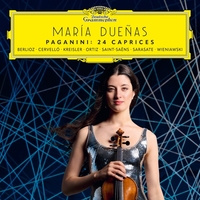 24 Caprices2025
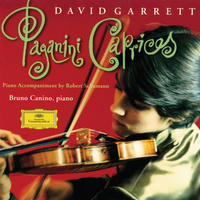 Paganini Caprices1997
 Dialogues: Contemporary & Classical Essentials2025Butterfly Lovers & Paganini2024Quartets for Strings and Guitar Nos. 11, 6 & 13202424 Caprices, op. 1 for Unaccompanied Flute2024Music for Violin & Strings2023Paganini: 24 Caprices for Solo Violin, Op. 12023Complete Quartets for String Trio and Guitar, Volume 12023Quartets for Strings and Guitar Nos. 5, 4 & 102023Chamber Music for Strings and Bassoon2022Quartets for Strings and Guitar nos. 7, 14 & 15202224+202124 Capricci, op. 12021Quartets for Strings and Guitar nos. 1, 2 & 9202124 Paganini Caprices2021String Quartet no. 3 / Three Duetti Concertanti202124 Caprices202124 Caprices2021Vivaldi / Paganini / Tartini2021Solo [Bach, Paganini, Ysaÿe], Volume. 12020Beethoven / Paganini / Stravinsky / Saint‐Saëns2020Paganini / Schubert2019Carnival2019Virtuosismo2019My Favourite Paganini2019Essentia2018BBC Music, Volume 27, Number 1: The Virtuoso Violin2018Nicolò Paganini Complete Edition2018KIMPOSSIBLE2018The Bel Canto Violin, Volume 62018The Bel Canto Violin, Volume 42018Beethoven: Concerto per violino e orchestra op. 61 / Paganini: Introduzione e variazioni per violino solo su un tema di Paisiello2018Sonatas for violin and guitar201824 Caprices201824 Caprices of Niccolo Paganini2018Carulli Giuliani Paganini2018Paganini at the Piano2018The New Paganini Project201824 Caprices2018Violin Concertos201724 Caprices2017Klassik überall...! Vol. 32017Paganini's Complete Caprices2017Bel canto Paganini: 24 Caprices and Other Works for Solo Violin201724 Caprices, op. 12016Music for Viola and Guitar2015Concertos for Violin and Orchestra I - VI2014Mister Paganini2013Paganini Fantasy2013Nathan Milstein Collection Vol. 22013Complete Violin Concertos2013Concertos, Sonatas and more...2013The Complete Classical Collection Volume 2: Sonata's2013Complete Guitar Music2013Live Performance - Chicago 19702012Great Violin Concertos2012Paganini L'Insolite (Paganini as you've never heard him)2012Paganini2012Berlioz: Harold in Italy / Paganini: Sonata per la Gran Viola e Orchestra2011Ghiribizzi: 43 Miniatures for Guitar2011Greig, Paganini, Bizet201024 Caprices2010Works for Solo Violin2010Сонаты И Каприсы2010Violinkonzerte2010Violin Concerto’s Nos. 1 & 22009Flying Solo2009Zigeneurweisen, Gypsy Airs200924 Caprices2009Niccolò Paganini - Violin Concertos nos. 1 & 22009Violin Concertos Nos. 1 & 2200924 Caprices for Solo Violin2009Violin Concertos Nos. 1 & 22008Cantabile200824 Capricci2007Capriccioso: Under the Blue Skies2007Violin Concertos 1 & 2 / 24 Caprices2007Musica per mandolino e chitarra del primo Ottocento2007The 37 Guitar Sonatas2007Great Violinists: Menuhin2006Paganini: Violinkonzert Nr. 4 / Suonata Varsavia / Leitner: Konzertstück200624 Caprices Op. 1 (arr. for Saxophone by Raaf Hekkema)2006Arthur Grumiaux interpreta Paganini y Mendelssohn: 2 conciertos para violín y orquesta2006Paganini: Violin Concerto no. 1 / Spohr: Violin Concerto no. 82006Bach, Paganini, Massenet2005Violin Showpieces2005Paganini: Complete Works for Guitar and Violin2004Pavel Šporcl & Paganini2004William Primrose: The Early Recordings, Violin and Viola2004Kreisler / Sarasate / Paganini / Wieniawski2004Konzerte für Violine und Orchester II & IV2004Itzhak Perlman reDiscovered: Violin Sonatas2004Violin Concertos (flute versions)2003Sonatas for Violin and Guitar2003Concertos no. 1 in E-flat major - no. 2 in B minor2003Grand Concerto in E minor - Concerto No. 4 in D minor200324 Capricci, op. 12003The 24 Caprices2003Violin Concertos2002
Others
Minuets for Solo Guitar (Rem Khabibullin)200724 Capricci per violino solo24 Caprices24 Caprices for Solo ViolinPaganini: Violin Concerto No. 1 / "Mosè" Variations / "La campanella" / Moto perpetuo / 6 CapricesGuitar Music: Sonatas / Ghiribizzi / Three Caprices24 Capricci24 CapricesThe Best of PaganiniAn Evening of PaganiniPaganini - The 24 Caprices for Electric GuitarViolin MusicL'alto lyriqueConcerto pour violon no. 1 - La Campanella, Moto Perpetuo, Cantabile, Variations