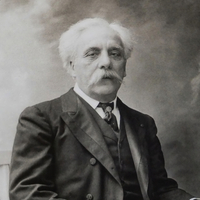
Gabriel Fauré
Gabriel Urbain Fauré (12 May 1845 – 4 November 1924) was a French composer, often seen as a transitional figure between the Romantic period and Impressionism. In contrast with his harmonic and melodic style, which pushed the bounds for his time, Fauré’s rhythmic motives tended to be subtle and repetitive, with little to break the flow of the line, although he did utilize subtle large scale syncopations, similar to those found in the works of Johannes Brahms. Aaron Copland referred to him as the ‘French Brahms’. Fauré’s piano works often use arpeggiated figures with the melody interspersed between the two hands, and include finger substitutions natural for organists. These aspects make them daunting for some pianists, but they are nonetheless central works. Fauré was born in Pamiers, Ariège, Midi-Pyrénées, France, to Toussaint-Honoré Fauré and Marie-Antoinette-Hélène Lalène-Laprade. Fauré was sent to live with a foster-nurse for four years. At the age of nine he was sent to study at the École Niedermeyer, a school which prepared church organists and choir directors in Paris, and continued there for eleven years. He studied with several prominent French musicians, including Camille Saint-Saëns, who introduced him to the music of several contemporary composers, including Robert Schumann and Franz Liszt. In 1870, Fauré enlisted in the army and took part in the action to raise the Siege of Paris during the Franco-Prussian War. During the Paris Commune he stayed at Rambouillet and in Switzerland, where he taught at the transported École Niedermeyer. When he returned to Paris in October of 1871, he was appointed assistant organist at Saint-Sulpice as accompanist to the choir, and became a regular at Saint-Saëns' salon. Here he met many prominent Parisian musicians and with those he met there and at the salon of Pauline Garcia-Viardot he formed the Société Nationale de Musique. In 1874, Fauré stopped working at Saint-Sulpice and began to fill in at the Église de la Madeleine for Saint-Saëns during his many absences. When Saint-Saëns retired in 1877, Fauré became choirmaster. In the same year he became engaged to Marianne Viardot, daughter of Pauline, but the engagement was later broken off by Marianne. Following this disappointment he travelled to Weimar, where he met Liszt, and Cologne in order to see productions of Richard Wagner's Der Ring des Nibelungen. Fauré admired Wagner, but was one of few composers of his generation not to come under his influence. In 1883, Fauré married Marie Fremiet, with whom he had two sons. In order to support his family Fauré spent most of his time in organising daily services at the Église de la Madeleine and teaching piano and harmony lessons. He only had time to compose during the summers. He earned almost no money from his compositions because his publisher bought them, copyright and all, for 50 francs each. During this period Gabriel Fauré wrote several large scale works, in addition to many piano pieces and songs, but he destroyed many of them after a few performances, only retaining a few movements in order to re-use motives. During his youth Fauré was very cheerful, but his broken engagement combined with his perceived lack of musical success led to bouts of depression which he described as "spleen". In the 1890s, however, his fortunes reversed somewhat. He had a successful trip to Venice where he met with friends and wrote several works. In 1892, he became the inspector of the music conservatories in the French provinces, which meant he no longer had to teach amateur students. In 1896, he finally became chief organist at the Église de la Madeleine, and also succeeded Jules Massenet as composition instructor at the Conservatoire de Paris. At this post he taught many important French composers, including Maurice Ravel and Nadia Boulanger. From 1903 to 1921, Fauré was a critic for Le Figaro. In 1905, he succeeded Théodore Dubois as director of the Paris Conservatory. He made many changes at the Conservatoire, leading to the resignation of a number of faculty members. This position meant that he was better off in terms of income, and he also became much more widely known as a composer. Fauré was elected to the Institut de France in 1909, but at the same time he broke with the old stodgy Société Nationale de Musique, and supported the rogue group which formed out of those ejected from the Société which was mainly comprised of his own students. During this time Fauré developed ear trouble and gradually lost his hearing. Sound not only became fainter, but it was also distorted, so that pitches on the low and high ends of his hearing sounded like other pitches. He made efforts to conceal his difficulty, but was eventually forced to abandon his teaching position. His responsibilities at the Conservatoire, combined with his hearing loss, meant that Fauré's output was greatly reduced during this period. During World War I Fauré remained in France. In 1920, at the age of 75, he retired from the Conservatoire mainly due to his increasing deafness. In this year he also received the Grand-Croix of the Légion d'Honneur, an honor rare for a musician. He suffered from poor health, partially brought on by heavy smoking. Despite this, he remained available to young composers, including members of Les Six, who were devoted to him. Gabriel Fauré died in Paris from pneumonia in 1924. He was given a state funeral at the Église de la Madeleine and is buried in the Cimetière de Passy in Paris. Music Overview Gabriel Fauré is regarded as the master of the French art song, or mélodie. His works ranged from Classical, when in his early years he emulated the style of Haydn and Mendelssohn, to Romantic, and finally to an ascetic 20th century aesthetic. His work was based on a strong understanding of harmonic structures which he received at the École Niedermeyer from his harmony teacher Gustave Lefèvre, who wrote the book Traité d'harmonie (Paris, 1889). In this book he sets forth a harmonic theory which differs significantly from the classical theory of Jean-Philippe Rameau in that seventh and ninth chords are no longer considered dissonant, and the mediant can be altered without changing the mode. In addition, Fauré's understanding of the church modes can be seen in various modal passages in his works, especially in his melodies. Notable works Fauré was a prolific composer, and among the most noteworthy of his works are his Requiem, the opera Penelope, the orchestral suite Masques et Bergamasques (based on music for a dramatic entertainment, or divertissement comique), and music for Pelléas et Mélisande. He also wrote chamber music; his two piano quartets are particularly well known. Other chamber music includes two piano quintets, two cello sonatas, two violin sonatas, and a number of piano pieces including the Nocturnes. He is also known for his songs, such as Après un rêve, Les roses d'Ispahan, En prière, and several song cycles, including La Bonne Chanson with settings of poems by Verlaine, and L'horizon chimérique. The Requiem, Op. 48, was not composed to the memory of a specific person but, in Fauré's words, "for the pleasure of it". It was first performed in 1888. Fauré is thought not to have had strong religious beliefs. It has been described as "a lullaby of death". In setting his requiem, he left out the Dies irae, though the reference to the day of judgment appears in the Libera me, which he added to the normal requiem mass. Several slightly different versions of the Requiem exist, and these have given rise to a number of different recordings. Personal grief may have influenced the composition as it was started after the death of his father, and before it was completed, his mother died as well. The Requiem can thus be seen as an expression of Fauré's personal tragedy written after the death of his parents. The Requiem is also acknowledged as a source of inspiration for the similar setting by Maurice Duruflé. His music is used in "Act I: Emeralds" of George Balanchine's ballet Jewels (1967).
Biography from Last.fm, available under CC BY-SA.
Country: FR
Deathdate: 1924-11-04
Disambiguation: French composer
Gender: Male
Is Living: No
Albums
 String Quartets2025Romances tardives2025Samsara2025Masques et bergamasques / Thème et variations / Caligula / Les Djinns2025La Bonne Chanson & Other Songs2025Pelléas et Mélisande - Suite / Prométhée (excerpts) / Shylock Suite / Songs2025Dialogues: Contemporary & Classical Essentials2025Liebestraum - Scarlatti, Liszt, Fauré, Tournier2024Élégie2024Notturno2024Gabriel Faure: Requiem (1888)2024Violin Concerto / Pénélope: Prélude / Berceuse / Élégie2024Mélodies; Le jardin clos / Mirages / L’horizon chimérique…2024Franck: Symphony in D minor / Fauré: Pelléas et Mélisande2024Chamber Music2024Nocturnes2024Fauré and Friends2024Impressions parisiennes2024Nocturnes & Barcarolles2024Fauré: Requiem / Gounod: Messe de Clovis2024Melodies and Choral Music2024Complete Works for Cello and Piano2024Pelléas et Mélisande2024Fauré: Ballade op. 19 / Fantaisie op. 111 Poulenc: Piano Concerto / Aubade2024The Complete Works2024Complete Works for Cello and Piano2024Gabriel Fauré2024Élégie & Cello Sonatas2024La Bonne Chanson / L'Horizon chimérique / Ballade / Mélodies2024In memoriam: Françoise Groben, Vol. 22024Four Hands2024Fauré: Complete Music for Solo Piano2024Debussy, Ravel & Fauré2024Boulanger, Fauré, Hahn2024Saint‐Saëns: Cello Concerto no. 1 – Franck, Fauré & Poulenc (Bonus Track Version)2023French Melodies2023Fauré: The Music for Cello and Piano2023Trio avec piano / Dolly / Sonate pour violoncelle et piano n° 2 / Sonate pour violon et piano n° 22023Nocturnes & Barcarolles2023Alter Ego: Music for Flute and Piano by Respighi, Fauré & Franck2023La Bonne Chanson op. 61 / Quatuor avec piano op. 1520231883 - R. Strauss, Grieg & Fauré2023BBC Music, Volume 31, Number 9: Songs of the Night2023Saint-Saëns, Fauré & Franck2023Impromptus2023The French Album2022The Aldeburgh Recital: Schumann, Schubert & Fauré202213 Barcarolles / Ballade op. 192022Complete Songs2022Horizons II2022Mélodies – Musical Backing Tracks for Classical Singers2022Mirages: The Art of French Song2022Récital de Harpe2022French Violin Sonatas2021Works for Cello & Piano2021…Le temps perdu…2021Four Visions of France2021The Complete Songs of Fauré, Vol. 42021Violin Sonatas nos. 1 & 22021Beethoven / Liszt / Viñes / Fauré / Ravel2021Violin Sonatas and Other Works2021Works for Violin & Piano2021Piano Quartets, op. 15 & op. 452021Cello Sonatas2020Fauré et ses poètes2020Franck: Prélude, Choral et Fugue / Fauré: Nocturnes nos. 2 & 4 / Impromptu no. 22020Piano Quartet no. 1 in C major / Nocturne no. 6 / Impromptu no. 22020Fantasque: French Violin Sonatas2020The Secret Fauré III: Sacred Vocal Works / Requiem2020In paradisum: A Fauré Recital, Volume 22020Complete Nocturnes2020Violin Sonatas2019Poèmes d'un jour2019Complete Piano Quartets2019The Secret Fauré II: Orchestral and Concertante Music2019The New York Concert2019BBC Music, Volume 27, Number 8: Panis Angelicus2019Essence2019Nocturnes2019Casadesus: 3 Danses méditerranéennes / Chabrier: 3 Valses romantiques / Fauré: Dolly Suite (Remastered)2019Songs and Vexations2019Fauré: Requiem / Poulenc: Figure humaine / Debussy: Trois chansons2019Solo2019Fauré / Debussy / Szymanowski / Chopin2019Sonates pour piano & violon2019Kennst du das Land… Lieder bearbeitet für Chor & Klavier2019Piano Trios2018Requiem2018Requiem / Messe basse / Cantique de Jean Racine / Ave Maria2018Fauré : Les Indispensables de Diapason2018The Secret Fauré: Orchestral Songs & Suites2018Clair de lune2018La Harpe consolatrice2018Reflets2018French Moments2018Fauré / Ravel / Tailleferre2018Illuminations201813 Barcarolles2018Visages impressionnistes2018Clair de Lune2018
Singles
Others
Pavane in F-sharp minor, for orchestra and chorus, Op. 502007Nocturne no. 4 in E-flat major, op. 362007Requiem, op. 482006Piano Quartet no. 1 in C minor, op. 15The Two Quartets for Piano & StringsMusic for Cello and PianoAirs françaisRequiem / Nocturne pour piano no. 6 / Quatuor à cordesAppassionatoFaure: Requiem / Wissink: Psaume 121 / Non invenientes Jesum / Ave MariaPiano Quintets