
Alban Berg
Alban Maria Johannes Berg (February 9, 1885 - December 24, 1935) was an Austrian composer. He was a member of the Second Viennese School along with Arnold Schoenberg and Anton Webern, producing works that combined Mahlerian romanticism with a highly personal adaptation of Schoenberg's twelve-tone technique. Berg was born in Vienna, the third of four children of Johanna and Conrad Berg. His family lived comfortably until the death of his father in 1900. He was more interested in literature than music as a child and did not begin to compose until he was fifteen, when he started to teach himself music. In late February or early March 1902 he fathered a child with Marie Scheuchl, a servant girl in the Berg family household. His daughter, Albine, was born on December 4, 1902.[1] Berg had little formal music education before he became a student of Arnold Schoenberg in October 1904. With Schoenberg he studied counterpoint, music theory, and harmony. By 1906, he was studying music full-time; by 1907, he began composition lessons. His student compositions included five drafts for piano sonatas. He also wrote songs, including his Seven Early Songs (Sieben frühe Lieder), three of which were Berg's first publicly performed work in a concert that featured the music of Schoenberg's pupils in Vienna that year. The early sonata sketches eventually culminated in Berg's Piano Sonata (Op. 1) (1907–1908); it is one of the most formidable "first" works ever written (Lauder, 1986). Berg studied with Schoenberg for six years until 1911. Berg admired him as a composer and mentor, and they remained close lifelong friends. Berg may have seen the older composer as a father figure, as Berg's father had died when he was only 15. Among Schoenberg's teaching was the idea that the unity of a musical composition depends upon all its aspects being derived from a single basic idea; this idea was later known as developing variation. Berg passed this on to his students, one of whom, Theodor Adorno, stated: "The main principle he conveyed was that of variation: everything was supposed to develop out of something else and yet be intrinsically different".[citation needed] The Piano Sonata is an example—the whole composition is derived from the work's opening quartal gesture and its opening phrase. Berg was a part of Vienna's cultural elite during the heady fin de siècle period. His circle included the musicians Alexander von Zemlinsky and Franz Schreker, the painter Gustav Klimt, the writer and satirist Karl Kraus, the architect Adolf Loos, and the poet Peter Altenberg. In 1906, Berg met the singer Helene Nahowski, daughter of a wealthy family (said by some to be in fact the illegitimate daughter of Emperor Franz Joseph I of Austria from his liaison with Anna Nahowski)[2]; despite the outward hostility of her family, the two were married on May 3, 1911. In 1913, two of Berg's Five Songs on Picture Postcard Texts by Peter Altenberg (1912) were premièred in Vienna, conducted by Schoenberg. Settings of aphoristic utterances, the songs are accompanied by a very large orchestra. The performance caused a riot, and had to be halted; the work was not performed in full until 1952 (and its full score remained unpublished until 1966). From 1915 to 1918, Berg served in the Austrian Army and during a period of leave in 1917 he began work on his first opera, Wozzeck. After the end of World War I, he settled again in Vienna where he taught private pupils. He also helped Schoenberg run his Society for Private Musical Performances, which sought to create the ideal environment for the exploration and appreciation of unfamiliar new music by means of open rehearsals, repeat performances, and the exclusion of professional critics. Three excerpts from Wozzeck were performed in 1924, and this brought Berg his first public success. The opera, which Berg completed in 1922, was not performed in its entirety until December 14, 1925, when Erich Kleiber directed a performance in Berlin. Today Wozzeck is seen as one of Berg's most important works. Berg completed only the first two acts of his later opera, the critically acclaimed Lulu, before he died. Berg's best-known piece is his elegiac Violin Concerto. Like much of his mature work, it employs a personal adaptation of Schoenberg's twelve tone technique that enables the composer to combine frank atonality with passages that use more traditional tonal harmonies; additionally, Berg incorporates quotations from historical tonal music, including a Bach chorale and a Carinthian folk song. The Violin Concerto was dedicated to Manon, the deceased daughter of architect Walter Gropius and Alma Schindler. Other well known Berg compositions include the Lyric Suite (seemingly a significant influence on the String Quartet No. 3 of Béla Bartók[citation needed]), Three Pieces for Orchestra and the Chamber Concerto for violin, piano and 13 wind instruments. Berg died in Vienna, on Christmas Eve 1935, apparently from blood poisoning caused by an insect bite. He was 50 years old. Douglas Jarman writes in the New Grove: "As the 20th century closed, the 'backward-looking' Berg suddenly came as Perle remarked, to look like its most forward-looking composer."[3]
Biography from Last.fm, available under CC BY-SA.
Country: AT
Deathdate: 1935-12-24
Disambiguation: Austrian composer
Gender: Male
Is Living: No
Albums
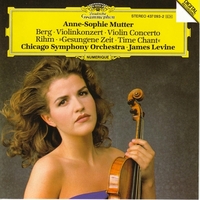 Berg: Violinkonzert / Rihm: "Gesungene Zeit"1992
 Suk: Fantazie g moll pro housle a orchestr / Berg: Koncert pro housle a orchestr1965
 Vienna 1908-19142025Piano Works2024Berg / Brahms / Poulenc / Schumann2024Sylvain Cambreling conducts2023Infinite Voyage2023Viennese Romance2023Transfigurations2023Sehnsucht2022Violin Concertos2022Lieder Der Neuen Wiener Schule / Songs Of The New Vienna School2022Berg: String Quartet Op. 3 / Webern: Langsamer Satz / Schoenberg: String Quartet No. 2, Op. 102022Violin Concerto / Three Orchestral Pieces / Piano Sonata / Passacaglia2022Lieder2022Bach, Berg, Schoenberg, Webern2022From the Early 20th, Vol. 22021Violin Concertos2021Wagner: Wesendonck-Lieder / Berg: Sieben frühe Lieder / Mahler: Rückert Lieder2021Beethoven - Berg - Boulez2021Clair-Obscur2021Violin Concerto / Seven Early Songs / Three Pieces for Orchestra, op. 62021Berg / Medtner / Janáček / Schubert2020Vienna 1905-19102020Bach, Brahms, Berg2020The Wanderer2020Concerto « A la mémoire d'un ange » / Trois pièces pour orchestre op. 6 / Wozzeck (extraits)2020Berg / Webern / Schreker2020Clytemnestra2020Michael Gielen Edition, Vol. 8 (1954-2013)2019Berg: Lyric Suite / Schubert: Death and the Maiden2019Liaison2018Perspectives 72018Brahms the Progressive2018Schumann / Reinecke / Debussy / Berg / Corigliano2018Berg & Brahms2017Liederabend2017Awakening2017Piano Works2017Wozzeck2017Towards Verklärte Nacht2016Schoenberg, Berg, Webern: Complete Works for String Quartet2016Nocturnal Variations2016Modern Times2016Chamber Music2015Piano – 20th Century2015Fiðlukonsertar2015Berg: Lyric Suite / Wellesz: Sonnets by Elizabeth Barrett Browning, op. 522015Schumann: Liederkreis / Frauenliebe und Leben / Berg: Sieben frühe Lieder2015Concord2015Fin de siècle2014Mendelssohn: Quartet, op. 13 / Berg: Lyric Suite2014Sonatenabend2014Schostakowitsch: Symphonie Nr. 5 / Berg: Violinkonzert2014Lieder2014Berg: Lyrische Suite / Schoenberg: Verklärte Nacht20141930s Violin Concertos, Vol. 12014Concerto "À la mémoire d'un ange" / Kammerkonzert (mono version)2014Strauss, Fauré, Debussy, Poulenc, Wolf & Berg - Wigmore Hall Live2013Berg: Violin Concerto / Bartók: Rhapsody no. 2 / Violin Concerto no. 22013Berg: Drei Orchesterstücke / Schönberg: Pelleas und Melisande2013No. 32013Amoroso2013Mahler: Das klagende Lied / Berg: Lulu‐Suite2013Schumann: Dichterliebe / Berg: Sieben frühe Lieder2013Violin Concertos2012The Legacy of Mahler2012Violin Concertos2012Bach / Berg / Brahms2011The Liszt Project2011Schubert: String Quartet, D887 / Berg: String Quartet, op. 32011The String Quartet and the Voice2011Schoenberg: Erwartung / Berg: Lulu Suite2011Tief in der Nacht2010Glenn Gould: Bach / Beethoven / Schönberg / Webern / Berg2010Stravinsky: The Soldier's Tale, Octet, Pastorale, Ragtime, Septet, Concertino / Schoenberg: Chamber Symphony no. 1 / Berg: Adagio2010Passion & Pain: Adams, Haydn & Schubert2010Orchesterwerke2009Violinkonzerte2009Zemlinsky: Lyric Symphony / Berg: Three Pieces From the Lyric Suite2009Orchestral Works2009Mozart: "Gran Partita" / Berg: Kammerkonzert2008Berg / Schoenberg / Webern2008Schönberg: Streichquartett Nr. 2 / Webern: Langsamer Satz / Berg: Die geheime Gesangstimme2008Beethoven: Fidelio Overture / Schubert: Symphony no. 9 "The Great" / Berg: Three Scenes from Wozzeck2008Vaughan Williams: Symphony no. 6 / Fantasia on a Theme by Thomas Tallis / Hadley: One Morning in Spring / Bax: Mediterranean / Berg: Lyric Suite200820th Century Piano Sonatas2007Berg: String Quartet / Lyric Suite / Wolf: Italian Serenade2007Berg: Vier Stücke / Fromm-Michaels: Stimmungen eines Fauns / Messiaen: Abîme des oiseaux / Schumann: Fantasiestücke / von Weber: Grand Duo Concertant2007Los clásicos de la Ópera, No. 23: Wozzeck (Orquesta Filarmónica de Nueva York feat. conductor: Dimitri Mitropoulos)2007Tippett: Concerto for Double String Orchestra / Berg: Violin Concerto / Janáček: Sinfonietta2007Shura Cherkassky2007Gielen: Pflicht und Neigung / Schönberg: Die glückliche Hand, op. 182007Songs by Sibelius, Strauss and Berg2006Arpeggione Sonata2006Music of the Viennese School2006Fantasies & Dream Figures2006Lulu2006Mahler: Symphony No. 4 / Berg: Sieben Frühe Lieder2005Complete Works for Piano2005
EPs
Others
Piano Sonata in B Minor Op. 12006Ives: Quarta Sinfonia / Berg: Der WeinWozzeck2009-10-12: Théâtre des Champs-Elysées, Paris, FranceFrühe KlaviermusikSieben frühe Lieder / Der Wein / An Leukon / Schließe mir die Augen beideGlenn Gould 10 CD SetConcerto For Violin And Orchestra, "A La Mémoire D'Un Ange" / Chamber Concerto For Violin / Piano And 13 Wind InstrumentsViolin Concertos