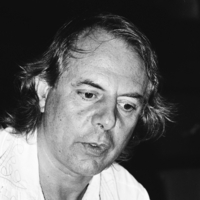
Karlheinz Stockhausen
Karlheinz Stockhausen (August 22, 1928 - December 5, 2007) was a German composer, widely acknowledged by critics as one of the most important but also controversial composers of the 20th and early 21st centuries. He is known for his ground-breaking work in electronic music, aleatory (controlled chance) in serial composition, and musical spatialization. He was educated at the Hochschule für Musik Köln and the University of Cologne, and later studied with Olivier Messiaen in Paris, and with Werner Meyer-Eppler at the University of Bonn. One of the leading figures of the Darmstadt School, his compositions and theories were and remain widely influential, not only on composers of art music, but also on jazz and popular-music artists. His works, composed over a period of nearly sixty years, eschew traditional forms. In addition to electronic music—both with and without live performers—they range from miniatures for musical boxes through works for solo instruments, songs, chamber music, choral and orchestral music, to a cycle of seven full-length operas. His theoretical and other writings comprise ten large volumes. He received numerous prizes and distinctions for his compositions, recordings, and for the scores produced by his publishing company. Some of his notable compositions include the series of nineteen Klavierstücke (Piano Pieces), Kontra-Punkte for ten instruments, the electronic/musique-concrète Gesang der Jünglinge, Gruppen for three orchestras, the percussion solo Zyklus, Kontakte, the cantata Momente, the live-electronic Mikrophonie I, Hymnen, Stimmung for six vocalists, Aus den sieben Tagen, Mantra for two pianos and electronics, Tierkreis, Inori for soloists and orchestra, and the gigantic opera cycle Licht. As an orphaned teenager, Stockhausen experienced true horror and carnage on active service near the end of WWII. He then went on to redefine contemporary music: from Kreuzspiel, the early electronic Kontakte, the intuitive works, the hour-long a-capella Stimmung, to the Licht cycle of seven operas. His influence is widely felt, even in unexpected places within the world of popular music. After dealing first-hand with the victims of conflict and allied bombing out in the field and in the hospital, he began his post-war musical studies in Europe. He had thoughts of being a writer, and did a stint as a travelling magician's pianist. This life gave way in the early-1950s to the project of redesigning music, from the bottom-up, on his own terms. Melody, regular rhythm, and literal repetition were not to be found, while fearsome serial structures (and philosophical paradigms) underpinned the sparsest surface texture. Stockhausen's frequent cosmic flights of philosophical and moral fancy are important to his works. The sharp practicality of his musical thinking is in its own league among post-war composers. By the mid-50s Stockhausen was enjoying huge success as leader of the avant garde. Dedicated festivals soon sprung up around the globe, and they continue. For some though, even now, this is one musical emperor who walks unclothed. Recommended for starters may be: the electronic Telemusik, all the early chamber pieces, the erotic ode Stimmung (arguably the finest of all takes on mimimalism), Mantra for two pianos, the epic Hymnen, Trans, Gruppen (for 3 orchestras), Carré (for 4 orchestras and choirs), Unsichtbare Chöre, Mixtur. From 1975 on, his work was centred around the opera cycle, Licht. He may be at his best in quiet moods, but the unprecedented live Stockhausen sound-happening, with overwhelming sonic swirlings in all directions, is something everyone should try at least once before they leave the planet. The composer has issued nearly all of his music on his own label.
Biography from Last.fm, available under CC BY-SA.
Country: DE
Deathdate: 2007-12-05
Disambiguation: composer
Gender: Male
Is Living: No
Albums
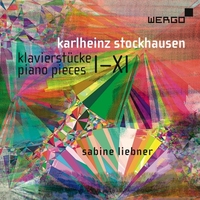 Klavierstücke I-XI2018
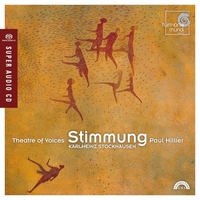 Stimmung2007
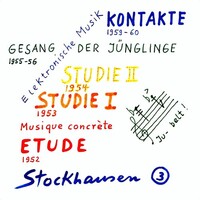 Elektronische Musik 1952–19601991
 Hymnen1969
 Tierkreis (1975): 12 Melodies of The Star Signs2024Mantra2021Tierkreis for Saxophone and Electronics2020Unbegrenzt2020Les Espaces Électroacoustiques Vol. 22019Running Back Mastermix: Front2018Gesang der Jünlinge2018Kurzwellen2018Chopin: Etudes, op. 10 / Scriabin: Late Works, opp. 70-74 / Stockhausen: Klavierstück IX2018Light2016Aus den sieben Tagen2016IN FREUNDSCHAFT – LINKER AUGENTANZ – TAURUS‐QUINTETT – KAMEL‐TANZ – ROTARY‐Bläserquintett2015MIXTUR 20032015[R]evolution: Stockhausen: 8 Klavierstück / Beffa: Suite / Stravinsky: Trois mouvements de Petrouchka2015EXPO für 32014IN FREUNDSCHAFT2014Amour / Der Kleine Harlekin / Wochenkreis2013MICHAELION2013Tierkreis2013IN FREUNDSCHAFT2012POLE für 2201212 x 12 - A Musical Zodiac (Tierkreis - Ars Nova - Ars Subtilior)2012Karlheinz Stockhausen2011HOFFNUNG und GLANZ: 9. und 10. Stunde von KLANG2011Harlekin2010Mantra2010New Directions in Music2010JERUSEM: 18. Stunde aus KLANG2010ORVONTON: 15. Stunde aus KLANG2010HARMONIEN und SCHÖNHEIT: 5. und 6. Stunde aus KLANG2010UVERSA: 16. Stunde aus KLANG2010BALANCE und GLÜCK: 7. und 8. Stunde aus KLANG2010TREUE und ERWACHEN: 11. Stunde und 12. Stunde aus KLANG2010JUBILÄUM für Orchester / TIERKREIS: Zehn Sternzeichen für Orchester / TIERKREIS für das historische Glockenspiel des Kölner Rathauses2010NEBADON: 17. Stunde aus KLANG2010PARADIES: 21. Stunde aus KLANG2009HAVONA: 14. Stunde aus KLANG2009EDENTIA: 20. Stunde aus KLANG2009Adventures in Sound2009Kontra-Punkte / Refrain / Zeitmasze / Schlagtrio2009Spiral / Pole / Japan / Zyklus / Tierkreis2009Tierkreis2008URANTIA: 19. Stunde aus KLANG2008Percussion Masterpieces2008Tierkreis2007Bass Clarinet & Piano2007Natürliche Dauern (2005-06, 3. Stunde aus KLANG, Die 24 Stunden des Tages)2007Cosmic Pulses2007HIMMELS‐TÜR – 24 TÜRIN (4. Stunde aus KLANG)2006Gruppen, Punkte2006Himmelfahrt (2004-05) Version für Synthesizer, Sopran und Tenor (1. Stunde aus KLANG, Die 24 Stunden des Tages)2006Freude (2. Stunde aus KLANG, Die 24 Stunden des Tages)2006Eötvös Conducts Stockhausen2006Für kommende Zeiten2005DÜFTE–ZEICHEN2004Zyklus (Four Realizations by Max Neuhaus)2004Tierkreis: 12 Melodien der Sternzeichen2003FREITAG aus LICHT2003Stockhausen 64 - Europa-Gruss / Stop und Start / Two Couples / Electronic and Concrete Music for Komet / Licht-Ruf2002Bassoon XX2002CHÖRE für DORIS / CHORAL / DREI LIEDER / SONATINE / KREUZSPIEL2002PAARE vom FREITAG, mit Sopran, Baß, elektronischen Instrumenten (1992/1999)2000BASSETSU‐TRIO – MITTWOCHS‐ABSCHIED20003× REFRAIN 20002000Zyklus, Kontakte, Klavierstücke V & IX2000Helikopter-quartett2000Litanei 97/Kurzwellen (world première Radio Bremen, 1968)2000Klavierstücke I-XIV2000Lichter - Wasser2000Piano Music of the Darmstadt School, Vol. 12000Piano Music1999new dimension music1999Helikopter-StreichQuartett1999Mantra1999Pupils of Messiaen: A Cappella Works by Messiaen, Stockhausen and Xenakis1999HYMNEN (Dritte Region): Elektronische Musik mit Orchester1997Musik für Posaune und Euphonium1997Orchester-Finalisten (vom Mittwoch aus LICHT)1997Kontakte1997Kurtág: Grabstein für Stephan, Op. 15c / Stele, Op. 33 / Stockhausen: Gruppen1996DIENSTAG aus LICHT1996Aus Den Sieben Tagen1996Spiral1996Klavierstücke I-XI1996Solo (Flöte) / Solo (Synthesizer) / Spiral1995Mantra (Andreas Grau, Gotz Schumacher)1995Stockhausen Edition, no. 11: Prozession / Ceylon1995Stockhausen Edition, no. 9: Mikrophonie I / Mikrophonie II / Telemusik1995Stockhausen Edition, no. 10: Hymnen1995Musik für Klarinette, Baßklarinette, Bassetthorn mit Suzanne Stepehns1994ARIES für Trompete und Elektronische Musik – KLAVIERSTÜCK ⅩⅢ (LUZIFERs TRAUM aus Klaviersolo)1994GEBURTSFEST (1987): Chormusik mit Tonszenen, vom MONTAG aus LICHT (Version von EVAs ERSTGEBURT für Chor a cappella und Tonband)1994Musik für Trompete, Piccolo‐Trompete, Flügelhorn, gespielt von Markus Stockhausen1994Oktophonie1994Geburts-Arien / Mädchenprozession199420th Century Music for Unaccompanied Clarinet1994
Others
Klavierstücke I-XILuzifer's Zorn / Die 7 Lieder Der Tage / Der KinderfängerMikrophonie I - Mikrophonie IISolo‐SYNTHI‐FOU: Synthesizer‐Solo zum Studium (nicht für Aufführungen) – SYNTHI‐FOU (oder KLAVIERSTÜCK ⅩⅤ) für einen Synthesizer‐Spieler und Elektronische Musik – DIENSTAGS‐ABSCHIED (JENSEITS – SYNTHPunktuelle Musik 1952 / Gruppen-Komposition 1952/55: 2 LesungenOrientierung 1952–53 / Elektronische Musik 1953: 2 VorträgeKlangkomposition 1953: LesungStatische Form 1954 (von Weber zu Debussy) / ZEITMASZE 1955–56: Vortrag – LesungGESANG DER JÜNGLINGE 1955 / Musik und Sprache 1957: Lesung und VortragElektronische und instrumentale Musik 1958: LesungMUSIK im RAUM 1958: VortragMUSIK und GRAPHIK 1959: Vortrag und LesungMomentform 1960: VortragErfindung und Entdeckung 1961: VortragEinheit der musikalischen ZeitKadenzrhythmik im Werk Mozarts: Lesung 1961Piano Music of the Darmstadt School, Vol. 2