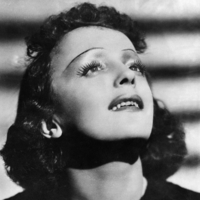
Édith Piaf
Édith Piaf (born Édith Giovanna Gassion, 19 December, 1915 – 11 October, 1963), was a French singer and cultural icon who became universally regarded as France's greatest popular singer. Her singing reflected her life, with her specialty being ballads. Among her songs are "La Vie en rose" (1946), "Non, je ne regrette rien" (1960), "Hymne à l'amour" (1949), "Milord" (1959), "La Foule" (1957), "l'Accordéoniste" (1955), and "Padam... Padam..." (1951). Despite the numerous biographies, many facts and events of Édith's life are shrouded in mystery. She was born Édith Giovanna Gassion in Belleville, Paris, France, the high-immigration district later described by Daniel Pennac. Legend has it that she was born on the pavement of Rue de Belleville 72 but according to her birth certificate that was at Hôpital Tenon, the Belleville arrondissement hospital. She was named Édith after the executed British nurse Edith Cavell (Piaf —Parisian jargon for "sparrow"— came from a nickname she would receive twenty years later). Her mother, Annetta Giovanna Maillard (1898 – 1945), was a partly-Italian 17-year-old girl, native of Livorno, working as a café singer under the pseudonym Line Marsa; from her, Édith took the middle name of Giovanna. Her father, Louis-Alphonse Gassion (1881 – 1944), was a street acrobat with a theatrical past. The little Édith was soon abandoned and left for a short time to her maternal grandmother, Mena (probably a Kabyle). Shortly after, Édith's father brought the child to his mother, who ran a brothel in Normandy, and then joined the French Army (1916). Thus Édith was in contact with the prostitutes and the various attenders of the brothel since her early years, a circumstance which must have had a deep impact on her personality and vision of life. From the age of three to seven she was blind. As part of Piaf's legend, she allegedly recovered her sight after her grandmother's prostitutes went on a pilgrimage to Saint Thérèse de Lisieux. In 1929 she joined her father in his acrobatic street performances. Then took a room at Grand Hôtel de Clermont (18 rue Veron, Paris 18ème) and separated from him, going her own way as a street singer in Pigalle, Ménilmontant and Paris suburbs (cf. the song "Elle fréquentait la Rue Pigalle"). She was about 16 years of age when she fell in love with a delivery-boy, Louis Dupont, and shortly after had a child, a little girl named Marcelle. Sadly, Marcelle died in infancy of meningitis. In 1935, Édith was discovered in the Pigalle area of Paris by the nightclub owner Louis Leplée, whose club was frequented by the upper and lower classes alike. He persuaded her to sing despite her extreme nervousness, which, combined with her height of only 4' 8" (142 cm) inspired him to give her the nickname that would stay with her for the rest of her life and become her stage name: La Môme Piaf (The Little Sparrow). Her first record was produced in the same year. Shortly afterwards, Leplée was murdered and Piaf was accused of being an accessory; she was acquitted. In 1940, Jean Cocteau wrote the successful play Le Bel Indifférent for her to star in. She began to make friends with famous people, such as the actor Maurice Chevalier and the poet Jacques Borgeat. She wrote the lyrics of many of her songs, and collaborated with composers on the tunes. Her signature song, "La vie en rose" (which was voted a Grammy Hall of Fame Award in 1998) was written in the middle of the German occupation of Paris in World War II. During this time, she was in great demand and very successful. She befriended many high-ranking Germans and sang for them. It is said that she collaborated with the Nazis, too. After the war, she toured Europe, the United States, and South America, becoming an internationally known figure. Her popularity in the U.S. was such that she appeared on the Ed Sullivan Show eight times. She helped to launch the career of Charles Aznavour, taking him on tour with her in France and the United States. The great love of Piaf's life, the boxer Marcel Cerdan, died in 1949. Piaf was married twice. Her first husband was Jacques Pills, a singer; they married in 1952 and divorced in 1956. Her second husband, Theophanis Lamboukas (also known as Théo Sarapo), was a hairdresser-turned-singer and actor, and was twenty years younger than Piaf; they married in 1962. In 1951 she was in a car accident, and thereafter had difficulty breaking a serious morphine habit. The Paris Olympia is the place where Piaf achieved fame and where, just a few months before her death, she gave one of her most memorable concerts while barely able to stand. In early 1963, Piaf recorded her last song, "L'homme de Berlin". At the early age of 47, Piaf died of cancer in Plascassier, on the French riviera, on October 10, 1963. Her friend Jean Cocteau, very shocked and afflicted by her death, died a few hours later. Her body was returned to Paris where her death was only announced on October 11, the official date of her death. She was buried in Père Lachaise cemetery, Paris. Although she was forbidden a Mass by the Roman Catholic archbishop of Paris (because of her lifestyle), her funeral procession drew hundreds of thousands of mourners onto the streets of Paris and the ceremony at the cemetery was jammed with more than forty thousand fans. Charles Aznavour recalled that Piaf's funeral procession was the only time, since the end of World War II, that Parisian traffic came to a complete stop. There is a museum dedicated to Piaf, the Musée Édith Piaf at 5, rue Crespin du Gast, 75011, Paris. Today she is still remembered and revered as one of the greatest singers France has ever produced. Her life was one of sharp contrasts: the range of her fame as opposed to her tragic personal life, and her fragile small figure on stage with the resounding power of her voice.
Biography from Last.fm, available under CC BY-SA.
Country: FR
Deathdate: 1963-10-11
Gender: Female
Is Living: No
Albums
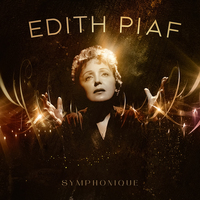 Symphonique2023
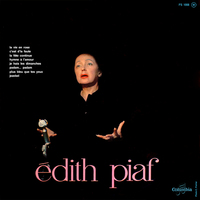 La Vie en rose2003
 Exclusive2024Une légende (Remastered 2022)2023Merry Christmas and A Happy New Year from Edith Piaf, Vol. 12023La Vie en rose2023La Vie en rose: The Golden Collection, vol. 042022La Vie en rose: The Golden Collection, vol. 032022Édith Piaf: Timeless Classic Albums20193 Légendes: Aznavour / Trenet / Piaf2018Édith Piaf: Complete Recordings2015La Vie en rose2014Hymne à la Môme2013Édith Piaf, Théo Sarapo & Christie Laume: Platinum Collection201350 succès essentiels2013Non je ne regrette rien: The Ultimate Best-Of (Remastered)2012Hymne à la Môme2012Enregistrements Publics (1955-1957) - Volume 12012Enregistrements Publics (1958-1963) - Volume 22012The Rough Guide Legends: Edith Piaf2011Edith Piaf - All The Best2011The Very Best of Edith Piaf2010Hits Collection2010Grandes Vozes: Colecção2010Simply Édith Piaf2009The Best of Édith Piaf2008La Vie en rose2008The Little Sparrow2007Le "Best of" des concerts2007La Vie en rose : The Legend Lives On2007La Môme2007Adieu mon cœur2006Paris en chansons2006Une voix inoubliable2006World Stars2005Édith Piaf chante en public2004Éternelle: Les Plus Grandes Chansons d’Edith Piaf2003Hymne à l’amour2003100 Chansons Françaises de Légende, Volume 22003La Môme de Paris2003Enregistrements exclusifs Europe 12003L’Intégrale2003Piaf au Carnegie Hall 1956-19572003Live in Concert at Carnegie Hall & Paris Olympia2002L’Accordéoniste2002The Best of Édith Piaf2001Éternelle2001Best of Édith Piaf2001Les 100 Plus Belles Chansons d'Edith Piaf2001Face à son public2000L’Accordéoniste2000Legends of the 20th Century: Edith Piaf1999La Vie en rose1999Les Concerts de Musicorama1999Paris Rive Gauche1999Live at the Copacabana199920 chansons d’or199835e Anniversaire1998100 Chansons1998Intégrale et Plus1998The Wonderful Music of Édith Piaf1998The Early Years, Volume 4: 1947-19481997Milord - Best of Édith Piaf1997La Vie en rose1996La Vie en rose 1940-461996Premières chansons1995L’Immortelle199430e Anniversaire1993À l'Olympia 19621993Édith Piaf : Succès et raretés 1936–19421993Versions inédites en public1993La Lumière de la rue1993The Very Best1991C’est pour ça - 18 Greatest Hits1990At the Paris Olympia1990The Legendary Édith Piaf1989The Story1989The Early Years/1938-1945, Volume 31989L’Intégrale 1936–1945198825e anniversaire, Volume 11988La Vie en rose198825e anniversaire, Volume 2198830e anniversaire: L’Intégrale 1946–19631988Édith Piaf, Volume 1 : 19361988Édith Piaf, Volume 2 : 1937-19381988Édith Piaf, Volume 3 : 1939-19421988Édith Piaf1987Compact d’or1987Les Années Frou-Frou1985Les Amants de Teruel1962Piaf!1959La Vie en rose / Édith Piaf Sings in English1956Le Tour de chant d'Édith Piaf1955Édith Piaf rencontre Charles Trenet1954Édith Piaf1953La Vie en rose1952Encores1951Chansons des cafés de Paris1950Chansons parisiennes1949La Rue Pigalle / Édith Piaf Sings (in French)1947
Singles
La Foule, part 22010Soudain une vallée...1998Plus bleu que tes yeux1997À quoi ça sert l’amour / Musique à tout va1962Fallait-il / Mon vieux Lucien1962Exodus / C’est l’amour1961Mon Dieu1961Milord1959Miséricorde / Avec ce soleil1955Sous le ciel de Paris1955Mea culpa1954Le grisbi1954Johnny, tu n’es pas un ange / N’y va pas Manuel1953Padam padam...1951Chante-moi1951La rue aux chansons1951Du matin jusqu'au soir1951Télégramme1951Paris1949Le prisonnier de la tour1949Un monsieur me suit dans la rue / Le Disque usé1946Les Trois Cloches / Perrine était servante1946Dans les prisons de Nantes / Céline1946Le petit homme1946Les deux rengaines1944J'ai qu'à le regarder1943Escales / L’Accordéoniste1942Où sont-ils mes petits copains ?1941Je n’en connais pas la fin / C’est lui que mon cœur a choisi1939Le Petit Monsieur triste / Les Deux Copains1939Mon légionnaire / Le Fanion de la légion1938Paris‐Méditerranée / Un jeune homme chantait1937Entre Saint‐Ouen et Billancourt / Corrèqu’ et réguyer1937La Julie jolie / Va danser1936Chand d’habits / La Petite Boutique1936Mon amant de la coloniale / Les Deux Ménétriers1936Les Mômes de la cloche / L’Étranger1936Quand‐même /Fais‐moi valser1936EPs
L'Homme de Berlin1968Mon légionnaire1963Édith Piaf chante Charles Dumont1962À quoi ça sert l'amour1962Édith Piaf et Charles Dumont chantent l’amour1961Non, je ne regrette rien1961Boulevard du crime1961Mon manège à moi1958Himno al Amor1958Edith Piaf chante Jo Moustaki1958La Goualante du pauvre Jean1956Soudain une vallée1956C'est à Hambourg1955