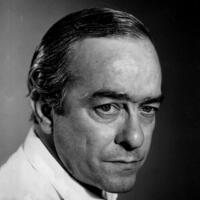
Vinicius de Moraes
Vinicius de Moraes, o poetinha (“the little poet”), (October 19, 1913 — July 9, 1980), born Marcus Vinicius da Cruz de Melo Morais in Rio de Janeiro, Brazil, was a seminal figure in contemporary Brazilian music (mpb. As a poet, he wrote lyrics for a great number of songs that became all-time classics. He was also a composer, a playwright, a diplomat and, as an interpreter of his own songs, he left several important albums. From a musical family, Vinicius began writing poetry early in life. At the age of 14, he became friends with the brothers Paulo and Haroldo Tapajós and, with the latter, composed “Loura ou Morena”, his first song. In 1929, Vinicius enrolled in law school in Rio de Janeiro. Then, starting in 1932, he wrote lyrics for ten songs that were recorded by the Tapajós brothers. Upon completing his studies, he published his first two collections of poetry Caminho Para a Distância (1933) and Forma e Exegese. Later, in 1935, he became a cinema censor for the Ministry of Health and Education. During this time, he wrote his third book Ariana, a Mulher (1936). Vinicius then headed to England (1938) with an English government scholarship to study literature at Oxford University and while there he wrote Novos Poemas. At that time he was married by proxy. In 1941, during World War II, Vinicius returned to Rio and began to write film reviews and other pieces for newspapers and magazines. Two years later, he joined Brazil’s diplomatic service and released his book Cinco Elegias. In 1946, he was sent to Los Angeles as vice-consul on his first diplomatic assignment and released Poemas, Sonetos e Baladas. In 1950 Vinicius returned to Brazil upon his father’s death. His first samba (composed with musician Antônio Maria), was Quando Tu Passas por Mim, released in 1953, which was the same year in which he moved to France as second secretary to Brazil’s embassy. The next year he wrote lyrics for some of Cláudio Santoro’s chamber music pieces and also staged his play Orfeu da Conceição, which was later adapted to cinema as Black Orpheus (Orfeu Negro, Marcel Camus, 1959. The play won the IV São Paulo Centennial Contest in 1954. During production he was introduced to a relatively unknown pianist, Antônio Carlos Jobim, who was commissioned to write the music for the play. Jobim composed the music for Se Todos Fossem Iguais a Você, Um Nome de Mulher, and several other songs included in the production. Following a return to his diplomatic duties in France and Uruguay, Vinicius released his books Livro de Sonetos and Novos Poemas II. In 1958, the singer Elizeth Cardoso released her album Canção do Amor Demais, marking the beginning of bossa nova. This record consists wholly of compositions by the either Jobim or Vinicius, or both. The recording also featured a relatively unknown João Gilberto on two tracks. With the release of this record Vinicius’s—and his collaborators—can be said to have truly begun. The songs of Jobim and Vinicius were recorded by numerous Brazilian singers and performers of that time. Renditions of many Jobim-Vinicius numbers on João Gilberto’s first three albums would firmly establish the sound and the core repertory of the bossa nova and would influence a new generation of singers and songwriters, especially in Rio de Janeiro. Among these songs are all time hits such as Garota de Ipanema, Insensatez and Chega de Saudade. Meanwhile, Black Orpheus won an Academy Award for best foreign film in 1960, and also was awarded with the Palme d’Or at the Cannes International Film Festival, and the 1960 British Academy Award. Vinicius’ songs Para uma Menina com uma Flor and Samba da Bênção (music by Baden Powell) were included on the soundtrack of A Man and a Woman (Un Homme et une Femme, Claude Lelouch, 1966), another Cannes film festival winner. In the ’60s and ’70s, Vinicius continued collaborating with many renowned Brazilian singers and musicians, particularly Baden Powell, with whom he penned a series of songs with a heavy Afro-Brazilian influence and which came to be known collectively as the Afro-Sambas. His last steady music partner was Antonio Pecci Filho, better known as Toquinho. With Toquinho he released a series of very popular and influential albums. Hundreds of international performers have recorded more than 400 of Vinicius’ songs. Vinicius de Moraes died in Rio de Janeiro, Brazil, on July 9, 1980 at the age of 66. He is buried in Rio’s São João Batista Cemetery.
Biography from Last.fm, available under CC BY-SA.
Country: BR
Deathdate: 1980-07-09
Disambiguation: O poetinha
Gender: Male
Is Living: No
Albums
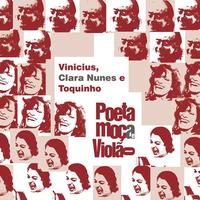 Poeta, moça e violão1991
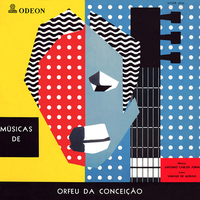 Orfeu da Conceição1956
 Canções de Amor2023A arca de Noé2013A Benção, Vinicius - A Arca Do Poeta2013Os Afro Sambas / A Vontade2008em Portugal2007Pure Bossa Nova - A View On The Music Of Vinicius De Moraes2006Os Afro - Sambas De Baden E Vinícius2006Novo Millennium2005Novo Millennium2005Vinicius2005Favourites2004A arte de2004De Vinicius e Baden especialmente para Ciro Monteiro2003I Concerti Live @ Rtsi - 18 Ottobre 19782002Como dizia o poeta2001Lances De Vinícius2000O melhor de 22000Pérolas2000Millennium1999Millennium1998Vinícius de Moraes1998Arca de Noé 21998Toquinho & Vinícius1997Gravado ao vivo no Canecão1997Coleção obras-primas1996El Poeta De La Bossa Nova199580 Anos De Poesia1993The Girl From Ipanema1992A felicidade1992Leurs plus belles chansons1991Poeta, Moça E Violão1991Les Plus Belles Chansons de Antônio Carlos Jobim et Vinícius de Moraes1990A arte do encontro1989La musique et la poesie de Vinicius de Moraes1988Convite para ouvir1988O grande encontro de Maria Creusa, Vinicius de Moraes e Toquinho1988Personalidade1987A arca de Noé1980Um pouco de ilusão198010 anos de Toquinho e Vinicius1979La voglia, la pazzia, l'incoscienza, l'allegria1976Deus lhe Pague1976O poeta e o violão1975Vinicius / Toquinho1975Saravá Vinicius!1974Fogo Sobre Terra1974Vinícius & Toquinho1974Toquinho/Vinicius & Amigos1973Nossa Filha Gabriela1972Jesus Cristo Superstar1972Toquinho e Vinicius1972Eu sei que vou te amar…1972São demais os perigos desta vida...1972Como dizia o poeta1971Vinicius + Bethânia + Toquinho1971Amália/Vinicius1970En "La Fusa"1970Os afro-sambas1966Vinícius: Poesia e canção, Vol. II1966Vinícius: Poesia e Canção1966Vinicius e Caymmi no Zum Zum1965Vinicius & Odette Lara1963Brasília: Sinfonia da Alvorada1961Minha HistóriaConvite para ouvir10 anos sem ViniciusSem LimiteToquinho & Vinicius & AmigosMusicalmenteL'arcaVinícius de Moraes por Odette Lara