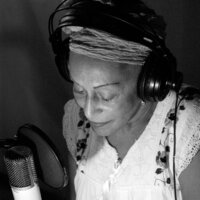
Omara Portuondo
Omara Portuondo (born in Havana, Cuba on 29 October 1930) is a Cuban singer whose career has spanned over half a century. Portuondo was born in October 1930 in Havana, one of three sisters; her mother came from a wealthy Spanish family, and had created a scandal by running off with and marrying a black professional baseball player. Omara started her career in 1945 as a dancer at Havana's Tropicana Club (following her older sister, Haydee). The two sisters used to sing for family and friends, however, and after a brief time in a band called Loquibambla Swing, in 1952 they got together with two friends (Elena Bourke and Moraima Secada) and formed the singing group Cuarteto las d'Aida, backed by pianist Aida Diestro. The group had considerable success, touring the United States, performing with Nat King Cole at the Tropicana, and recording an album for RCA Victor. In 1959 Portuondo recorded a solo album, Magia Negra, involving both jazz and Cuban music. This didn't, however, mark the beginning of a solo career, and although Haydee left the group in 1961, Omara continued singing with Cuarteto las d'Aida until 1967. In 1967 Portuondo embarked on a solo career, and in the same year represented Cuba at the Sopot Festival in Poland, singing Juanito Marquez' "Como un Milagro". Alongside her solo work, in the 1970s she sang with charanga band Orquestra Aragon, and toured with them. In 1974 she recorded, with guitarist Martin Rojas, what would become one of her most critically acclaimed albums in which she sings praises to Salvador Allende and the people of Chile a year after the military coup led by General Augusto Pinochet. Among many other hits from the album, she also praises the work of Ernesto "Che" Guevara in the beautiful "Hasta Siempre". During the 1970s and 1980s Portuonda enjoyed considerable success at home and abroad, with tours, albums (including one of her most lauded recordings in 1984 with Adalberto Alvarez), film rôles, and her own television series. Her international profile was due to soar, however, in 1996. Portuondo sang (duetting with Compay Segundo) on the album Buena Vista Social Club in 1996. This led, not only to more touring (including playing at Carnegie Hall with the Buena Vista troupe) and her appearance in Wim Wenders' film The Buena Vista Social Club, but to two further albums for the World Circuit label: Buena Vista Social Club Presents Omara Portuondo (2000) and Flor de Amor (2004). In July 2005 she presented a symphonic concert of her most important repertoire at the Berlin Festival Classic Open Air am Gendarmenmarkt for an audience of 7,000. The entire program was specially orchestrated by Roberto Sánchez Ferrer, a colleague with whom she had worked during her early years at Havana's Tropicana Club. Scott Lawton conducted the Deutsches Filmorchester Babelsberg.
Biography from Last.fm, available under CC BY-SA.
Country: CU
Gender: Female


Albums
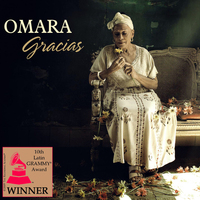 Gracias2008
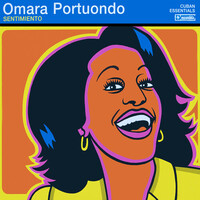 Sentimiento2005
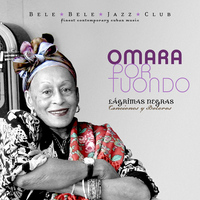 Lágrimas negras: Canciones y boleros2005
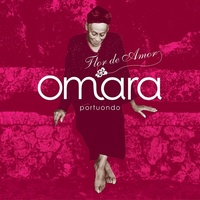 Flor de amor2004
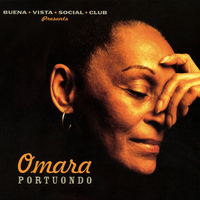 Buena Vista Social Club presents Omara Portuondo2000
 Vida2023Mariposas2020The Real Cuban Music - Son Boleros2019Perlas cubana2015Queen of Cuba2013Omara & Chucho2011Buena Vista Legend2010Grandes Éxitos2009The Cuban Heroes Collection : Omara Portuondo2008Omara Portuondo e Maria Bethânia2008Omara Portuondo Singles20075 leyendas2005Together2004Together Again2004Joyas inéditas2002La colección cubana2001Dos gardenias2001Veinte años2000Desafíos1999Palabras1996Soy cubana1991Canta el son1984Y tal vez1981Omara Portuondo & Martin Rojas1975Omara!1974Magia negra1959Omara PortuondoQuiéreme muchoEsta es Omara PortuondoOmara Portuondo: Roots of Buena VistaOmaraOro musical