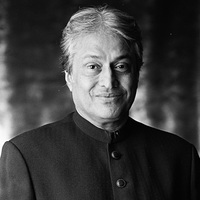
Amjad Ali Khan
Ustad Amjad Ali Khan is a highly acclaimed Indian sarod player and composer. Khan was born in Gwalior, Madhya Pradesh in 1945, is the sixth-generation sarod player in his family and his ancestors have developed and shaped the instrument over several hundred years. "You could say it's my family instrument", says Khan, "Whoever is playing the sarod today learned directly or indirectly from my forefathers." His forefathers came from Afghanistan to India's relaxed music atmosphere and brought the Rabab which later developed into Sarod. The modern sarod has undergone modifications to improve its tonal quality, notably from Ustad Allauddin Khan and his brother Ayet Ali Khan of the Maihar Gharana. Khan was taught by his father Hafiz Ali Khan, a musician to the royal family of Gwalior; he was born to the Bangash lineage rooted in the Senia Bangash School of music and is the sixth generation inheritor of this lineage. Amjad Ali Khan has developed a unique style of playing the sarod. The key innovations in his style are compositions based on vocal music, the technical ability to play highly complex phrases (ekhara taans) on the sarod spanning three octaves and the emphasis on simple and elegant compositions. His technical mastery and control over his instrument is unsurpassed - a fact acknowledged by most musicians. He has simplified the instrument by removing some strings (his sarod has only two jod and chikari strings and 11 tarab stings) and has also removed the resonant gourd (tumba) which is in use by other sarod schools. His base frequency is also lower than the other schools. His instrument is made by Hemen Sen of Kolkata, who also makes the sarod for other leading maestros such as Ali Akbar Khan. His playing does reflect the older dhrupad tradition and he places emphasis on the conventional technique of "dara diri" using the plectrum made of coconut shell (java). However, his chief innovation is his ekhara taans (complex high speed phrases), something which many sarod players find very difficult to do. Paraphrasing his words "I asked my father why the sarod could not keep up with sitar when it came to taans....my father explained that the sarod was a much more difficult instrument to play, not having frets ... it is then I resolved to develop a style where I could match sitar like taans...". Amjad Ali Khan has had a successful career spanning over 40 years and continues to be one of the busiest classical musicians in India. He was awarded India's second highest civilian award, the Padma Vibhushan in 2001.
Biography from Last.fm, available under CC BY-SA.
Country: IN
Disambiguation: Indian classical musician
Gender: Male

Albums
 Masterworks From The NCPA Archives2013A Journey Begins, Vol. 22012Masterworks From the NCPA Archives2011Indian Classical Ragas2011Mesmerizing Maestros2009Ancient Sounds2009Breaking Barriers2007Yaara2007Raga Abhogi2006Bandish Symphony2006Music from the 13th Century2005Moksha2005Sarod Trilogy2004Ru-Ba-Ru ( Vol.2)2004Ru-Ba-Ru ( Vol.1)2004Sangeet Sangam, Volume 12004Sadaayen2002Amjad Ali Khan with sons - live2001Evening Raga2001Late Night Ragas1999Homage To Mother Teresa1999Raga Lalitadhvani1998Moods Of The Day - Evening Ragas1995Raga Bhimpalasi1995Raga Bilaskhani Todi & Brindani Sarang1994Raga Bhairav1994Tribute to Germany1994Inde du Nord1993The Best of Amjad Ali Khan1992RAGA Puriya Kalyan & Pilu Jungla1992Rag Pilu - Rag Khammaj1991Afternoon Ragas (Vol 1)1990Atma1990Swar Tarang1990The Maestro's Musings1986South Meets North1983Raga Darbari1975Ustad Amjad Ali Khan1974Music Of The Monsoon1968Amjad Ali Khan1967Morning Ragas Volume 2Afternoon Ragas (Vol 4)Night Ragas Volume FourEvening Ragas (Volume Two)Indian Classical MaestrosMaestro's Choice: Series One: SarodRaag YamanTribute to Tagore