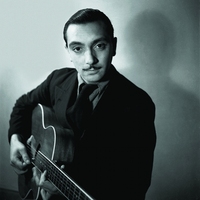
Django Reinhardt
Jean "Django" Reinhardt (23 January 1910 - 16 May 1953) was a Belgian guitarist and composer credited with popularizing Gypsy jazz, as well as conceptualizing the style together with several other Gypsy musicians. Reinhardt's nickname purportedly means "I Awake" in the Romani language; however, it may also have been a diminutive or a local Walloon version of "Jean." He severely injured two of the digits on his left hand as a youth and changed his guitar playing style to adapt to his handicap. Together with violinist Stéphane Grappelli, he founded the Quintette du Hot Club de France, regarded as one of the most innovative recording groups in the history of jazz music. Born in Liberchies, Pont-à-Celles, Belgium into a family of Manouche Gypsies, Jean Reinhardt learned to play several instruments such as the banjo, violin and guitar from an early age; he spent most of his youth in Gypsy encampments close to Paris. His family made a living from crafting furniture, but included several amateur musicians who inspired Reinhardt. Eventually, Reinhardt was given a banjo-guitar, at which point he stopped playing the violin. During this period, he was inspired by two older Gypsy musicians, Gusti Mahla and Jean Castro. Able to make a living from his music from his teen years onwards, playing in bal-musette halls in Paris, Reinhardt received little formal education until his adult life; fellow band member Stéphane Grappelli taught him the rudiments of literacy. At the age of eighteen, Reinhardt was injured in a fire that ravaged the caravan he shared with Florine "Bella" Mayer, his first wife. They were very poor, and to supplement their income, Bella made imitation flowers out of celluloid and paper; consequently, their home was full of this highly inflammable material. Returning from a performance late one night, Django apparently knocked over a candle on his way to bed. While his family and neighbors were quick to pull him to safety, he received first- and second-degree burns over half his body. His right leg was paralyzed, and the third and fourth fingers of his left hand were badly burned. Doctors believed that he would never play guitar again and intended to amputate one of his legs. Reinhardt refused to have the surgery and left the hospital after a short time; he was able to walk within a year with the aid of a cane. His brother, Joseph Reinhardt, an accomplished guitarist himself, bought Django a new guitar. With painful rehabilitation and practice, Reinhardt relearned his craft in a completely new way, even as his third and fourth fingers remained partially paralyzed. Hence, he played all his guitar solos with only two fingers and used the two injured digits only for chord work. After regaining his ability to play, Reinhardt resumed his career playing in Parisian cafes. According to one story, during his period of recovery, Reinhardt was introduced to the aesthetics of American jazz when he purchased a 78 rpm disc of "Dallas Blues" by Louis Armstrong at an Orléans flea market. In 1934, Reinhardt and Parisian violinist Stéphane Grappelli were approached by hot club chief Pierre Nourry with the idea of forming a new hot club group. Thus, the Quintette du Hot Club de France was formed, with Reinhardt's brother Joseph and Roger Chaput on guitar, and Louis Vola on double bass. Occasionally, Chaput was replaced by Reinhardt's best friend and fellow Gypsy Pierre "Baro" Ferret. As the group had no true percussion section, percussion was instead provided by the group's guitarists. The Quintette du Hot Club de France thus became one of the few well-known jazz ensembles composed entirely of string instruments. Jean Sablon was the first singer to record with the Quintette, resulting in more than thirty collaborations from 1933 onwards. Vocalist Freddy Taylor participated on a few songs, such as "Georgia on My Mind" and "Nagasaki". A long line of recordings for Decca, HMV, and Ultraphone ensured long-lasting international success for the Quintette. As a composer, Reinhardt wrote several influential, highly original tunes recorded by the Quintette, ranging from the dulcet ballads "Daphne", "Nuages", and "Manoir de mes rêves", to mad swingers such as "Minor Swing" and the ode to his record label of the 1930s, "Stomping at Decca". With time, many of his songs became jazz standards in their own right. Reinhardt also experimented with recordings outside the "comfort zone" of the Quintette; in March 1933 Reinhardt recorded two takes each of "Parce que je vous aime" and "Si, j'aime Suzy", vocal numbers with lots of guitar fills and great guitar support, using three guitarists along with an accordion lead, violin, and bass. In August of the following year, recordings were also made with more than one guitar, featuring Joseph Reinhardt, Roger Chaput, and Django, including the first recording by the Quintette. In both years, it should be noted, the great majority of recordings featured a wide variety of horns, often in multiples, as well as piano, etc. Throughout his career, Reinhardt played and recorded with many American jazz legends such as Benny Carter, Coleman Hawkins, Rex Stewart (who later stayed in Paris), and a led a jam-session and radio performance with Louis Armstrong. Later in his career, he performed with Dizzy Gillespie in France. The outbreak of war in 1939 broke up the Quintette, with Grappelli remaining in London where the group was playing and Reinhardt returning to France. During the war years he led a big band, another quintet with clarinettist Hubert Rostaing in place of Grappelli, and after the liberation of Paris, recorded with such visiting American jazz artists as Mel Powell, Peanuts Hucko, and Ray McKinley. In 1946, Reinhardt took up the electric guitar and toured America as a soloist with the Duke Ellington Band, but his appearances were poorly received. Some of his recordings on electric guitar late in his life are bop escapades where his playing sounds frantic and jagged, a world apart from the jubilant swing of old. However, starting in January 1946, Reinhardt and Grappelli held several sporadic reunions, where the bop influences were more subtly integrated into the old swing format of the Quintette's glory days. In the 1950s, Reinhardt became more reclusive, remaining in Europe and playing and recording sporadically until his death from a stroke on 16 May 1953, in Fontainebleau, France.
Biography from Last.fm, available under CC BY-SA.
Country: FR
Deathdate: 1953-05-16
Disambiguation: French jazz guitarist and composer
Gender: Male
Is Living: No
Groups
 Michel Warlop et son orchestreDjango Reinhardt et son orchestre du Bœuf sur le toitQuintette du Hot Club de FranceRex Stewart QuintetDjango Reinhardt et son quintetteNina Rette et son Hot TrioSouvenirs de Django ReinhardtDjango Reinhardt QuartetChico ChicoDjango Reinhardt and His American Swing BandPhilippe Brun and His “Jam” BandPhilippe Brun and His Swing BandDjango’s MusicStéphane Grappelli and His Hot FourDjango Reinhardt OrchestraDjango Reinhardt Trio
Albums
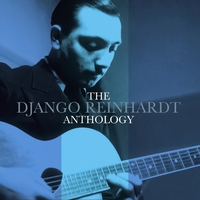 The Django Reinhardt Anthology2014
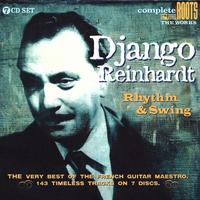 Complete Roots: Rhythm & Swing2008
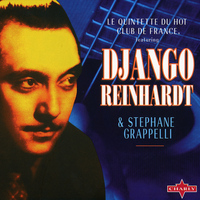 Le Quintette Du Hot Club De France1997
 The Last Be-Bop Sessions2024The Days of Being Young and Free2021Ultimate Star Collection2020Django's Delights2020Electrified Django (1947)2020Djangology: Solo & Duet Recordings2019Django Reinhardt2019Django2019With The Quintet of the Hot Club of France2019Three Fingered Lightning2019Django Plays Gershwin & Ellington2019Le Dernier Django - The Ultimate Django (1951-1953)2018Essential Electric2018Django (Bande originale du film)2017The Absolutely Essential 3 CD Collection2016Paris 19452016Classic Early Recordings2015100 Essentials of Django Reinhardt2014The Best of the Broadcast Performances2014The Discovery of Jazz2014Die Zeit: Legenden des Jazz2013For Sentimental Reasons: The Rarities Collection2013Django Reinhardt on Vogue - Complete Edition (1934-1951)2012The Best of the Radio Sessions (Expanded Edition)2012Postwar Recordings 1944-19532012Mitos do jazz, Volume 20: Django Reinhardt2012Swing de Paris2011Renown & Resistance 1937-19432011Four Classic Albums Plus: DJANGO / django / The Legendary Django / Django Reinhardt2011The Very Best Of2011The Essential Django Reinhardt2011Dinette2011Quintesential2011Musette to Maestro2010Swing Guitars2010Manoir de ses rêves2010Plays the Blues2010Greatest Hits2010The Electric Years2009Djangologie2009Kind of Reinhardt2009Le maître du Jazz2009Django Reinhardt Plays the Music of George Gershwin & Duke Ellington2009Les Rois Du Swing Manouche2009With Stephane Grappelli & The Quintet Hot Club2009Airwaves2009The Django Reinhardt Anthology2009The Ultimate Collection2008The Ultimate Collection2008Django on the Radio2008Anthology2008Django Reinhardt & Stéphane Grapelli2008100 Chansons2008Platinum Collection2008Plays Django Reinhardt2008100 Swinging Greats!2007De legendes van de jazz2007Django Reinhardt, Volume 10: Belleville, Classic Recordings 1940-19422007Djangology2007La Marseillaise2007The Very Best Of Django Reinhardt200740 Breathtaking Recordings2006Two Is Company: Complete Studio Duets 1937-1942200620 chansons d'or2006Keep Cool (Guitar Solos 1950-53)2006The Art of the Jazz Guitar, Vol. 22006Django Reinhardt Volume 22006Memorial2006Panorama 1928-19502006Out of Nowhere2006The Django Reinhardt Collection2006Best Recordings 12005Trésors2005In Solitaire: Complete Recordings for Solo Guitar 1937-19502005Intégrale Django Reinhardt, Vol. 20 : “Pour que ma vie demeure” 1953 & Compléments 1928-19472005The Best of Django Reinhardt2005Swing in Paris2005With Strings and Brass2005Nuages2005Le Jazz Hot2005Django Reinhardt and the Singers with Jean Sablon2005Genius of Improvisation2005Jazz Ballads 7: Django Reinhardt2004Vol. 6: Nuages2004Intégrale Django Reinhardt, Vol. 19 : “Troublant Boléro” 1950–19522004Django Reinhardt, Volume 4: 1937 Swingin' with Django2004Djangology2004Ultimate Jazz & Blues2004H.C.Q. Strut, Vol. 5 1938 - 1939 (Classic Recordings By Quintette Du Hot Club De France)2004RTL Jazz: La Collection2004Douce Ambiance2003Les années Django2003Intégrale Django Reinhardt, Vol. 17 : “La Mer” 19492003Intégrale Django Reinhardt, Vol. 18 : “I’ll Never Be the Same” 1949–19502003Django in Rome 1949/19502003Swing From Paris2003Rétrospective: 1934-532003
Singles
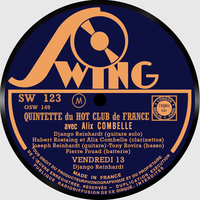 Vendredi 13 / Crépuscule1941Minor Swing / Douce Ambiance1953Stockholm / Nuages1953Babik – Bi-Bop1948What Is This Thing Called Love? / Si tu savais1948Festival 48 / Fantaisie1948Eveline / Diminishing1948Mike / Lady Be Good1948Folie a amphion / Anniversary Song1947How High the Moon / Lover Man1947R‐Vingt Six / Blue Lou1947Blues / Yours and Mine1947I Can’t Give You Anything but Love / Blues clair1947Ol’ Man River / Si tu savais1947Echos De France / Embraceable You1946Improvisation no. 31946On the Sunny Side of the Street / I Won’t Dance1946Coquette / Django’s Tiger1946Out of Nowhere / Baby1945I’ll See You in My Dreams / Tea for Two1945Belleville1943Oui / Manoir de mes rêves1943Fleur d’ennui / Swing de Paris1943Douce Ambiance / Cavalerie1943Dinette / Lentement mademoiselle1942All of Me / Swingtime in Springtime1941Swing 42 / Stockholm1941Stockholm / Swing 19411941Petits Mensonges / Oiseaux des îles1941Sweet Sue / Pour vous1941Swing 42 / Mabel1941Naguine / Echoes of Spain1939Interprétation swing et improvisation du premier mouvement du concerto en ré mineur de J.‐S. Bach1938Sweet Georgia Brown / You Rascal You1938Parfum / Improvisation1937Avalon / Djangology1937Lily Belle May June / Smoke Rings1937Ultrafox / I’ve Had My Moments1937Saint‐Louis Blues / Bouncin’ Around1937Pennies From Heaven / Tiger Rag1937Dinah / Lady Be Good1935Tiger Rag / I Saw Stars1935Clouds / Believe it, Beloved1935Chasing Shadows / I’ve Had My Moments1935Chasing Shadows / Some of These Days1935St. Louis Blues / China Boy1935Lily Belle May June / Sweet Sue, Just You1935Confessin’ / The Continental1935Sweet Sue, Just You / Ton Doux Sourire1935Blue Drag / Swanee River1935