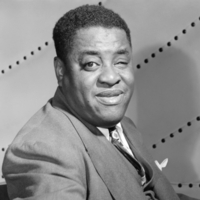
Art Tatum
Art Tatum (Arthur Tatum, Jr., October 13, 1909, Toledo, Ohio, USA - November 5, 1956, Los Angeles, California) was an American jazz pianist and virtuoso who played with phenomenal facility despite being nearly blind since birth. Tatum is widely acknowledged as one of the greatest jazz pianists of all time. He was noted for the complexity and speed of his performances, which set a new standard for jazz piano virtuosity. Tatum drew inspiration from his contemporaries James P. Johnson and Fats Waller, and had a great influence on other famous jazz pianists, such as Thelonious Monk, Bud Powell, Chick Corea, and Oscar Peterson. Saxophonist Charlie Parker took his first job in New York as a dishwasher where Tatum played, just for the experience of hearing Tatum's harmonic inventions. Tatum identified Fats Waller as his main influence, but according to pianist Teddy Wilson and saxophonist Eddie Barefield, "Art Tatum's favorite jazz piano player was Earl Hines. He used to buy all of Earl's records and would improvise on them. He'd play the record but he'd improvise over what Earl was doing ..... 'course, when you heard Art play you didn't hear nothing of anybody but Art. But he got his ideas from Earl's style of playing – but Earl never knew that." A major event in his meteoric rise to success was his appearance at a cutting contest in 1933 at Morgan's bar in New York City that included Waller, Johnson and Willie "The Lion" Smith. Standard contest pieces included Johnson's "Harlem Strut" and "Carolina Shout" and Fats Waller's "Handful of Keys." Tatum triumphed with his arrangements of "Tea for Two" and "Tiger Rag", in a performance that was considered to be the last word in stride piano. James P. Johnson, reminiscing about Tatum's debut afterward, simply said, "When Tatum played Tea For Two that night I guess that was the first time I ever heard it really played." Tatum's debut was historic because he outplayed the elite competition and heralded the demise of the stride era. He was not challenged further until stride specialist Donald Lambert initiated a half-serious rivalry with him. Tatum worked first around Toledo and Cleveland and then later in New York at the Onyx Club for a few months; he recorded his first four solo sides on the Brunswick label in March, 1933. He returned to Ohio and played around the American midwest - Toledo, Cleveland, Detroit, Saint Louis and Chicago - in the mid-1930s and played on the Fleischman Hour radio program hosted by Rudy Vallee in 1935. He also played stints at the Three Deuces in Chicago and in Los Angeles he played at The Trocadero, the Paramount and the Club Alabam. In 1937 he returned to New York where he appeared at clubs and played on national radio programs. The following year he embarked on the Queen Mary for England where he toured, playing for three months at Ciro's Club owned by bandleader Ambrose. In the late 1930s he returned to play and record in Los Angeles and New York. In 1941, Tatum recorded two sessions for Decca Records with singer Big Joe Turner, the first of which included "Wee Wee Baby Blues", which attained national popularity. Two years later Tatum won Esquire Magazine's first jazz popularity poll. Perhaps believing there was a limited audience for solo piano, Tatum formed a trio in 1943 with guitarist Tiny Grimes and bassist Slam Stewart, whose perfect pitch enabled him to follow Tatum's excursions. Tatum recorded exclusively with the trio for almost two years, but abandoned the trio format in 1945 and returned to solo piano work. Although Tatum was idolized by many jazz musicians, his popularity faded in the mid to late forties with the advent of bebop - a movement which Tatum did not embrace. The last two years of his life, Tatum regularly played at Baker's Keyboard Lounge in Detroit, including his final public performance in April 1956. Earlier, Tatum had personally selected and purchased for Clarence Baker the Steinway piano at Baker's, finding it in a New York showroom, and shipping it to Detroit. Tatum was widely recognized among his colleagues as the most gifted jazz pianist alive, some going so far as to say he was one of the greatest pianists of any genre. Such classical luminaries as Vladimir Horowitz and Sergei Rachmaninov greatly admired his technique. Unusually for a jazz musician, Tatum rarely abandoned the original melodic lines of the songs he played, preferring innovative reharmonization (changing the chord progressions that supported the melodies). He also had a penchant for filling spaces within melodies with his trademark runs and other embellishments, which some critics considered gratuitous and "unjazzlike."
Biography from Last.fm, available under CC BY-SA.
Country: US
Deathdate: 1956-11-05
Disambiguation: US jazz pianist
Gender: Male
Is Living: No

Albums
 Jewels In The Treasure Box: The 1953 Chicago Blue Note Jazz Club Recordings2024Late Night Art Tatum2024Jazz: The Essential Collection2020I Got Rhythm, Vol. 3: 1935-19442019Nine Classic Albums2014Body and Soul2011Performance: Solo Piano Recordings From 1933 to 19522010The Best of Jazz Piano2010Centennial Celebration2009Dwn Beat (The Ben Webster-Art Tatum quartet)2009Tatum Art: Art Tatum Live Performances 1934-19562008Piano Starts Here: Live at The Shrine (Zenph Re-Performance)2008The Album2006The Tatum Group Masterpieces2006Art Tatum Live 1944-52, Volume 92005Stormy Weather2005Jazz Ballads 18: Art Tatum2004The Discovery of Jazz2004Art Tatum Live 1953-55, Volume 72004Piano Grand Master2003BD jazz n°16: Art Tatum / Frédérik Salsedo "Le concert idéal"2003The Incredible Tatum! 1933-19492003Art Tatum Live 1945-49, Volume 32003Art Tatum Live 1951 - Volume 52003The Definitive Art Tatum2002Hall of Fame2002Swings2002Art Tatum Live 1944-45, Volume 22002Art Tatum Live 1934-44, Volume 12002Midnite Jazz & Blues: Sweet Lorraine2001Midnite Jazz & Blues: Cocktails for Two2001Art Tatum: Complete Original American Decca Recordings2001Begin the Beguine2001The Complete Jazz Chronicle Solo Sessions +2000Midnite Jazz & Blues: Art's Blues2000The Chronological Classics: Art Tatum 19492000Begin the Beguine2000Get Happy2000The Chronological Classics: Art Tatum 1945-19471998God Is in the House: Original 1940-41 Recordings1998The Complete Capitol Recordings of Art Tatum1997Jazz Greats, Volume 32: Art Tatum: The Shout199720th Century Piano Genius1996The Quintessence: New York – Los Angeles 1933–19451996Art Tatum - The Standard Sessions1996Trio Days1995An Introduction to Art Tatum: His Best Recordings 1933-19441995The Chronological Classics: Art Tatum 1940-19441995The Chronological Classics: Art Tatum 19441995Tea for Two1995The Art of Tatum1995Tea for Two1994California Melodies1994The Art Tatum Solo Masterpieces, Volume 21994The Art Tatum Solo Masterpieces, Volume 71994The Art Tatum Solo Masterpieces, Volume 81994I Got Rhythm - The Original Decca Recordings, Vol. 3 (1935-44)1993Complete Brunswick & Decca Recordings, 1932-19411993Rare Test Pressings and Transcriptions 1932–19511992The Complete Pablo Group Masterpieces1991The Tatum Group Masterpieces, Volume 51991The Complete Pablo Solo Masterpieces1991The Chronological Classics: Art Tatum 1934-19401991In Private1991The Standard Sessions: 1935-1943 Transcriptions1991Classic Early Solos (1934-1937)1991The Tatum Group Masterpieces, Volume 41991The Tatum Group Masterpieces, Volume 71991The Genius of Keyboard1990The Chronological Classics: Art Tatum 1932-19341990Solos (1940)1990Standards1990The Complete Capitol Recordings, Volume 11989The Complete Capitol Recordings, Volume 21989Body and Soul1989Giants of The Piano1989Solos 1937 & Classic Piano Solos1988The Complete Trio Sessions With Tiny Grimes & Slam Stewart, Volume 21988The V-Discs1988Masterpieces 1938-19391988Masters of Jazz1987The Best of Art Tatum1987The Tatum Group Masterpieces, Volume 31987Live At The Crescendo1986Pure Genius1986Strange As It Seems1983Lasting Impressions1979The Art Tatum Solo Masterpieces, Volume 61977. . . Again! - The Tatum Group Masterpieces1976Art Tatum At The Crescendo Vol. II1975The Tatum Group Masterpieces1975Art Tatum Legacy1974Art Tatum 1: Piano Solos "Art of Tatum" 1934-19371972Art Tatum 2: Piano Solos "Art of Tatum" 1939-19401972Piano Starts Here1968An Art Tatum Concert Plus His First Three Recorded Solos1966Piano Modern1966More of the Greatest Piano of Them All1961Still More of the Greatest Piano of Them All1960Makin' Whoopee1958