
Louis Armstrong & His Orchestra
Louis Armstrong (4 August 1901[3] – July 6, 1971), nicknamed Satchmo and Pops, was an American jazz trumpeter and singer. Armstrong was a charismatic, innovative performer whose inspired, improvised soloing was the main influence for a fundamental change in jazz, shifting its focus from collective melodic playing, often arranged in one way or another, to the solo player and improvised soloing. One of the most famous jazz musicians of the 20th century, he was first known as a cornet player, then as a trumpet player, and toward the end of his career he was best known as a vocalist and became one of the most influential jazz singers. Early life Armstrong often stated in public interviews that he was born on July 4, 1900 (Independence Day in the USA), a date that has been noted in many biographies. Although he died in 1971, it wasn't until the mid-1980s that his true birth date of August 4th, 1901 was discovered through the examination of baptismal records.[5] He was recorded as an illegitimate black child. Armstrong was born into a very poor family in New Orleans, Louisiana, the grandson of slaves. He spent his youth in poverty in a rough neighborhood of Uptown New Orleans, known as “Back of Town”, as his father, William Armstrong (1881–1922), abandoned the family when Louis was an infant, and took up with another woman. His mother, Mary Albert Armstrong (1886–1942), then left Louis and his younger sister Beatrice Armstrong Collins (1903–1987) in the care of his grandmother, Josephine Armstrong and at times, his Uncle Isaac. At five, he moved back to live with his mother and her relatives, and saw his father only in parades. He attended the Fisk School for Boys where he likely had his first exposure to Creole music. He brought in a little money as a paperboy and also by finding discarded food and selling it to restaurants but it wasn’t enough to keep his mother from prostitution. He hung out in dance halls particularly the “Funky Butt” which was the closest to his home, where he observed everything from licentious dancing to the quadrille. He hauled coal to Storyville, the famed red-light district, and listened to the bands playing in the brothels and dance halls, especially Pete Lala’s where Joe "King" Oliver performed and other famous musicians would drop in to jam. Armstrong grew up at the bottom of the social ladder, in a highly segregated city, but one which lived in a constant fervor of music, which was generally called “ragtime”, and not yet “jazz”. Despite the hard early days, Armstrong seldom looked back at his youth as the worst of times but instead drew inspiration from it, “Every time I close my eyes blowing that trumpet of mine—I look right in the heart of good old New Orleans...It has given me something to live for.” After dropping out of the Fisk School at eleven, Armstrong joined a quartet of boys in similar straits as he, and they sang in the streets for money. He also started to get into trouble. Cornet player Bunk Johnson said he taught Armstrong (then 11) to play by ear at Dago Tony's Tonk in New Orleans,[7] although in his later years Armstrong gave the credit to Oliver. His first cornet was bought with money loaned to him by the Karnofskys, a Russian-Jewish immigrant family who had a junk hauling business and gave him odd jobs. To express gratitude towards the Karnofskys, who took him in as almost a family member, and fed and nurtured him, Armstrong wore a Star of David pendant for the rest of his life. Armstrong seriously developed his cornet playing in the band of the New Orleans Home for Colored Waifs, where he had been sent multiple times for general delinquency, most notably for a long term after firing his stepfather's pistol into the air at a New Year's Eve celebration, as police records confirm. Professor Peter Davis (who frequently appeared at the Home at the request of its administrator, Captain Joseph Jones)[9] instilled discipline in and provided musical training to the otherwise self-taught Armstrong. Eventually, Davis made Armstrong the band leader. The Home band played around New Orleans and the thirteen year old began to draw attention to his cornet playing, starting him on a musical career.[10]At fourteen he was released from the Home, and living again with his father and new stepmother, and then back to his mother and also back to the streets and its temptations. Armstrong got his first dance hall job at Henry Ponce’s where Black Benny became his protector and guide. He hauled coal by day and played his cornet at night. He also played in the city's frequent brass band parades and listened to older musicians every chance he got, learning from Bunk Johnson, Buddy Petit, Kid Ory, and above all, Joe "King" Oliver, who acted as a mentor and father figure to the young musician. Later, he played in the brass bands and riverboats of New Orleans, and first started traveling with the well-regarded band of Fate Marable which toured on a steamboat up and down the Mississippi River. He described his time with Marable as "going to the University," since it gave him a much wider experience working with written arrangements. In 1919, Joe Oliver decided to go north and he resigned his position in Kid Ory's band, then regarded as the best hot jazz group in New Orleans. Armstrong replaced his mentor and played second cornet. Soon he was promoted to first cornet and he also became second trumpet for the Tuxedo Brass Band, a society band.
Biography from Last.fm, available under CC BY-SA.
Country: US
Members
Barney BigardWellman BraudPete ClarkCozy ColeNarvin KimballBernard AddisonGus Aiken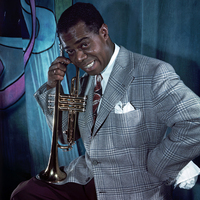 Louis ArmstrongPaul BarbarinSidney BechetLee BlairPete BriggsErnie CaceresHappy CaldwellRed CallenderMancy "Peck" CarrAl CaseyRupert ColeArthur DaveyLeonard "Ham" DavisPaul "Stump" EvansBernard FloodJohnny GuarnieriAl HallShelton "Scad" HemphillJ.C. HigginbothamBenny HillCharlie HolmesPeanuts HuckoPreston JacksonOtis JohnsonWill JohnsonClaude JonesDale JonesHenry “Moon” JonesBingie MadisonCastor McCordTed McCordBig Mike McKendrickMarty NapoleonBill PerkinsRuss PhillipsHenry PrinceZilner RandolphWesley RobinsonDonald RuffellLuis RussellHarold ScottZutty SingletonEmitt Slay
Albums
 New Orleans Original Film Soundtrack2018The Jubilee Shows Vol. 8, No. 26 & No. 322004Pocketful of Dreams1995Jazz Genius1995The Chronological Classics: Louis Armstrong and His Orchestra 1940-19421993Heart Full of Rhythm, Volume 2 (1936-38)1993The Chronological Classics: Louis Armstrong and His Orchestra 1928-19291991The Chronological Classics: Louis Armstrong and His Orchestra 1939–19401991The Chronological Classics: Louis Armstrong and His Orchestra 1936-19371990The Chronological Classics: Louis Armstrong and His Orchestra 1938-19391990The Chronological Classics: Louis Armstrong and His Orchestra 1932-19331990The Chronological Classics: Louis Armstrong and His Orchestra 1934-19361990The Chronological Classics: Louis Armstrong and His Orchestra 1930-19311990The Chronological Classics: Louis Armstrong and His Orchestra 1931-19321990The Chronological Classics: Louis Armstrong and His Orchestra 1937-19381990The Chronological Classics: Louis Armstrong and His Orchestra 1929-19301990Just Louis1990Swing That Music!1990Georgia On My Mind1990The Great Louis Armstrong1970Satchmo Sings1955Louis Armstrong Classics1939The Louis Armstrong Connection
Singles
Your Cheatin' Heart / Congratulations to Someone1953It Takes Two to Tango / I Laughed at Love1952I Can't Give You Anything but Love / Dippermouth Blues1952St. Louis Blues / Super Tiger Rag1952Once in a While / Confessin' (That I Love You)1952Kiss of Fire / I'll Walk Alone1952If / (I Wonder Why) You're Just in Love1951C'est si bon1950Perdido Street Blues / Knockin' a Jug1950Jack Armstrong Blues / Endie1949Maybe It's Because / I'll Keep the Lovelight Burning1949(What Did I Do to Be So) Black and Blue / I Can't Give You Anything Be Love1947You Don't Learn That in School / I Believe1947It Takes Time / I Wonder, I Wonder, I Wonder1947Back O'Town Blues / Linger in My Arms a Little Longer, Baby1946No Variety Blues / Whatta Ya Gonna Do1946Some of These Days / After You 've Gone1945Confessin' (That I Love You) / If It's Good (Then I Want It)1945Perdido Street Blues / 2:19 Blues1945Mahogany Hall Stomp / I Can't Give You Anything but Love1944When the Saints Go Marching In / Sweethearts on Parade1944Mahogany Hall Stomp / Basin Street Blues1942Cash for Your Trash / I Never Knew1942West End Blues / Savoy Blues1942Among My Souvenirs / Coquette1942Long, Long Ago / I Cover the Waterfront1941I Used to Love You / Leap Frog1941Ev'rything's Been Done Before / In the Gloaming1941I'll Get Mine Bye and Bye / Yes Suh!1941New Do You Call That a Buddy / Hey Lawdy Mama1941Twelfth Street Rag / Knockin’ a Jug1941Hear Me Talkin' to Ya / Save It, Pretty Mama1940Hep Cats' Ball / Lazy 'Sippi Steamer1940You Run Your Mouth, I'll Run My Business / Cain and Abel1940Swing That Music / Wolverine Blues1940Bye and Bye / Poor Old Joe1940When It's Sleepy Time Down South / Mighty River1940Sweethearts on Parade / Cut Off My Legs and Call Me Shorty1940Down in Honky Tonk Town / Coal Cart Blues1940You've Got Me Voodoo'd / Harlem Stomp1940Jeepers Creepers / What Is This Thing Called Swing?1939You're a Lucky Guy / You're Just a No Account1939Hotter Than That / That's When I'll Come Back to You1939Confessin' That I Love You / Our Monday Date1939Baby Won't You Please Come Home / Shanty Boat on the Mississippi1939If It's Good (Then I Want It) / West End Blues1939Savoy Blues / Me And Brother Bill1939That's My Home / I Hate to Leave You Now1939As Long as You Live (You'll Be Dead If You Die) / When the Saints Go Marching In1938I Double Dare You / Satchel Mouth Swing1938True Confession / Jubilee1938Love Walked In / Something Tells Me1938I Double Dare You / True Confession1938On the Sentimental Side / It's Wonderful1938I've Got a Heart Full of Rhythm / I've Got a Pocketful of Dreams1938I Can't Give You Nothing but Love / Ain't Misbehavin'1938Snow Ball / Swing, You Cats1938So Little Time (So Much to Do) / Mexican Swing1938Caravan / Public Melody Number One1938Hustlin’ and Bustlin’ for Baby / Sittin’ in the Dark1938So Little Time / Love Walked In1938Let That Be a Lesson to You / Struttin' With Some Barbeque1938I've Got a Pocketfull of Dreams / Naturally1938Knockin' a Jug / I Can't Give You Anything but Love1938I Wonder Who / St. Louis Blues1938I’ve Got a Heart Full of Rhythm / Alexander’s Ragtime Band1937Black and Blue / Sweet Savannah Sue1937No One Else but You / Beau Koo Jack1937I Got Rhythm / After You've Gone1937Once in a While / On the Sunny Side of the Street1937(What Did I Do to Be So) Black and Blue / Blue Again1937Public Melody Number One / Yours and Mine1937Cuban Pete / She’s the Daughter of a Planter From Havana1937Yours and Mine / Sun Showers1937Indian Cradle Song / I'm a Ding Dong Daddy (From Dumas)1937Public Melody Number One / Red Cap1937I Gotta Right to Sing the Blues / High Society1937After You’ve Gone / Basin Street Blues1936Somebody Stole My Break / I Come From a Musical Family1936Swing That Music / Thankful1936I’m Putting All My Eggs in One Basket / Yes‐Yes! My‐My!1936On Treasure Island / Red Sails in the Sunset1936Old Man Mose / The Music Goes 'round and Around1936Rhythm Saved the World / Mahogany Hall Stomp1936I Surrender, Dear / When It's Sleepy Time Down South1936That Rhythm Man / No1936Lyin’ to Myself / Ev’ntide1936Thanks a Million / Solitude1936I Hope Gabriel Likes My Music / Shoe Shine Boy1936Fireworks / Sugar Foot Strut1936I'm Shooting High / I've Got My Fingers Crossed1936Old Man Mose / Falling in Love With You1935You Are My Lucky Star / La Cucaracha1935I'm in the Mood for Love / Got a Bran' New Suit1935That Rhythm Man / Blue, Turning Grey Over You1935Basin Street Blues / St. Louis Blues1935Body and Soul / I'll Be Glad When You're Dead, You Rascal You1935Don’t Play Me Cheap / Mighty River1934Laughin’ Louie / Tomorrow Night1934St. Louis Blues / Dusky Stevedore1933