
Sidney Bechet
Sidney Bechet (May 14, 1897 – May 14, 1959) was an American jazz saxophonist, clarinetist, and composer. He was one of the first important soloists in jazz (beating cornetist and trumpeter Louis Armstrong to the recording studio by several months and later playing duets with Armstrong), and was perhaps the first notable jazz saxophonist. Forceful delivery, well-constructed improvisations, and a distinctive, wide vibrato characterized Bechet's playing. Bechet's erratic temperament hampered his career, however, and not until the late 1940s did he earn wide acclaim. Bechet was born in New Orleans on 14th May 1897. From a young age he was able quickly to master any musical instrument he encountered. Some New Orleanians remembered him as a cornet hot-shot in his youth. At first, though, he decided on the clarinet as his main instrument, and Bechet remained one of jazz's greatest clarinetists for decades. He is, however, perhaps best remembered as the master of the soprano saxophone. Bechet was the first notable jazz saxophonist of any sort, his playing characterised by forceful delivery, well conceived, improvised ideas, and a distinctive wide vibrato. Bechet had experience playing in travelling shows even before he left New Orleans at the age of twenty. Never long content in one place, he alternated between Chicago, New York, and Europe as his base of operations until finally he settled in France in 1950. He married Elisabeth Ziegler in Antibes, France in 1951. Bechet successfully composed in jazz, pop, and extended concert work forms. His recordings have often been reissued. Some of the highlights include 1924 sides with Louis Armstrong in "Clarence Williams Blue Five", the 1932, 1940, and 1941 New Orleans Feetwarmers sides, a 1938 Tommy Ladnier Orchestra session ("Weary Blues", "Really the Blues"), and various versions of his own composition, "Petite Fleur". In 1941, as an early experiment in overdubbing at RCA Studios, he recorded on six different instruments: the clarinet, soprano saxophone, tenor saxophone, piano, bass, and drums. This recording can be heard under the title "Sheik of Araby". Shortly before his death in Paris, Bechet dictated his autobiography, Treat It Gentle. He died on 14th May 1959 - his sixty-second birthday. Legacy and honors Bechet successfully composed in jazz, pop-tune, and extended concert work forms. He knew how to read music but chose not to, due to his highly developed inner ear; he developed his own fingering system and never played section parts in a big band or swing-style combo. His recordings have often been reissued. Sidney Bechet's primary instruments were the clarinet and the soprano sax. His playing style is intense and passionate, and had a wide vibrato. He was also known to be very proficient with his instruments and a master at improvisation (both individual and collective). Bechet liked to have his sound dominate in a performance, and trumpeters found it very difficult to play alongside him. Bechet's song Si tu vois ma mère was prominently featured in the Woody Allen film Midnight in Paris (2011). Some of the highlights of his career include 1923 sides with Louis Armstrong in the Clarence Williams Blue Five; the 1932, 1940, 1941 New Orleans Feetwarmers sides; a 1938 Tommy Ladnier Orchestra session ("Weary Blues", "Really the Blues"); a hit 1939 recording of "Summertime"; and various versions of his own composition, "Petite Fleur". In 1939, Bechet co-led a group with pianist Willie "The Lion" Smith that recorded several early versions of what was later called Latin jazz, adapting traditional méringue, rhumba and Haitian songs to the jazz idiom. On July 28, 1940, Sidney Bechet made a guest appearance on NBC Radio's The Chamber Music Society of Lower Basin Street show, playing two of his show pieces ("Shake It and Break It" and "St. Louis Blues") with Henry Levine's Dixieland band. Levine invited Bechet into the RCA Victor recording studio (on 24th Street in New York City), where Bechet lent his soprano sax to Levine's traditional arrangement of "Muskrat Ramble." On April 18, 1941, as an early experiment in overdubbing at Victor, Bechet recorded a version of the pop song "The Sheik of Araby", playing six different instruments: clarinet, soprano saxophone, tenor saxophone, piano, bass, and drums. A hitherto unissued master of this recording was included in the 1965 LP Bechet of New Orleans, issued by RCA Victor as LPV-510. On the liner notes, George Hoeffer quotes Bechet as follows: "I started by playing The Sheik on piano, and played the drums while listening to the piano. I meant to play all the rhythm instruments, but got all mixed up and grabbed my soprano, then the bass, then the tenor saxophone, and finally finished up with the clarinet." In 1944, 1946, and 1953 he recorded and performed in concert with the Chicago jazz pianist and vibraphonist Max Miller, private recordings that are part of the Max Miller archive and have never been released. These concerts and recordings are covered completely in John Chilton's authoritative book on Bechet. Bechet was an important influence on the alto saxophonist Johnny Hodges, who studied with him as a teenager. In 1919, Ernest Ansermet, a Swiss classical conductor, wrote a tribute to Bechet, one of the earliest (if not the first) to a jazz musician from the classical field of music, linking Bechet's music with that of Bach. In 1968, Bechet was inducted into the Down Beat Jazz Hall of Fame. The New York Times music writer Robert Palmer wrote of Bechet: "by combining the 'cry' of the blues players and the finesse of the Creoles into his 'own way,' Sidney Bechet created a style which moved the emotions even as it dazzled the mind." "Bechet to me was the very epitome of jazz ... everything he played in his whole life was completely original. I honestly think he was the most unique man to ever be in this music." — Duke Ellington. The British poet Philip Larkin wrote an ode to Bechet in The Whitsun Weddings. In popular culture Sugar Blue, the renowned blues harmonica player, took his name from the Bechet recording "Sugar Blues", saying: "I needed a nickname ... all the good ones were taken! You know 'Muddy Waters', 'Blind Lemon', 'Sonny Boy' ... until one night a friend and I were leaving a concert — a Doc Watson concert — when somebody threw out of the window a box full of old 78s: I picked one up and it said "Sugar Blues" by Sidney Bechet ... That's it! I thought it was perfect ... so here I am". Bechet is said to have inspired the character of the saxophonist "Pablo" in the novel Steppenwolf. Hermann Hesse likely learned about jazz by listening to his playing in Europe in the 1920s. In the novel Replay by Ken Grimwood, Bechet is featured performing at an underground Paris jazz club in the novel. This appearance is anachronistic as the scene takes place in 1963; Bechet died in 1959. In music Bob Dorough, who played with Bechet, recorded a tribute song, called "Something for Sydney," on his Right On My Way Home album. Van Morrison mentions Bechet in his song "See Me Through Part II (Just A Closer Walk With Thee)". The French chanteuse Patricia Kaas recorded the song, "L'Enterrement de Sidney Bechet" ("The Funeral of Sidney Bechet"), on her 1990 album Scène de vie. Raquel Bitton pays tribute to Sydney Bechet in her CD Paris Blues, singing "Petite Fleur" (2006). Radiohead used his single "Egyptian Fantasy" as the exit song for their 2012 tour. In film/TV In the 1997 documentary Wild Man Blues, Woody Allen, the director and clarinetist, repeatedly referred to Bechet. He named one of his children adopted with his wife Soon-Yi Previn after Bechet. Bechet is portrayed by Jeffrey Wright in two episodes of the television series The Young Indiana Jones Chronicles. In the 2009 Disney animated feature The Princess and the Frog, Bechet is mentioned by Louis, the trumpet playing alligator, during the musical number "When We're Human."
Biography from Last.fm, available under CC BY-SA.
Country: US
Deathdate: 1959-05-14
Gender: Male
Is Living: No
Groups
Louis Armstrong & His OrchestraSidney Bechet TrioNoble Sissle and His OrchestraRed Onion Jazz BabiesFormer (1924–1925)Bechet-Mezzrow FeetwarmersOlympia OrchestraClarence Williams’ Blue FiveThe King Bechet TrioThe Harlem TrioSidney Bechet and His New Orleans FeetwarmersSidney Bechet, Muggsy Spanier and the All-StarsSidney Bechet and His OrchestraSidney Bechet’s Blue Note JazzmenSidney Bechet & His All Star BandSidney Bechet and His Circle SevenSidney Bechet's Hot SixSidney Bechet’s One Man BandSidney Bechet and Martial Solal QuartetSidney Bechet QuartetFormerSidney Bechet with Bob Wilber's WildcatsFormerAlbums
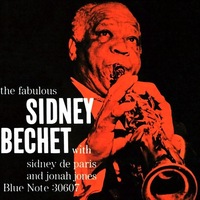 The Fabulous Sidney Bechet2001
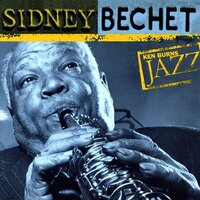 Ken Burns Jazz: Sidney Bechet2000
 Sidney Bechet at the 1949 International Jazz Festival of Paris (2021 Remaster)2021Together, Town Hall 19472021Jazz: The Essential Collection, Vol. 42020Essential Original Albums2017Sidney Bechet: Four Classic Albums2016Sidney Bechet in Switzerland2014The Complete American Masters 1931–19532011Original Recordings 1932-19522011Up in Sidney's Flat2010In Concert at the Brussels Fair, 19582010When the Sun Sets Down South2009The Essential Collection2009Sidney Bechet2009I Got Rhythm2008The Chronological Classics: Sidney Bechet 1952, Volume 22007Pre-War Classic Sides2007Petite Fleur2006Sidney Bechet2006Mosaic Select2006Shake It and Break It2005The Chronological Classics: Sidney Bechet 19522005Masters of Music2005Petite Fleur2005The Chronological Classics: Sidney Bechet 1951-19522004The Blue Note Years2004Classic Jazz Archive: Sidney Bechet2004The Chronological Classics: Sidney Bechet 19502003Petite fleur2003The Chronological Classics: Sidney Bechet 1950-19512003BD Music Presents Sidney Bechet2003New Orleans - Paris (& Vice Versa)2003BD Jazz, Volume 3: Sidney Bechet / Julie Faulques2003Blue Horizon2002The Chronological Classics: Sidney Bechet 1949, Volume 32002The Chronological Classics: Sidney Bechet 1949, Volume 22001Portrait2001At the Jazzband Ball2001Maple Leaf Rag2001Complete 1939-1951 Blue Note Master Takes2001Trésors2001The Sidney Bechet Story2001Perdido Street Blues2000Jazz in Paris: Sidney Bechet et Claude Luter2000Summertime2000The Chronological Classics: Sidney Bechet 19492000The Chronological Classics: Sidney Bechet 1947-19492000Blue Horizons2000Up a Lazy River1999Sidney Bechet, Volume 13 : 1943-19441999Shake 'em Up1999Bunk & Bechet in Boston1999Dear Old Southland1999Blues in the Air1999Revolutionary Blues: 1941-19511999Sidney Bechet, Volume 11 : 1941-19421998Chant in the Night1998Essential: Masters of Jazz1998High Society1998Sidney Bechet1997Sidney Bechet, Volume 9 :1940-19411997Sidney Bechet, Volume 10 :19411997The Chronological Classics: Sidney Bechet 1945-19461997Sidney Bechet1997Slippin' and Slidin': The Bluebird Sessions1997Rendez-Vous Avec Sidney Bechet Et André Réwéliotty Et Son Orchestre1997Centenary Celebration-1997: Great Original Performances 1924 to 19431997Pleyel Jazz Concert1997Really the Blues1997Sidney Bechet, Volume 8 :19401996Sidney Bechet, Volume 7 :19401996Le soir où... l'on cassa l'Olympia1996The Chronological Classics: Sidney Bechet 1941-19441996Jazz Greats, Volume 15: Sidney Bechet: Summertime1996Sidney Bechet & Pee Wee Russell1996Sidney Bechet, Volume 6 :19391995The Quintessence: New York – Glovesville – Chicago 1932–19431995Jazz & Blues Collection 12: Sidney Bechet1995Lives in Paris1994Sidney Bechet, Volume 5 : 1938-19391994Sidney Bechet1994Sidney Bechet: His Best Recordings 1923 - 19411994Double Dixie1994The Complete Sidney Bechet, Vol. 5 (1941–1943) Plus Ladnier/Mezzrow/Newton (1938–1939)1994The Best of Sidney Bechet1994Sidney Bechet, Volume 4 : 1937-19381993Série Noire1993Really the Blues1993Jazz Classics - Volume I1993Jazz Double Bill - Sidney Bechet & Django Reinhard1993Sidney Bechet1993The Chronological Classics: Sidney Bechet 1940-19411992The ★ Collection1992The Complete Sidney Bechet, Volumes 1/2 (1932–1941)1992Sidney Bechet, Volume 2 :1923-19301991Summertime: 1932-19401991The Chronological Classics: Sidney Bechet 1938-19401991The Chronological Classics: Sidney Bechet 1937-19381991The Chronological Classics: Sidney Bechet 1923–19361991